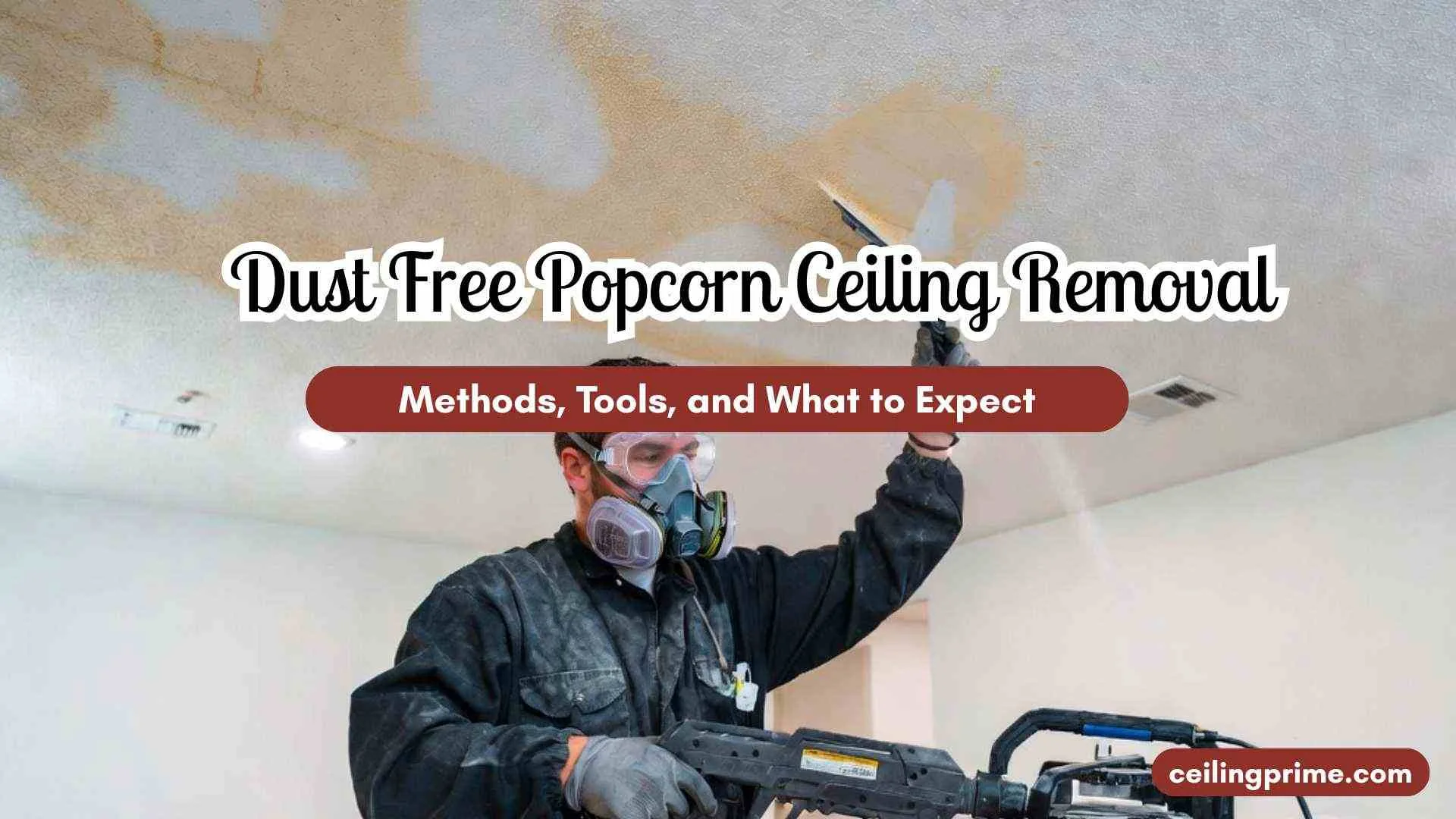
Dust Free Popcorn Ceiling Removal: Methods, Tools, and What to Expect
Dust free popcorn ceiling removal is not a marketing term — it is a real technique that cuts airborne particulate by 90–95% compared to dry scraping. It matters because popcorn ceiling removal without dust control produces a white fog of fine particles that settles on every surface in the room and re-circulates through HVAC systems.
For homeowners with allergies, asthma, or respiratory concerns — and for anyone in a home where occupants are present during work — dustless removal methods are the right approach.
Asbestos First: Why It Changes Everything About Dust Control?
Dust free removal is doubly important when the ceiling is pre-1980. Standard asbestos-containing ceiling texture releases asbestos fibers when scraped — and those fibers are far more hazardous than drywall dust. High-Efficiency Particulate Air (HEPA) filtration can capture asbestos fibers above 0.3 microns, which covers the fiber sizes most commonly released during ceiling disturbance. But HEPA alone does not make asbestos removal safe or legal.
If the ceiling was installed before 1980, get it tested by a licensed asbestos inspector before any work begins. The Environmental Protection Agency (EPA) regulatory threshold is 1% asbestos by weight.
Above that level, removal must be performed by a licensed abatement contractor following EPA National Emission Standards for Hazardous Air Pollutants (NESHAP) and Texas Commission on Environmental Quality (TCEQ) procedures — regardless of how good the dust control equipment is.
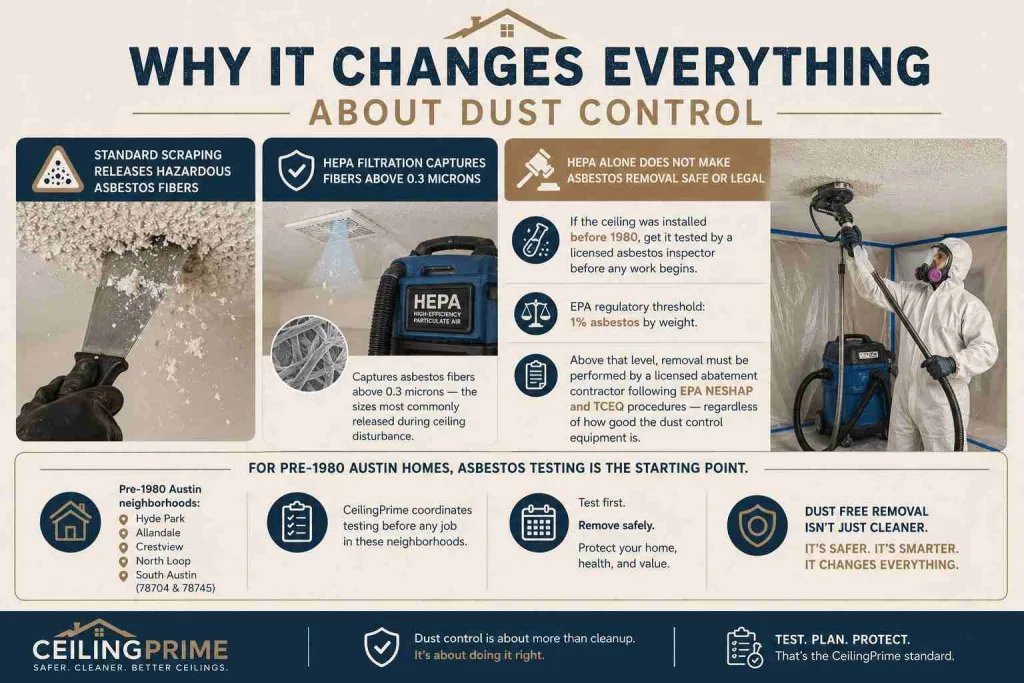
For pre-1980 Austin homes in Hyde Park, Allandale, Crestview, North Loop, and South Austin’s 78704 and 78745 zip codes, asbestos testing is the starting point, not an optional extra.
The Three Dustless Popcorn Ceiling Removal Methods
True dust free ceiling removal combines wet application (to bind particles to the surface before they can become airborne) with vacuum capture (to collect particles at the point of disturbance before they reach the room air). Here are the three main approaches:
| Wet scrape + vacuum scraper | 80–90% | Unpainted and lightly painted ceilings | Garden pump sprayer, specialty scraper with vacuum hose or bag attachment, Shop-Vac |
| HEPA drywall sander system | 90–95% | Unpainted ceilings; best for fine finishing | Electric drywall sander with HEPA vacuum attachment (e.g., DeWalt DWE6401DS or similar orbital sander with dust collection) |
| Plastic bag scraper (capture method) | 70–80% | Small areas and spot repairs | Wide drywall knife, heavy plastic bag, tape |
| Wet scrape + containment setup | 85–95% | Rooms with sensitive occupants or HVAC concerns | Full plastic containment sheeting, negative air machine with HEPA filter, wet scrape tools |
| Dry scraping (no dust control) | 0% | Not recommended — baseline for comparison | Standard drywall knife — no dust capture whatsoever |
Method 1: Wet Scrape With Vacuum Attachment
This is the most practical dust free method for residential popcorn ceiling removal and the one CeilingPrime uses as standard practice.
How it works?
Water is misted onto the ceiling surface using a pump garden sprayer. The moisture is absorbed into the porous texture, softening the adhesive bond and causing the texture to release from the drywall more easily. Critically, wet texture particles are heavier than dry ones — they fall rather than becoming airborne, which is what makes the wet method inherently lower-dust than dry scraping.
The scraping tool — either a specialty scraper with an integrated vacuum hose port, or a standard wide drywall knife fitted with a vacuum hose attachment — captures the falling debris directly at the blade as the texture releases. The connected Shop-Vac or vacuum system pulls the particles through the hose rather than letting them fall to the floor and bounce into the air.
The painted ceiling problem
If the popcorn ceiling has been painted — even once — the paint film creates a barrier that water cannot penetrate easily. The standard 15–20 minute soak time does not work on painted surfaces.
Options for painted ceilings include: scoring the surface with a scoring tool before wetting (creates entry points for water), applying a longer soak with repeated misting over 30–60 minutes, or switching to the sander method. Many painted popcorn ceilings are better approached with drywall overlay than with attempted wet scraping.
Soak time matters
Under-soaking the ceiling — applying water and scraping immediately — produces more dust, not less. The texture needs 15–20 minutes at minimum to absorb enough moisture to release cleanly. Working in sections across the room allows earlier sections to soak while you mist later ones.
Method 2: HEPA Drywall Sander System
A commercial-grade electric drywall sander with a HEPA vacuum attachment is the highest-performance dust reduction option for unpainted popcorn ceilings. These systems — like the DeWalt HEPA orbital sander with integrated dust collection — capture 90–95% of airborne particles directly at the sanding head.
The sander’s dust shroud surrounds the sanding pad. As the pad removes texture, the HEPA-filtered vacuum immediately pulls particles away before they can disperse into the room. The filter captures particles down to 0.3 microns — which includes the fine silica and cellulose dust from ceiling texture.
The limitation: sanding generates heat and friction that works differently on wet vs. dry surfaces. For this method, the ceiling should be dry. It is also slower than wet scraping on heavily textured or thickly applied ceilings.
Method 3: Plastic Bag Capture Method
The simplest dust-capture approach for DIY removal or small spot work: a wide drywall knife with a heavy plastic bag taped to the back edge of the blade, positioned to catch falling texture as the blade passes across the ceiling. The bag collects debris before it hits the floor and bounces airborne.
This method reduces mess and floor contamination but does not capture airborne particles the way a vacuum system does. For large rooms or significant texture removal, it is a partial solution. For a homeowner doing a single room without professional equipment, it is better than nothing — particularly combined with slow, wet scraping and good room ventilation toward the outside (not through HVAC).
Room Preparation for Dust Free Removal
Even with dust-capture equipment, preparation of the room is essential. No removal method is 100% dust-free — the goal is reduction, not elimination.
| Cover the floor | Plastic sheeting or contractor paper over the entire floor. Tape edges to walls. Two layers of 4-mil plastic at minimum for a professional job. |
| Seal HVAC registers | Cover all ceiling and wall registers with plastic and tape. Ceiling texture particles in ductwork re-circulate through the house for weeks after a job. This is one of the most important and most-skipped steps in DIY removal. |
| Remove or cover furniture | Everything leaves the room or is covered entirely in plastic, sealed at the edges. Even a few hours of removal work produces enough fine particles to coat every surface in an uncovered room. |
| Turn off ceiling fans | Ceiling fans circulate airborne particles and deposit them on walls and furniture. Turn off and cover the motor housing during removal. |
| Seal doorways | Plastic sheeting over any doorway into adjacent rooms, with tape at all edges. If the room has a hallway return air vent, cover it and seal the hallway door. |
| Personal protection | N95 respirator minimum; P100 half-face respirator for extended work. Safety goggles (not glasses — overhead work produces falling particles). Work clothes you can leave outside or bag immediately after the job. |
After Dust Free Removal: What Comes Next
Dust free removal gets the texture off — but the ceiling is not paint-ready at that point. Here is the sequence that follows:
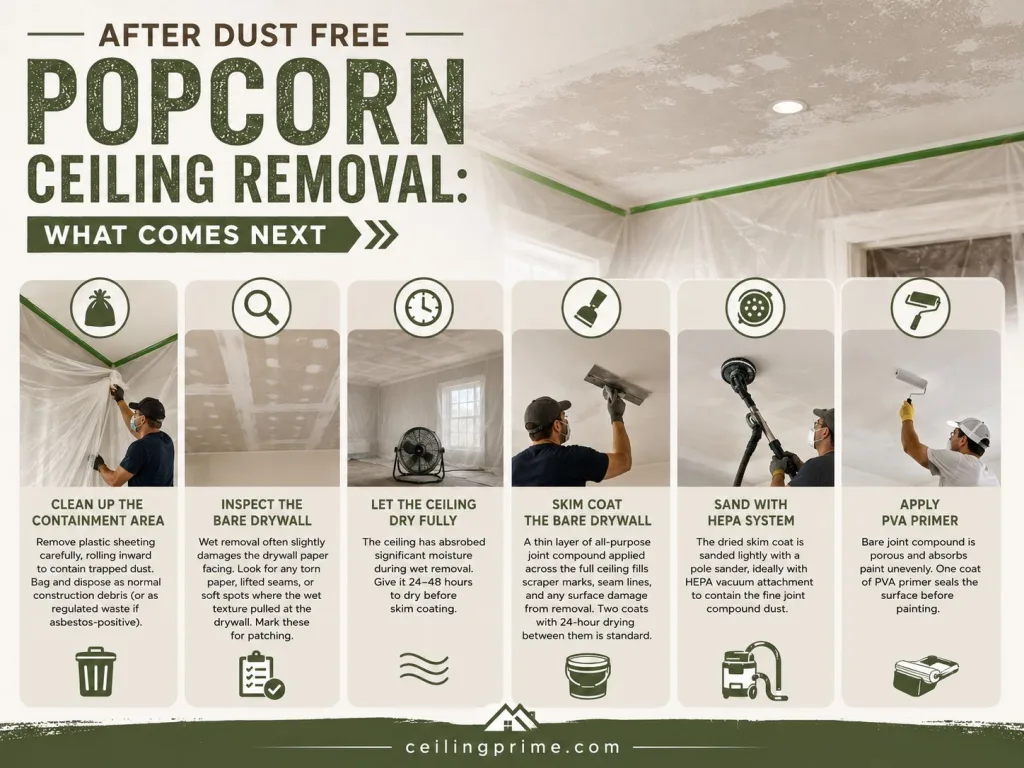
- Clean up the containment area — Remove plastic sheeting carefully, rolling inward to contain trapped dust. Bag and dispose as normal construction debris (or as regulated waste if asbestos-positive).
- Inspect the bare drywall — Wet removal often slightly damages the drywall paper facing. Look for any torn paper, lifted seams, or soft spots where the wet texture pulled at the drywall. Mark these for patching.
- Let the ceiling dry fully — The ceiling has absorbed significant moisture during wet removal. Give it 24–48 hours to dry before skim coating. Applying joint compound to a damp ceiling creates adhesion problems.
- Skim coat the bare drywall — A thin layer of all-purpose joint compound applied across the full ceiling fills scraper marks, seam lines, and any surface damage from removal. Two coats with 24-hour drying between them is standard. This is what creates the smooth, flat ceiling surface.
- Sand with HEPA system — The dried skim coat is sanded lightly with a pole sander, ideally with HEPA vacuum attachment to contain the fine joint compound dust.
- Apply PVA primer — Bare joint compound is porous and absorbs paint unevenly. One coat of PVA primer seals the surface before painting.
Dust Free Popcorn Ceiling Removal Cost in Austin
Dust free removal costs more than standard removal because of the additional equipment and setup time required. Here is what to expect in Austin:
- Standard removal + skim coat (CeilingPrime) — $2.30–$4.05 per square foot. CeilingPrime’s standard process uses wet scraping with vacuum capture — this is already dust-controlled work, not dry scraping.
- Upgrade to full HEPA containment with negative air machine — Additional cost on top of standard removal; typically $0.50–$1.00 per square foot extra for commercial-grade containment setup and negative air machine rental.
- Asbestos abatement (if confirmed positive) — Licensed abatement is a separate cost structure with containment, licensed disposal, and clearance air testing. This is regulated work with specific permitting requirements in Texas.
- Asbestos testing — $25–$75 per lab sample plus inspector fee. Required before dust free or any other removal on pre-1980 ceilings.
- DIY dust free removal (materials only) — Pump sprayer ($25–$50), specialty scraper ($30–$80), Shop-Vac ($60–$120 if you do not own one), plastic sheeting, N95 masks. Budget $200–$400 in equipment for a first-time DIY job.
Frequently Asked Questions
Q. Is dust free popcorn ceiling removal really possible?
Yes — but 100% dust-free is not achievable. Properly executed wet scraping with vacuum capture reduces airborne particulate by 80–90% compared to dry scraping. HEPA sander systems push that to 90–95%. What remains is far below what dry scraping produces, and the room is usable much sooner after work than with traditional removal methods.
Q. What is the dustless popcorn ceiling removal method?
The two main methods are:
(1) wet scraping — misting the ceiling with water to soften the texture bond, then scraping with a vacuum-equipped tool that captures debris at the blade; and
(2) HEPA orbital sanding — using an electric sander with a HEPA-filtered dust collection system to grind down the texture with near-full particle capture. Most professional jobs use wet scraping as the primary method and HEPA sanding for final cleanup.
Q. Can I do dustless popcorn ceiling removal myself?
Yes on asbestos-negative ceilings. You need a pump sprayer, a wide drywall knife (with bag attachment or vacuum hose), plastic sheeting for the floor and HVAC registers, and personal protection. The biggest DIY mistake is not sealing HVAC registers — ceiling dust in the duct system circulates through the whole house for weeks. For asbestos-positive ceilings, professional licensed abatement is required regardless of dust control approach.
Q. How much does dustless popcorn ceiling removal cost?
In Austin, professional removal with dust control runs $2.30–$4.05 per square foot for standard removal and skim coat. Full commercial HEPA containment setups for sensitive environments add $0.50–$1.00 per square foot.
Q. Does a HEPA vacuum capture asbestos during popcorn ceiling removal?
A true HEPA filter captures particles down to 0.3 microns, which covers most asbestos fiber sizes. However, HEPA vacuum use does not make asbestos removal legal or safe for unlicensed workers — Texas requires licensed abatement contractors for ceilings that test positive at the EPA threshold of 1% or more. HEPA is one tool in a licensed abatement setup; it is not a substitute for licensed abatement.