Home Upgrading Installment: How to Finance Home Improvements in 2026
Most home upgrades worth doing cost more than most homeowners have sitting in a savings account. A kitchen remodel runs $15,000 to $50,000. A new roof costs $8,000 to $15,000. A bathroom renovation runs $10,000 to $25,000. Even smaller projects — new windows, HVAC replacement, flooring — add up to $5,000 to $15,000 before you’ve finished the first room. That’s where home upgrading installment plans come in — financing options that let you spread the cost of home improvements over monthly payments instead of paying everything upfront.
Home upgrading installment options include personal loans (unsecured, fast funding, fixed monthly payments), home equity loans (lump sum secured by your home, lower rates), HELOCs (revolving credit line, draw as needed), cash-out refinancing (rolls renovation costs into a new mortgage), FHA 203(k) loans (government-backed renovation financing), FHA Title I loans (for homes with limited equity), contractor-offered installment plans, and 0% APR credit cards for smaller projects.
The best option depends on how much you need, how much equity you have, how fast you need the money, and whether you’re willing to use your home as collateral. This guide compares every home upgrading installment method — with rates, terms, pros, cons, and the honest answer for which one fits your situation.
Home Upgrading Installment Options at a Glance
| Financing Method | Best For | Typical Rate (2026) | Loan Amount | Secured? | Funding Speed |
| Personal loan | Small-to-mid projects ($5K–$50K), no equity needed | 7–15% | $1K–$100K | No (unsecured) | 1–7 days |
| Home equity loan | Large projects ($25K+), known budget | 7–9% | Up to 80–85% of equity | Yes (home) | 2–6 weeks |
| HELOC | Phased projects, ongoing renovations | 8–10% (variable) | Up to 80–85% of equity | Yes (home) | 2–6 weeks |
| Cash-out refinance | Large projects, favorable rate environment | 6.5–8% | Up to 80% LTV | Yes (home) | 30–45 days |
| FHA 203(k) loan | Buying a fixer-upper, major renovation | 6.5–8% | Up to 110% of post-renovation value | Yes (home) | 45–60 days |
| FHA Title I loan | Limited equity, smaller repairs ($7.5K–$25K) | 7–12% | Up to $25K (single-family) | Varies | 2–4 weeks |
| Contractor financing | Specific projects (windows, roofing, HVAC) | 0–15% | Project cost | Varies | At time of service |
| 0% APR credit card | Small projects under $5K | 0% intro (12–21 months) | Credit limit | No | Immediate |
Option 1: Personal Loan
A personal loan is an unsecured, fixed-rate installment loan repaid in equal monthly payments over a set term — typically 2 to 7 years. It’s the fastest and most accessible home upgrading installment option because it doesn’t require home equity or collateral.
How It Works
You apply with a lender (bank, credit union, or online lender), receive approval based on your credit score and income, and get a lump sum deposited into your account — often within 1 to 3 business days. You repay in fixed monthly installments over the loan term.
Best For
- Projects costing $5,000 to $25,000
- Homeowners with good credit (680+) but limited home equity
- Renters making improvements to their space
- Anyone who needs money fast (1 to 7 day funding)
- Homeowners who don’t want to risk their home as collateral
Pros and Cons
| Pros | Cons |
| No home equity required | Higher interest rates than secured loans (7–15%) |
| Fixed monthly payments (predictable budget) | Lower borrowing limits ($100K max, typically $50K or less) |
| Fast funding (1–7 days) | Monthly payments start immediately |
| Home is not used as collateral | Shorter repayment terms (2–7 years = higher monthly payments) |
| No closing costs (usually) | Best rates require excellent credit (720+) |
Option 2: Home Equity Loan
A home equity loan is a secured, fixed-rate installment loan that lets you borrow a lump sum against the equity you’ve built in your home — typically up to 80 to 85% of your home’s value minus what you owe on your mortgage.
How It Works
You apply through a lender, your home is appraised, and you receive a lump sum based on your available equity. You repay in fixed monthly installments over 5 to 30 years. Your home is the collateral — if you default, the lender can foreclose.
Best For
- Large projects ($25,000+) with a known, fixed budget
- Homeowners with significant equity (20%+ equity recommended)
- Borrowers who want a fixed rate and predictable payments
- Projects like kitchen remodels, additions, or whole-house renovations
Pros and Cons
| Pros | Cons |
| Lower rates than personal loans (7–9%) | Home is collateral (risk of foreclosure if you default) |
| Higher borrowing limits (up to 80–85% of equity) | Closing costs (2–5% of loan amount) |
| Fixed rate and fixed payments | Slower funding (2–6 weeks) |
| Longer repayment terms (5–30 years = lower monthly payments) | Requires home appraisal |
| Interest may be tax-deductible (consult a tax advisor) | Not available for homeowners with limited equity |
Option 3: HELOC (Home Equity Line of Credit)
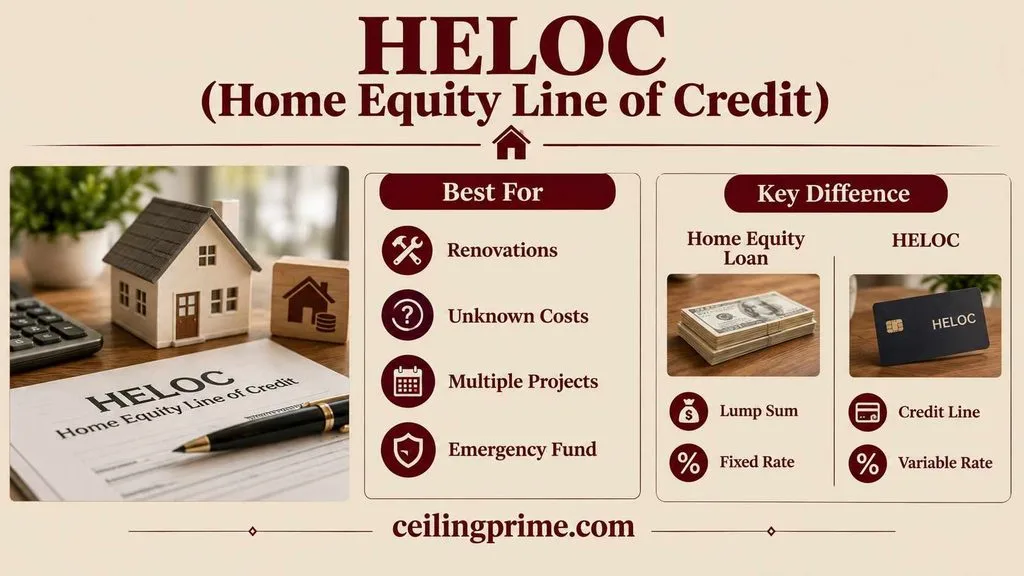
A HELOC is a revolving credit line secured by your home equity — you draw funds as needed (like a credit card) during a draw period (typically 5 to 10 years), then repay during a repayment period (10 to 20 years).
Best For
- Phased or ongoing renovations (draw funds as each phase begins)
- Homeowners who aren’t sure of the total project cost upfront
- Multiple smaller projects spread over months or years
- Emergency fund backed by home equity
Key Difference from Home Equity Loan
A home equity loan gives you a lump sum with a fixed rate. A HELOC gives you a credit line with a variable rate — you borrow only what you need, when you need it. HELOCs are better for phased projects. Home equity loans are better for single, known-cost projects.
Option 4: Cash-Out Refinance
A cash-out refinance replaces your existing mortgage with a new, larger mortgage — you take the difference in cash and use it for home improvements.
Best For
- Homeowners who can refinance at a lower rate than their current mortgage
- Large projects ($50,000+) where other loan types don’t provide enough funding
- Homeowners with significant equity who want to consolidate debt and renovate simultaneously
Key Consideration
Cash-out refinancing only makes financial sense if the new mortgage rate is equal to or lower than your current rate. In a high-rate environment, refinancing at a higher rate to fund renovations can cost tens of thousands of dollars in additional interest over the life of the mortgage. Run the numbers carefully before choosing this option.
Option 5: FHA 203(k) Renovation Loan
The FHA 203(k) loan is a government-backed mortgage that combines the cost of buying (or refinancing) a home with the cost of renovations — all in a single loan with a single monthly payment.
Two Versions
| Version | Max Renovation Budget | Best For |
| Limited 203(k) | Up to $35,000 | Cosmetic repairs, minor upgrades (no structural work) |
| Standard 203(k) | No fixed limit (up to FHA loan limits) | Major renovations, structural work, room additions |
Best For
- Buying a fixer-upper and financing the purchase + renovation together
- Homeowners refinancing and adding renovation costs to the new mortgage
- Borrowers with lower credit scores (580+ eligible)
- Projects that will significantly increase the home’s value
Key Considerations
- Requires FHA mortgage insurance for the life of the loan
- More paperwork than standard loans (contractor bids, work plans, inspections)
- Longer closing timeline (45 to 60 days)
- Must use licensed, bonded contractors (no DIY work)
Option 6: FHA Title I Loan
The FHA Title I Property Improvement Loan is a government-backed loan designed specifically for home improvements — available even to homeowners with limited or no equity.
| Detail | Info |
| Max loan amount | $25,000 (single-family home) / $12,000 (per unit, multi-family) |
| Secured? | Unsecured up to $7,500; secured (home as collateral) above $7,500 |
| Term | Up to 20 years |
| Credit requirement | Varies by lender (generally 580+) |
| Best for | Homeowners with limited equity who need $7,500–$25,000 for improvements |
Option 7: Contractor-Offered Installment Plans
Many contractors, retailers, and home improvement companies offer their own financing — often promoted as “0% interest for 12/18/24 months” or “low monthly payments” on specific projects like windows, roofing, HVAC, or siding.
How It Works
The contractor partners with a financing company (GreenSky, Synchrony, Mosaic, etc.) to offer installment payments at the point of sale. You apply during the sales consultation, receive approval (often instant), and the loan is used to pay the contractor. You make monthly payments to the financing company.
Watch Out For
- Deferred interest traps. Many “0% interest” offers are deferred interest — if you don’t pay the full balance before the promotional period ends, you owe all the interest that accrued from day 1 (not just from the end of the promo period). This can add 20 to 30% to the total cost.
- Higher rates after promo. Standard APRs after the promotional period often run 18 to 26% — higher than personal loans or home equity products.
- Inflated project pricing. Some contractors inflate project costs to offset the financing costs they absorb. Always get 2 to 3 competing quotes before accepting contractor financing.

Option 8: 0% APR Credit Card
For smaller projects (under $5,000), a 0% introductory APR credit card lets you finance improvements with no interest for 12 to 21 months — effectively a free installment plan if you pay the balance before the promo expires.
Best For
- Small upgrades: paint, fixtures, appliances, landscaping, small bathroom updates
- Homeowners with good credit (700+ for the best 0% offers)
- Disciplined payers who will pay the balance in full before the promotional period ends
Warning
If you don’t pay the full balance before the 0% period ends, the standard APR (typically 18 to 28%) kicks in on the remaining balance. Only use this option if you’re confident you can pay it off in time.

How to Choose the Right Home Upgrading Installment Plan?
| Your Situation | Best Option |
| Need $5K–$25K fast, no equity | Personal loan |
| Need $25K+, have 20%+ equity, known budget | Home equity loan |
| Phased renovation, draw funds over time | HELOC |
| Buying a fixer-upper | FHA 203(k) loan |
| Limited equity, need under $25K | FHA Title I loan |
| Specific project (windows, HVAC, roof) | Contractor financing (verify terms carefully) |
| Small project under $5K | 0% APR credit card |
| Can refinance at a lower rate + need $50K+ | Cash-out refinance |
Government Programs for Home Upgrades
Several federal and state programs help homeowners finance upgrades — particularly for energy efficiency, safety, and low-income households.
| Program | What It Covers | Who Qualifies |
| FHA 203(k) | Purchase + renovation in 1 loan | Homebuyers and refinancers (580+ credit) |
| FHA Title I | Home improvements up to $25K | Homeowners with limited equity |
| HUD Title I | Property improvements | Owner-occupants of 1-4 unit properties |
| USDA Rural Repair Loans | Repairs for rural homeowners | Very-low-income rural homeowners |
| VA Renovation Loans | Purchase + renovation for veterans | Eligible veterans and active-duty military |
| Weatherization Assistance (WAP) | Energy efficiency upgrades | Low-income households |
| Federal tax credits | Energy-efficient upgrades (solar, heat pumps, insulation, windows) | All homeowners (via IRS Form 5695) |
Energy efficiency tax credits (2026): Under the Inflation Reduction Act, homeowners can claim up to $3,200/year in tax credits for qualifying energy-efficient upgrades — heat pumps, insulation, Energy Star windows, water heaters, and electrical panel upgrades. Solar installations qualify for a 30% federal tax credit through 2032.
Final Thoughts
Home upgrading installment plans exist because most homeowners can’t — and shouldn’t — pay $20,000 cash for a kitchen remodel or $10,000 for a new roof all at once. The financing options in this guide range from 0% interest (credit cards with promotional rates) to 7 to 9% (home equity products) to 15%+ (high-interest personal loans and contractor financing). The right choice depends on your equity, your credit score, your project size, and your comfort level with using your home as collateral.
The rule of thumb: if you have 20%+ equity and need $25,000 or more, a home equity loan or HELOC gives you the lowest rate. If you need $5,000 to $25,000 quickly and don’t want to touch your equity, a personal loan funds in days with no home risk. If you’re buying a fixer-upper, the FHA 203(k) rolls everything into one mortgage. And if the project is under $5,000, a 0% APR credit card is the cheapest financing available — as long as you pay it off before the promotional period ends.
Get 2 to 3 quotes for the project itself. Get 2 to 3 quotes for the financing. Compare total cost (principal + interest + fees), not just the monthly payment. And never sign contractor financing at the kitchen table without comparing it to what a bank, credit union, or online lender would offer for the same amount. The cheapest monthly payment isn’t always the cheapest loan — and the difference over 5 to 10 years can be thousands of dollars.
Home Upgrading Installment: Frequently Asked Questions
What is a home upgrading installment?
A home upgrading installment is any financing method that lets you pay for home improvements in monthly payments over time instead of paying the full cost upfront. Options include personal loans, home equity loans, HELOCs, FHA loans, contractor financing, and credit cards.
What credit score do I need for a home improvement loan?
It depends on the loan type. Personal loans typically require 660+ for competitive rates (580+ for some lenders). Home equity loans and HELOCs require 680+. FHA 203(k) loans accept 580+. The best rates go to borrowers with 720+ scores.
Is it better to use a personal loan or HELOC for home improvements?
Personal loans are better for smaller projects ($5K–$25K) when you need fast funding and don’t want to risk your home. HELOCs are better for larger or phased projects when you have significant equity and want lower rates. Personal loans have fixed rates (predictable payments). HELOCs have variable rates (payments can increase).
Can I finance home improvements with no equity?
Yes — personal loans, FHA Title I loans, and 0% APR credit cards do not require home equity. Personal loans are unsecured (no collateral). FHA Title I loans are unsecured up to $7,500. Credit cards require no equity but carry high interest after promotional periods.
Are home improvement loan interest payments tax-deductible?
Interest on home equity loans and HELOCs used for home improvements may be tax-deductible under IRS rules — but only if the loan is used to “buy, build, or substantially improve” the home securing the loan. Personal loan interest is generally not tax-deductible. Consult a tax advisor for your specific situation.
What is the cheapest way to finance home improvements?
Paying cash is cheapest (no interest). Among financing options, home equity loans and HELOCs offer the lowest rates (7–10%). 0% APR credit cards are free if paid off during the promotional period. Personal loans (7–15%) are next. Contractor financing and standard credit cards (18–28%) are the most expensive options.