what to do if popcorn ceiling has asbestos
If your popcorn ceiling has asbestos — confirmed or suspected — the next steps matter. The wrong move releases harmful asbestos fibers into the air in your home. The right move protects your family, keeps you legally covered, and sets you up for a clean finish. Here is a plain-language guide about what to do if popcorn ceiling has asbestos, from the moment you suspect it to the day the job is done.
Step 1: Stop All Work Immediately
If you have already started scraping or sanding and you suspect your popcorn ceiling has asbestos, stop. Set down the tools, leave the room, and close the door. Airborne asbestos dust is invisible. Unlike sawdust or drywall dust, you cannot see it settling — but it can remain suspended in the air for hours and coat every surface in the room.
Do not use a regular vacuum. Standard vacuums do not filter asbestos fibers and will blow them back into the air. Do not run fans or open windows to air out the room — that spreads contamination further. Leave the room sealed until you have professional guidance on what to do next.
Homes built before 1980 are the primary concern. In Austin, that includes a large share of properties in Hyde Park, Allandale, Crestview, North Loop, and much of South Austin’s 78704 and 78745 zip codes — all built heavily in the 1950s through 1970s.
Step 2: Confirm Whether Asbestos Is Actually Present
You cannot confirm asbestos by looking at a popcorn ceiling. No visual inspection, color test, or home testing kit provides reliable results. The only way to know is a laboratory analysis of a physical ceiling sample.
Professional sampling — the right approach
A licensed asbestos inspector collects a small ceiling sample using wet-wipe technique to prevent fiber release during collection. The sample goes to an accredited lab that uses polarized light microscopy (PLM) to identify fiber type and percentage. Results take 2–5 business days. Expect to pay $25–$75 per sample at the lab, plus the inspector’s fee.
A professional will often pull samples from multiple rooms if the home was built in stages or has sections with different ceiling textures. Different batches of texture material — even in the same house — can have different asbestos content.
Home testing kits — the wrong approach
Home testing kits require you to collect the sample yourself, which means disturbing the ceiling material without proper containment, respirators, or training. Even if the kit is lab-processed (not just visual), the sampling method invalidates the safety benefits of professional testing. For a pre-1980 residential structure, always engage a licensed asbestos professional for sampling.
Step 3: Understand Your Two Main Options
Once a lab confirms your popcorn ceiling has asbestos, you have two paths: removal (abatement) or encapsulation. Each has different costs, long-term implications, and regulatory requirements.
| What it does | Ceiling texture is stripped, bagged as regulated waste, and disposed of by a licensed contractor | A sealant is applied over the texture, bonding fibers and preventing release |
| Best for | Renovation, remodeling, selling the home, deteriorating ceilings | Intact ceilings, tight budgets, no immediate renovation planned |
| Disruption | Significant — room sealed off with plastic, typically 1–3 days per area | Minimal — paint-like application, usually 1 day |
| Cost (Austin) | $2.30–$4.05 per sq ft for removal + skim coat finish | $1.00–$2.00 per sq ft for sealant only |
| Long-term outcome | Asbestos is gone — no future concern | Asbestos remains — future renovation still requires abatement |
| Real estate impact | Full disclosure of removal is clean; increases buyer confidence | Must still disclose asbestos presence; buyers may still negotiate down |
| Texas regulation | Requires licensed abatement contractor and proper disposal under TCEQ rules | No license required for encapsulation, but material still present |
What Happens During Professional Asbestos Abatement?
Professional asbestos abatement of a popcorn ceiling is not the same as a standard ceiling scrape. Here is exactly what a licensed contractor does:
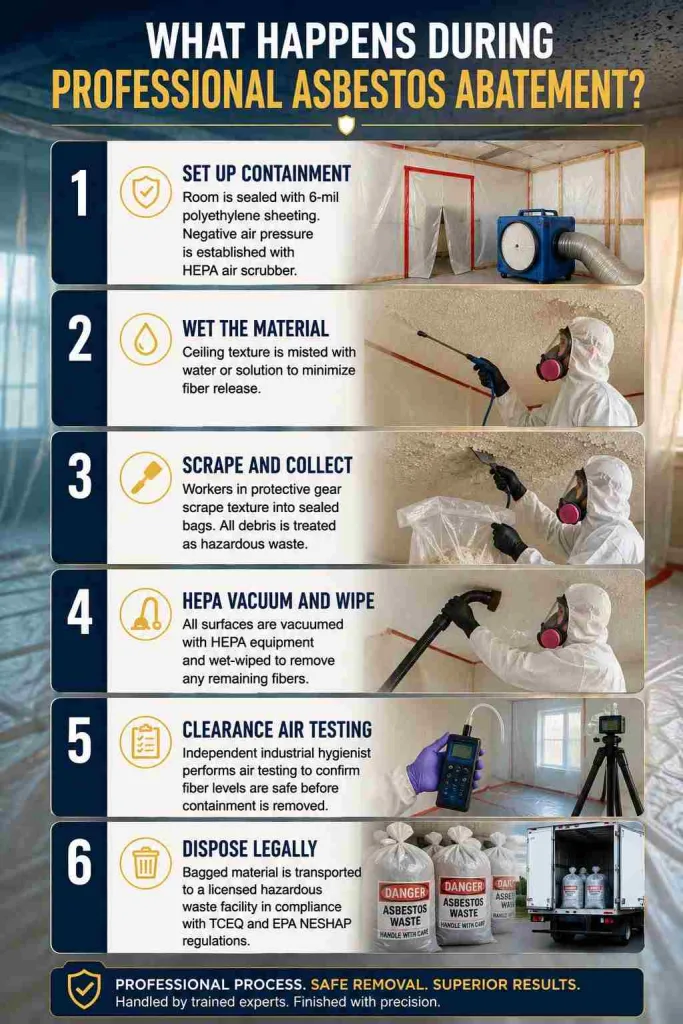
- Set up containment — The room is sealed with 6-mil polyethylene sheeting on all doorways, vents, and openings. Negative air pressure is established using a HEPA-filtered air scrubber to ensure fibers cannot migrate to other rooms.
- Wet the material — The ceiling texture is misted with water or an amended water solution before scraping. Wet asbestos-containing material (ACM) releases far fewer fibers than dry ACM during disturbance.
- Scrape and collect — Workers in Tyvek suits and full-face respirators (P100 or N100 minimum) scrape the texture into sealed bags. All debris is treated as regulated hazardous waste.
- HEPA vacuum and wipe — Every surface in the containment area is vacuumed with a HEPA-filtered vacuum and wet-wiped to capture any settled fibers.
- Clearance air testing — A post-abatement clearance test by an independent industrial hygienist confirms airborne fiber levels are within safe limits before the containment is removed.
- Dispose legally — All bagged material is transported to a licensed hazardous waste facility. In Texas, disposal must comply with Texas Commission on Environmental Quality (TCEQ) and EPA National Emission Standards for Hazardous Air Pollutants (NESHAP) rules.
What Happens After the Asbestos Is Removed?
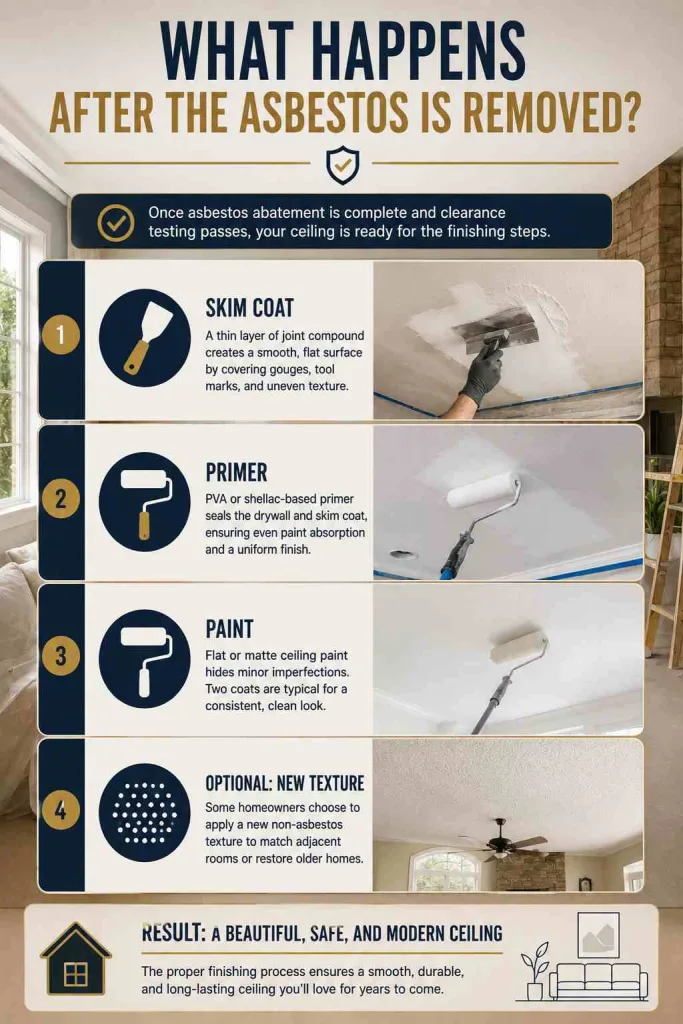
Once asbestos abatement is complete and clearance testing passes, you have bare drywall — or in some older Austin homes, plaster — overhead. The surface is rarely paint-ready. Here is what typically follows:
Skim coat
Scraping often leaves gouges, tool marks, and uneven texture in the drywall or plaster below. A skim coat — a thin layer of joint compound spread across the entire ceiling — creates a smooth, flat surface. This is the most common next step and the one that produces the clean, modern ceiling most homeowners are looking for.
Primer
Bare drywall and fresh skim coat both need a PVA or shellac-based primer before paint. Skipping the primer causes blotchy, uneven paint absorption — particularly noticeable under raking light.
Paint
Flat or matte ceiling paint is standard. A flat sheen hides minor surface imperfections. Two coats are typical. For Austin homes with high ceilings (common in 1970s open-plan living rooms and university district rentals), a roller with a longer nap extension helps reach without lap marks.
Optional: new texture
Some homeowners, particularly those matching adjacent rooms or restoring older homes, opt to apply a new non-asbestos texture after skim coat — knockdown, orange peel, or smooth Santa Fe are common choices in Austin.
Can You Remove a Popcorn Ceiling with Asbestos Yourself?
If asbestos is confirmed at 1% or greater — the EPA regulatory threshold — DIY removal is not a legal option in Texas or most US jurisdictions. It is also not a safe one.
The risk is not just to you. Airborne asbestos fibers released during an uncontrolled DIY removal settle on furniture, clothing, HVAC ducts, and building materials. Fibers brought home on work clothes have caused secondary mesothelioma in family members who never touched asbestos directly. Children are especially vulnerable because asbestos-related diseases like asbestosis and mesothelioma develop over decades — exposure in childhood is particularly dangerous.
Painters and contractors who encounter a likely asbestos popcorn ceiling and proceed without testing are exposing themselves to the same risk. Industry forums have documented cases of painters discovering mid-job that the material they were scraping had already been tested positive in a prior inspection — with no one having told them. Proper testing and precautions before any work begins are the only protection.
The only scenario where a homeowner legally handles asbestos-containing ceiling material themselves is single-family residential properties in Texas where the work qualifies as owner-occupant work under specific exemptions — and even then, disposal still requires a licensed hazardous waste hauler. Get a legal opinion before acting on that exemption.
Health Risks of Asbestos Exposure from Popcorn Ceilings
Asbestos fibers cause disease through inhalation. Once lodged in lung tissue, they do not dissolve or pass through. Over time — typically 10 to 40 years after exposure — they cause inflammatory scarring and cellular damage that leads to:
- Progressive, irreversible scarring of lung tissue that reduces breathing capacity. Asbestosis
- A rare and aggressive cancer of the lining around the lungs or abdomen. Almost exclusively caused by asbestos exposure and typically diagnosed 20–50 years after exposure. Mesothelioma
- Asbestos exposure increases lung cancer risk independently of smoking. Combined with smoking, the risk multiplies significantly. Lung cancer
- Thickening and calcification of the membrane surrounding the lungs, reducing lung expansion. Pleural disease
There is no safe level of asbestos exposure established by regulatory science. The Environmental Protection Agency (EPA), Occupational Safety and Health Administration (OSHA), and Consumer Product Safety Commission (CPSC) all treat any asbestos fiber inhalation as carrying some level of risk.
Single, low-level exposures from a ceiling disturbance are unlikely to cause disease — but repeated, unprotected exposure in a contaminated home is a documented cause of asbestos-related illness.
Texas Legal Obligations: What Homeowners and Landlords Must Know
Texas law imposes real obligations on property owners dealing with asbestos-containing material (ACM). Here is the short version:
Sellers
Texas Property Code requires disclosure of known material defects. A confirmed asbestos popcorn ceiling is a material defect. Selling without disclosing it creates legal exposure for lawsuits and settlements long after closing. Buyers can and do sue for fraud and non-disclosure when asbestos is discovered post-sale.
Landlords
A rental property with a deteriorating or friable asbestos popcorn ceiling may create habitability liability under Texas landlord-tenant law. Tenants exposed to asbestos fibers due to a landlord’s failure to address a known hazard can pursue financial compensation. Many lawsuits in this area originate from university-area rentals and older multi-family properties — exactly the type of stock common in central Austin.
Renovation projects
Any renovation, remodeling, or demolition that will disturb more than 160 square feet of ACM in a residential structure must follow EPA NESHAP procedures, which require a licensed contractor, proper notification, and compliant disposal. Ignoring this during a flip or remodel creates personal liability for the owner, not just the contractor.
Frequently Asked Questions
Q. What happens if you scrape a popcorn ceiling that has asbestos?
Scraping releases asbestos fibers into the air. They settle on all surfaces in the room and can remain airborne for hours. Inhaled fibers do not leave the body. The health effects — asbestosis, mesothelioma, lung cancer — appear decades later. If you have already scraped and the ceiling was pre-1980, contact a licensed asbestos professional for air testing and decontamination of the space.
Q. How do I know if my popcorn ceiling has asbestos before testing?
You do not — and you cannot. There is no reliable visual indicator. Home age is the best proxy: pre-1977 homes are high risk, 1977–1985 homes carry moderate risk due to stockpile materials still in use. The only confirmation is a lab analysis of a physical sample collected by a licensed inspector.
Q. Does painting over a popcorn ceiling seal the asbestos?
Paint does not reliably encapsulate asbestos. Standard paint can peel, chip, or be disturbed. Proper encapsulation uses a penetrating sealant product formulated to bond asbestos fibers — not a standard ceiling paint like oil paint or even products like Cloverdale Ecolologic. If you want encapsulation as an option, it must be done with the right material and applied correctly over intact texture.
Q. Can I live in my home during asbestos popcorn ceiling removal?
Not in the affected rooms. Licensed contractors set up full containment with negative air pressure — the treated space is effectively isolated from the rest of the house during work. Occupants can typically remain in unaffected areas of the home, but should discuss this with the abatement contractor based on the scope of work and HVAC configuration.
Q. What does asbestos popcorn ceiling removal cost in Austin?
In Austin, popcorn ceiling removal (without confirmed asbestos) runs $2.30–$4.05 per square foot with CeilingPrime. When asbestos abatement is required, costs increase due to regulatory requirements, licensed waste disposal, containment, and clearance testing. Get a written estimate that covers the full scope — removal, post-abatement testing, surface prep, and finish — before any work starts.
Q. What if my popcorn ceiling has asbestos but is in perfect condition?
An intact, non-deteriorating asbestos popcorn ceiling poses minimal immediate risk if left undisturbed. The standard guidance is: do not disturb it, monitor it regularly for any cracking or peeling, and plan removal before any renovation or sale. Encapsulation is a viable holding option for intact ceilings with no near-term plans for remodeling.