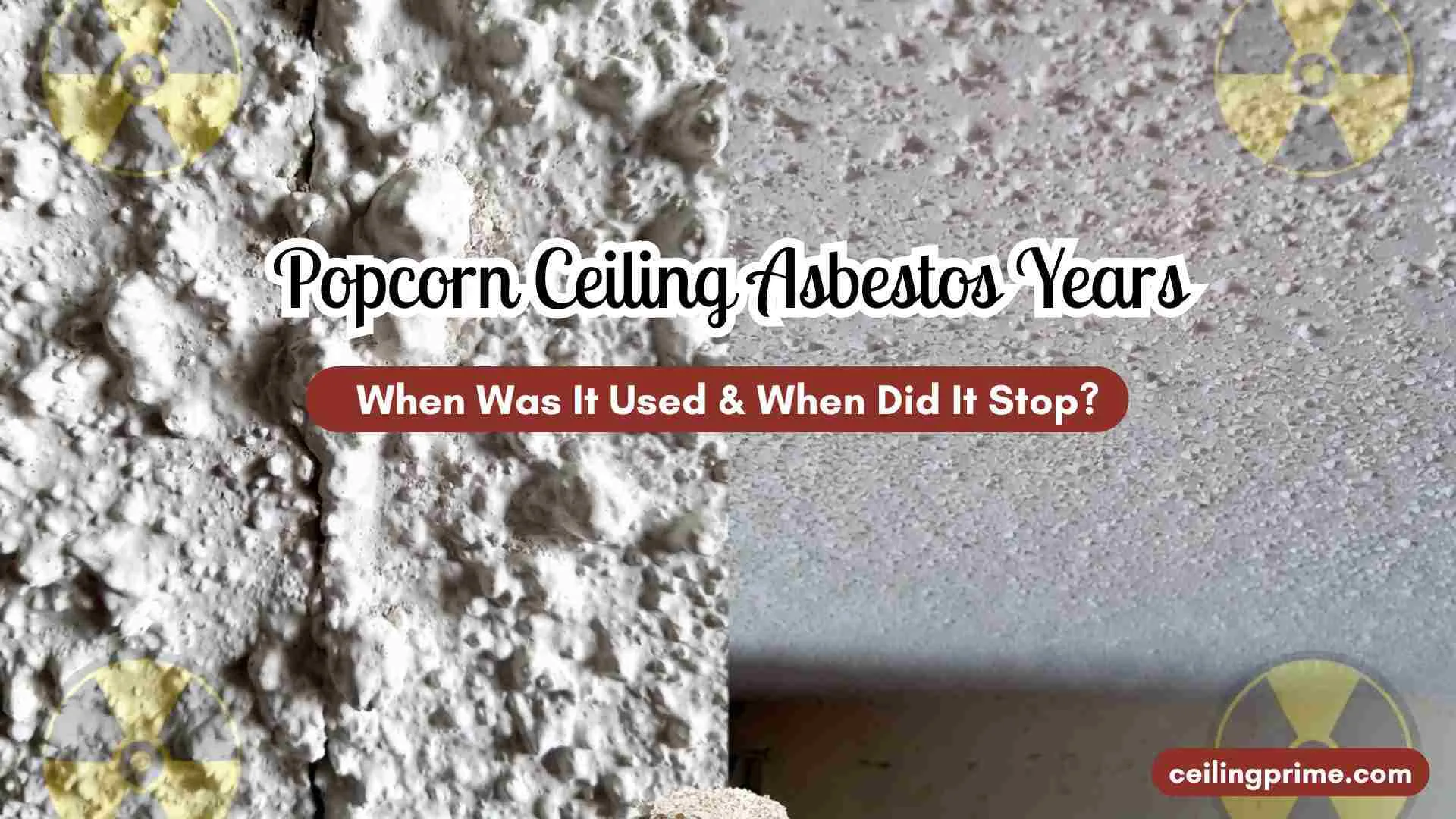
Popcorn Ceiling Asbestos Years: When Was It Used & When Did It Stop?
Asbestos was used in popcorn ceiling texture products from the late 1950s through the early 1980s. The U.S. Consumer Product Safety Commission (CPSC) restricted it in ceiling texture products in 1978, and the Environmental Protection Agency (EPA) banned most asbestos-containing construction products in 1989.
But the risk window is wider than those dates suggest — here is exactly why, and what it means for your home. Now, let’s explore the complete details about Popcorn Ceiling Asbestos Years.
The Full Asbestos Timeline for Popcorn Ceilings
Asbestos was not added to popcorn ceilings all at once, and it was not removed all at once either. The table below shows when it entered the market, peaked, and phased out — and what each period means for homeowners today.
| Pre-1950s | Rare — not yet in ceiling texture | No regulation | Very low — popcorn ceilings were not yet standard |
| 1950s | Growing — added for fire resistance | No regulation | Moderate — post-war housing boom; some products contained asbestos |
| 1960s | Widespread — standard in most formulations | No regulation | High — asbestos was a routine ingredient in ceiling texture |
| 1970s | Peak — standard in residential construction | Scrutiny begins late in decade | High — the majority of homes from this decade are in the risk window |
| 1978 | CPSC restricts asbestos in consumer ceiling texture | Restriction begins | High — stockpile materials continued to be sold and applied after restriction |
| 1980–1984 | Declining — manufacturers reformulate | Transition period | Moderate — some installs still used pre-ban asbestos-containing stock |
| 1985–1988 | Minimal — asbestos largely phased out | Near-complete phase-out | Low — but not impossible if older stock was used |
| 1989+ | Banned in new construction products (EPA) | EPA ban in effect | Very low — ceiling texture installed after this date is essentially asbestos-free |
The key point: 1978 is not a clean cutoff. Manufacturers could legally sell existing inventory after the CPSC restriction, and many contractors applied that stockpile well into the early 1980s. A ceiling installed in 1982 or even 1984 may still contain asbestos if the contractor was working through old materials.
Why Was Asbestos Added to Popcorn Ceiling Texture?
After World War II, residential construction expanded rapidly across the United States. Builders needed materials that were inexpensive, fast to apply, and fire-resistant. Asbestos checked every box.
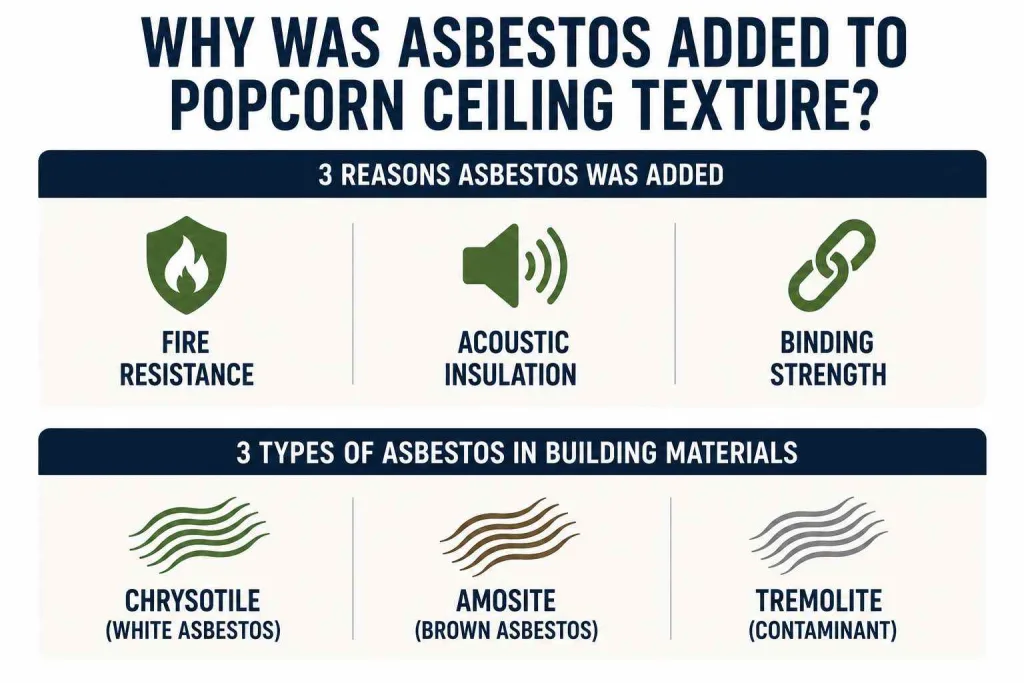
Manufacturers mixed asbestos fibers into spray-on ceiling texture for three specific reasons:
- Fire resistance — Chrysotile (white asbestos), the most common type in ceiling products, does not combust. It helped homes meet early fire code requirements cheaply.
- Acoustic insulation — Asbestos fibers trap air, providing the sound-dampening effect that made textured ceilings popular in the first place.
- Binding strength — Fibers gave the texture mix tensile strength, reducing cracking and extending the surface life.
Three asbestos types appeared in building materials of this era. Chrysotile dominated ceiling texture formulations. Amosite (brown asbestos) showed up in some acoustic ceiling tiles. Tremolite was a contaminant found in certain vermiculite deposits used in ceiling products — a risk that was not well understood until decades later.
When Did They Stop Using Asbestos in Popcorn Ceilings?
The phase-out happened in three overlapping stages — not a single year.
1978: CPSC Restriction
The CPSC restricted asbestos in consumer products, including ceiling texture compounds. This did not immediately remove asbestos products from shelves. Manufacturers could sell existing inventory, and contractors continued applying asbestos-containing materials from stockpiles well into the early 1980s.
Early 1980s: Manufacturer Reformulation
Most major manufacturers reformulated their ceiling texture products by the early 1980s, replacing asbestos fibers with cellulose, polystyrene, and other synthetic binders. The transition was uneven — regional distributors and smaller suppliers may have moved slower than national brands.
1989: EPA Ban
The EPA issued a near-total ban on asbestos-containing construction products in 1989, ending any legal use of asbestos in new ceiling texture materials. Homes built or renovated after 1989 are considered asbestos-free for ceiling texture purposes.
Risk by Home Build Year: Where Does Your House Fall?
The practical question for most Austin homeowners is not regulatory history — it is whether their specific home carries risk. Here is a decade-by-decade breakdown:
| Before 1960 | Lower — popcorn texture was not yet universal, but asbestos was present in some early products. Test if planning any ceiling work. |
| 1960–1977 | High — asbestos was standard in most formulations. Treat the ceiling as containing asbestos until a lab test says otherwise. |
| 1978 | High — the CPSC restriction was issued this year but supply chains did not shift overnight. A 1978 home is still firmly in the high-risk window. |
| 1979–1984 | Moderate to High — manufacturers were transitioning, but stockpile materials were widely in use. Test before any disturbance or renovation. |
| 1985–1988 | Low to Moderate — most products were reformulated, but not all regional suppliers had fully transitioned. Testing is still recommended before any work. |
| 1989 and after | Very Low — EPA ban took effect. Newly applied ceiling texture is essentially asbestos-free. Original pre-ban ceilings that were never removed are a different matter. |
In Austin, the housing stock in Hyde Park, Allandale, Crestview, North Loop, and the 78704 corridor of South Austin was built heavily from the 1940s through the 1970s. That puts a large share of central Austin homes squarely in the highest-risk popcorn ceiling asbestos years.
What Percentage of Old Popcorn Ceilings Contain Asbestos?
No nationally verified figure exists, and any specific percentage published online is an estimate. What EPA and building inspection data confirm is that asbestos-containing materials (ACM) were present in some — not all — ceiling texture products of the era. Formulations varied by manufacturer, region, and year.
CeilingPrime, has a field-level read: in pre-1980 Austin homes, roughly half to two-thirds of the popcorn ceilings encounter on job sites test positive. That is not a reason to panic — it is a reason to test before touching anything.
How to Confirm Whether Your Popcorn Ceiling Has Asbestos?
Visual inspection cannot identify asbestos. No color, texture pattern, or physical characteristic distinguishes asbestos-containing ceiling texture from asbestos-free texture. The only reliable method is laboratory testing of a professionally collected sample.
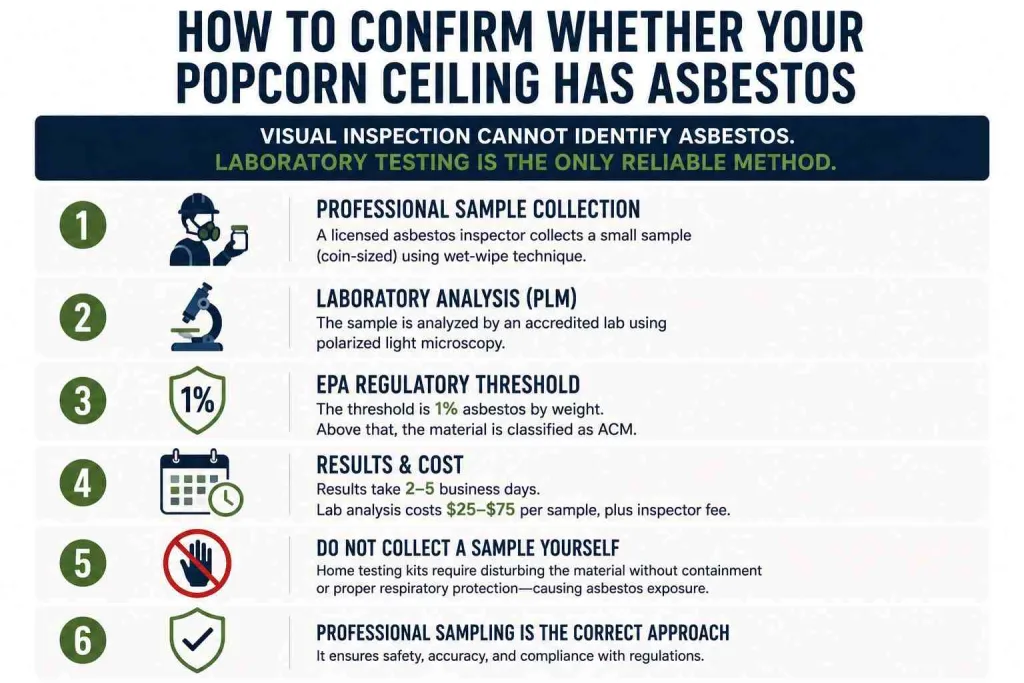
- A licensed asbestos inspector collects a small sample — typically coin-sized — using wet-wipe technique to minimize fiber release.
- The sample goes to an accredited lab for polarized light microscopy (PLM) analysis, which identifies fiber type and percentage by weight.
- The EPA regulatory threshold is 1% asbestos by weight. Above that, the material is classified as asbestos-containing material (ACM) and must be handled under regulated abatement procedures.
- Results take 2–5 business days. Lab analysis costs $25–$75 per sample, plus the inspector fee.
Do not collect a sample yourself. Home testing kits require disturbing the ceiling material without containment or proper respiratory protection — which is exactly what causes asbestos exposure. Professional sampling is the correct approach.
Specific Year Questions Answered
Does a popcorn ceiling from 1978 have asbestos?
Very likely yes. The CPSC restriction took effect in 1978, but did not stop contractors from using existing stock. A ceiling installed in 1978 carries the same risk profile as one from 1975. Test it before any work.
Does a popcorn ceiling from 1980 have asbestos?
Possibly. 1980 falls in the transition period when some manufacturers had reformulated and others were still selling older stock. The risk is real — lower than 1970s homes, but not negligible. Only a professional test confirms it either way.
Does a popcorn ceiling from 1985 have asbestos?
Less likely, but not impossible. Most manufacturers had transitioned by 1985. However, regional stockpiles and smaller suppliers create uncertainty. If the ceiling is original to a pre-1986 home, testing before any renovation is a reasonable precaution.
Does a popcorn ceiling from 1990 have asbestos?
Almost certainly not. The EPA ban took effect in 1989, and any legally sold ceiling texture product after that point should be asbestos-free. A ceiling original to a post-1990 home is not a realistic asbestos concern.
What if my 1980s home had the ceiling re-textured?
It depends on when the re-texturing happened and what product was used. If it occurred before 1985 with leftover stock, asbestos is possible. If after 1989, the new texture should be asbestos-free. The original ceiling below may still contain asbestos if the old texture was not fully removed before the new coat was applied.
Health Risks When Asbestos Fibers Are Released
A popcorn ceiling with asbestos that is intact and undisturbed does not release fibers. The health risk is activated by disturbance — scraping, sanding, drilling, or water damage that breaks down the texture and sends fibers airborne.
Inhaled asbestos fibers do not leave the body. Over 10 to 50 years, they cause lung tissue damage that leads to asbestosis (progressive scarring), mesothelioma (a lethal cancer of the lung lining), and lung cancer. The EPA and Occupational Safety and Health Administration (OSHA) treat any asbestos inhalation as carrying some level of health risk — there is no established safe exposure level.
This is why the popcorn ceiling asbestos years matter practically: a homeowner who scraped their own ceiling in 1983 without knowing the material contained asbestos may have had significant fiber exposure. Anyone in that situation should discuss asbestos exposure history with a physician.
Frequently Asked Questions
Q. What years did popcorn ceilings have asbestos?
Asbestos was used in popcorn ceiling texture from the late 1950s through the early 1980s. Peak use was in the 1960s and 1970s. The CPSC restricted it in 1978 and the EPA banned it from new construction products in 1989. Homes built from 1960 to 1984 carry the greatest risk.
Q. When did they stop putting asbestos in popcorn ceilings?
Most manufacturers phased out asbestos by the early 1980s, but the EPA’s formal ban did not take effect until 1989. Because manufacturers could sell existing stock after the 1978 CPSC restriction, installations using asbestos-containing materials continued into the mid-1980s.
Q. Is it safe to live with an asbestos popcorn ceiling?
Yes, if the ceiling is intact and undisturbed. Asbestos only becomes dangerous when fibers are released — typically from scraping, sanding, water damage, or deterioration. A stable, bonded ceiling poses minimal immediate risk.
Q. Do all old popcorn ceilings have asbestos?
No. Asbestos was common but not universal in ceiling texture products from the 1960s through the early 1980s. The only way to confirm whether a specific ceiling contains asbestos is a professional lab test.
Q. How much does asbestos testing cost in Austin?
Lab analysis costs $25–$75 per sample. Most homes need one to three samples. Add the licensed inspector fee for safe sample collection.