
How Long Does It Take to Remove Popcorn Ceiling? (2026 Guide)
Quick Answer
A professional crew takes half a day to one full day to remove popcorn ceiling in a single standard room (150–300 sq ft) — including prep, scraping, surface repair, and primer. A full house (1,000–2,000 sq ft) takes one to three days. Add one to two days upfront for asbestos testing on pre-1978 homes. DIY popcorn ceiling removal (PCR) on the same room takes two to three times longer and produces inconsistent results.
The most common answer you’ll find online is “one to seven days.” That’s technically accurate and completely useless. A bathroom ceiling is not the same project as a whole-house removal, and an asbestos-positive 1965 Austin home is not the same as a clean 1995 Cedar Park ranch.
This guide gives you specific timelines by room size, ceiling condition, and scenario. The Austin TX sections reflect what CeilingPrime’s crew actually completes on real jobs in Hyde Park, Allandale, South Austin, and surrounding neighborhoods.
How Long Does It Take to Remove Popcorn Ceiling: Timeline by Room Size
Room size is the starting point for every timeline estimate. Here’s what professional removal actually takes in 2026 on Austin-area jobs:
| Room / Project | Sq Ft | Pro Timeline | What That Covers |
| Bathroom or closet | Under 100 | 2–4 hours | Prep, scrape, light repair, prime |
| Small bedroom | 100–180 | Half day (4–5 hrs) | Prep, scrape, repair, prime |
| Standard bedroom (12×12) | 144 | Half to full day | Scrape + skim coat if needed + prime |
| Large bedroom or kitchen | 180–300 | Full day (7–8 hrs) | Scrape + DW repair + skim + prime |
| Living room or open plan | 300–500 | 1–2 days | Includes skim coat and extended repair |
| Full house floor (all ceilings) | 1,000–1,500 | 2–3 days | Scrape + repair + skim + prime |
| Large home (all ceilings) | 1,500–2,500+ | 3–5 days | Full service; painting adds 1 day |
7 Factors That Change How Long Popcorn Ceiling Removal Takes
The table above assumes standard conditions. Seven variables push the timeline in both directions.
1. Asbestos Testing (Pre-1978 Homes)
Asbestos testing (AT) adds one to two business days before any scraping can begin. A certified inspector collects ceiling samples and sends them to a lab. Standard turnaround is two to five business days; rush results in 24 hours cost more.
In Austin, the neighborhoods most likely to need testing are Hyde Park, Rosedale, Allandale, North Loop, Travis Heights, and East Austin — all areas with significant pre-1978 housing stock. If the test returns positive, licensed asbestos abatement (AA) adds another two to five days before standard removal work can begin.
Never skip asbestos testing on a pre-1978 Austin home. The testing delay is real, but scraping without testing is a health risk and a legal liability under Texas DSHS regulations.
2. Whether the Ceiling Has Been Painted
An unpainted popcorn ceiling softens quickly when wet and scrapes cleanly in a single pass. A painted popcorn ceiling is harder. The paint layer blocks water from penetrating to the texture binder, requiring scoring the surface first, applying a vinegar solution, longer wait times (15–30 minutes vs. 10 minutes), and multiple scraping passes.
Painted ceilings typically add 30–50% to the scraping time. A room that takes four hours unpainted takes five to six hours painted.
3. Condition of the Ceiling
A ceiling with water damage from aging plumbing — common in Austin’s older central neighborhoods — requires additional treatment. Soft drywall (DW) from moisture damage slows scraping because the board itself can tear under normal pressure. Post-scrape drywall repair (DWR) on water-damaged areas adds half a day to a full day depending on extent.
Pre-1980 ceilings that require skim coating after removal — the case on most Austin homes from this era where the DW was never properly finished — add one to two days for a full-house job.
4. Ceiling Height
Standard 8-foot ceilings are the baseline. Ceilings above 9 feet require longer setup time, extension poles, and more careful ladder positioning. Vaulted or cathedral ceilings (CC) — common in 1980s construction in Lakeway, Northwest Hills, and Bee Cave — may require scaffolding. Scaffolding adds half a day for setup and breakdown and slows the scraping pace by 20–30%.
5. Room Access and Furniture Protection
Preparation time (PT) includes moving or wrapping furniture, removing or protecting light fixtures, sealing vents, and laying drop cloths wall to wall. A room that’s been pre-cleared by the homeowner starts faster than one where the crew has to move and wrap a full bedroom set. Clearing the room yourself saves 30–60 minutes per room in billable labor.
6. Hard-to-Reach Areas
Corners, wall junctions, edges around light fixture boxes, and ceiling fan mounting plates all require hand work with a narrow scraper rather than a wide pole scraper. Hard-to-reach areas add 15–30 minutes per room that aren’t captured in the square footage estimate. Rooms with more fixtures and corners — kitchens, bathrooms — take longer per square foot than open living rooms.
7. Post-Scraping Finish Requirements
The timeline question most homeowners don’t ask: how long does it take to remove popcorn ceiling versus how long until the ceiling is ready to paint? These are different numbers.
| Stage After Scraping | Added Time | Notes |
| Drywall primer only | 2–4 hours | Primer dries in 1–2 hours; ceiling ready for paint |
| Spot repairs + primer | Half to full day | JC dries 4–8 hours; sand + prime |
| Full skim coat (1–2 coats) | 1–2 days | Each coat dries 4–8 hrs; sand between; prime after |
| Painting (2 coats) | 1 day | Cut in, roll, second coat; includes drying time |
How Hard Is It to Remove Popcorn Ceiling? Honest Assessment
For an unpainted, asbestos-free ceiling in a post-1978 home: moderately easy. The physical work is straightforward. Most of the difficulty is in the preparation, containment, and cleanup — not the scraping itself.
For a painted ceiling on a pre-1978 Austin home with unfinished drywall underneath: significantly harder. The painted surface resists moisture. The scoring and multiple spray-wait-scrape cycles are tedious. The post-scrape skim coat requirement adds two days of skilled trade work that most DIYers aren’t equipped to deliver well.
DIY vs. Professional: Where the Real Difference Shows
| Factor | DIY | Professional (Austin) |
| Scraping time (300 sq ft) | 8–12 hours (first-timer) | 3–4 hours |
| Painted ceiling | Very slow; tools often wrong | Faster with calibrated spray + technique |
| Asbestos handling | Cannot DIY if positive | Test + abatement coordinated |
| Skim coat quality | Inconsistent; often visible lines | Trade-quality flat surface |
| Total room-to-painted timeline | 5–10 days (drying, rework) | 2–3 days including painting |
| Cleanup | Often underestimated; multi-day | Same-day; included in quote |
The physical act of scraping is manageable for most homeowners on a small room. The skim coat, drywall repair, and getting a flat, professional-looking finish is where DIY jobs most often fall short. These stages require specific tools, techniques, and experience that take time to develop.
How Long Does Popcorn Ceiling Removal Take With Asbestos?
Asbestos changes the timeline significantly. Here’s the complete sequence for a pre-1978 Austin home with positive asbestos testing (AT):
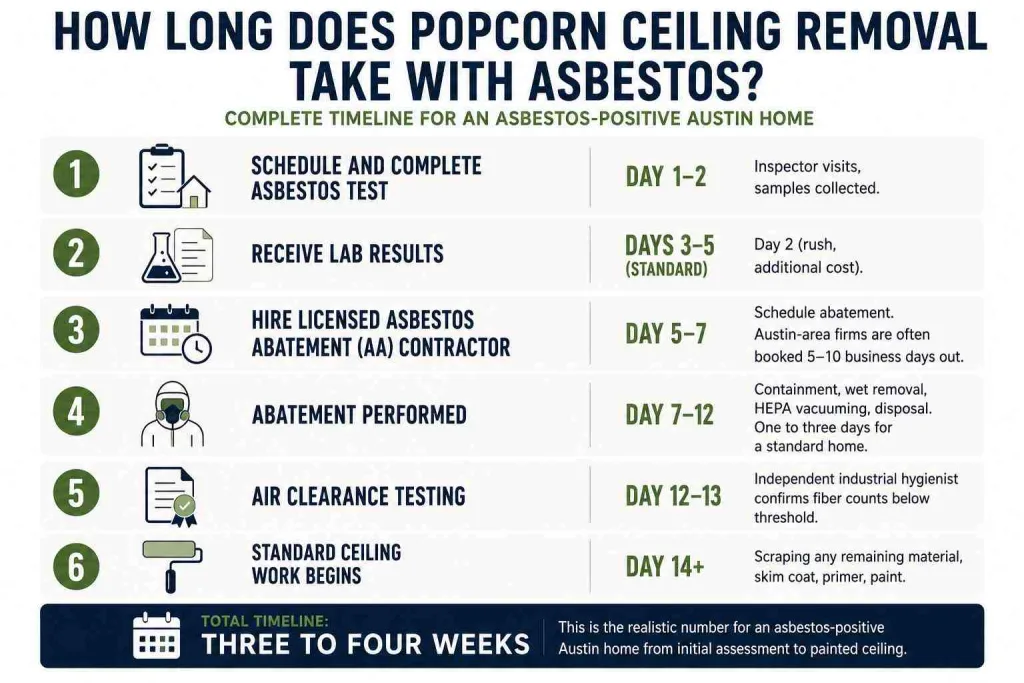
- Schedule and complete asbestos test. Day 1–2: Inspector visits, samples collected.
- Receive lab results. Days 3–5 (standard); Day 2 (rush, additional cost).
- Hire licensed asbestos abatement (AA) contractor. Day 5–7: Schedule abatement. Austin-area firms are often booked 5–10 business days out.
- Abatement performed. Day 7–12: Containment, wet removal, HEPA vacuuming, disposal. One to three days for a standard home.
- Air clearance testing. Day 12–13: Independent industrial hygienist confirms fiber counts below threshold.
- Standard ceiling work begins. Day 14+: Scraping any remaining material, skim coat, primer, paint.
Total timeline for an asbestos-positive Austin home from initial assessment to painted ceiling: three to four weeks. This is the realistic number, not the “3–7 days” range that assumes a clean, non-asbestos job.
Austin-Specific Timeline Considerations
Austin’s housing market and climate create specific timeline factors that national guides don’t address.
Austin’s Housing Era and What It Means for Your Timeline
A large share of Austin’s inner-ring housing stock was built between 1950 and 1980. Homes in Hyde Park, Allandale, Crestview, Rosedale, North Loop, Travis Heights, and South Congress date primarily from this window. For these homes, how long does it take to remove popcorn ceiling includes mandatory asbestos testing before scraping — adding at minimum two to five days upfront.
Post-1985 suburbs — Cedar Park, Round Rock, Pflugerville, Georgetown, and parts of Lakeway — are largely post-asbestos concern. Standard timelines apply without the testing delay.
Austin Humidity and Drying Time
Austin’s summer humidity (June through September) slows joint compound (JC) drying significantly. A skim coat that dries in four hours in October may take six to eight hours in August. Plan for 25–50% more drying time between coats when scheduling summer ceiling work.
Fall and spring are Austin’s best seasons for popcorn ceiling removal. October through November and March through April offer lower humidity, faster drying, and easier scheduling with local contractors.
How Austin Housing Density Affects Scheduling?
Austin’s renovation market is active. Quality ceiling contractors in Hyde Park, South Lamar, and Cedar Park are often booked two to four weeks out. Add this scheduling lead time to your overall project timeline. A job that takes two days to complete may need to be scheduled three to four weeks in advance.
The Complete Popcorn Ceiling Removal Process: What Happens and When
This is what the popcorn ceiling removal process (PCRP) actually looks like on a CeilingPrime job in Austin, step by step:
- Asbestos test (pre-1978 homes). Scheduled before the job. Results received before any ceiling work is scheduled. One to two day lag.
- Room preparation. Hour 1–2. Drop cloths laid, walls masked with painter’s tape, vents sealed, light fixtures removed or protected, furniture cleared or wrapped.
- Wet scrape. Hours 2–5. Water (or vinegar solution on painted ceilings) applied with a garden sprayer in small sections. Texture softened, then scraped with wide-blade taping knives. Shop-Vac run continuously.
- Surface inspection. Hour 5. Angled light inspection reveals gouges, torn drywall paper, mud lines, and water stains.
- Drywall repair. Hours 5–7. Joint compound fills all damage. Spot primer on torn paper. Let dry (4–8 hours).
- Skim coat (if needed). Next day. Two to three thin coats of diluted JC across the entire ceiling, sanded between coats. 120-grit sanding screen.
- Final sand and vacuum. Final day (or same day on simple jobs). 150-grit final sand, shop-vac with HEPA bags, damp mop.
- Drywall primer. Final coat. Kilz 2 Primer or equivalent. Dry two to four hours.
- Paint (if included). Two coats of flat ceiling paint. Cut in, roll, second coat. Inspect under angled light.
Common Mistakes That Extend the Timeline
These mistakes don’t just slow the job — they create rework that doubles the total timeline.
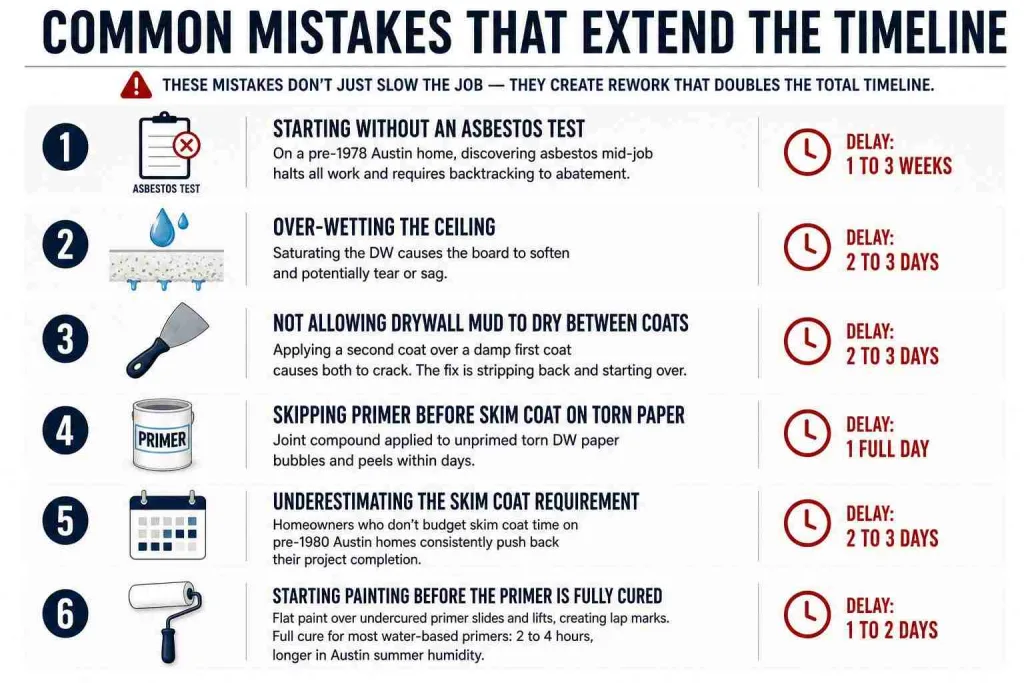
- Starting without an asbestos test. On a pre-1978 Austin home, discovering asbestos mid-job halts all work and requires backtracking to abatement. The delay: one to three weeks.
- Over-wetting the ceiling. Saturating the DW causes the board to soften and potentially tear or sag. Drying out a waterlogged ceiling before repair can add two to three days.
- Not allowing drywall mud to dry between coats. Applying a second coat over a damp first coat causes both to crack. The fix is stripping back and starting over.
- Skipping primer before skim coat on torn paper. Joint compound applied to unprimed torn DW paper bubbles and peels within days. Re-doing this step correctly adds one full day.
- Underestimating the skim coat requirement. Homeowners who don’t budget skim coat time on pre-1980 Austin homes consistently push back their project completion by two to three days.
- Starting painting before the primer is fully cured. Flat paint over undercured primer slides and lifts, creating lap marks. Full cure for most water-based primers: two to four hours, longer in Austin summer humidity.
Best Time of Year for Popcorn Ceiling Removal in Austin
Austin’s climate matters for ceiling removal scheduling. Here’s how each season affects the timeline:
| Season | Humidity | Drying Impact | Scheduling Notes |
| Spring (Mar–May) | Moderate | Normal drying | Good conditions; contractors booking up |
| Summer (Jun–Sep) | High | +25–50% per coat | Budget extra drying time; heat slows workers |
| Fall (Oct–Nov) | Low–moderate | Fastest drying | Best season in Austin; book early |
| Winter (Dec–Feb) | Low | Normal to fast | Slower market; easier scheduling; cooler indoor temp |
October through November is the Austin sweet spot for ceiling work. Lower humidity, post-summer contractor availability, and stable temperatures keep the timeline tight and predictable.
Frequently Asked Questions
Q. How long does it take to remove popcorn ceiling in one room?
A standard bedroom (144 sq ft) takes a professional half a day to one full day including prep, scraping, surface repair, and primer. DIY on the same room takes two to three times longer.
Q. How long does it take to remove popcorn ceiling with asbestos?
Add one to two days for testing, then one to three weeks for abatement scheduling and completion, then another two to three days for standard removal work after clearance. Total from decision to finished ceiling: three to five weeks on asbestos-positive Austin homes.
Q. How long does it take to scrape popcorn ceiling off one room?
Scraping alone on a 144 sq ft bedroom ceiling takes a professional two to three hours. A first-time DIYer on the same room: four to six hours. On a painted ceiling, add 50–75% more time for both.
Q. How hard is it to remove popcorn ceiling?
The scraping itself is physically manageable. The difficulty is in the prep, containment, and post-scrape finishing. Skim coating a pre-1980 Austin ceiling to a professional standard is the hardest part — it’s skilled trade work that takes experience to do correctly.
Q. Is it worth removing popcorn ceilings before selling an Austin home?
Yes. Austin buyers in competitive neighborhoods like Crestview, 78704, and East Austin price popcorn ceilings into their offers. The timeline for pre-sale removal — two to three days for a standard home without asbestos — is well within a typical listing prep period. ROI on removal in Austin is consistently 75–100%.
Q. Can I stay in my home during popcorn ceiling removal?
For a single room, yes. Contractors contain the work area with plastic sheeting and seal the room from the rest of the house. For a whole-house removal, most Austin homeowners make arrangements to stay elsewhere for two to three days while the work is in progress and the ceiling is drying.
Q. How long after popcorn ceiling removal can I paint?
After scraping: if no skim coat is needed, prime the next day and paint the following day. With a two-coat skim coat, add two days of drying and sanding time. From scraping to final painted ceiling: two to four days on a straightforward job, four to seven days when skim coating is required.