Which Way Should a Ceiling Fan Turn in the Summer?
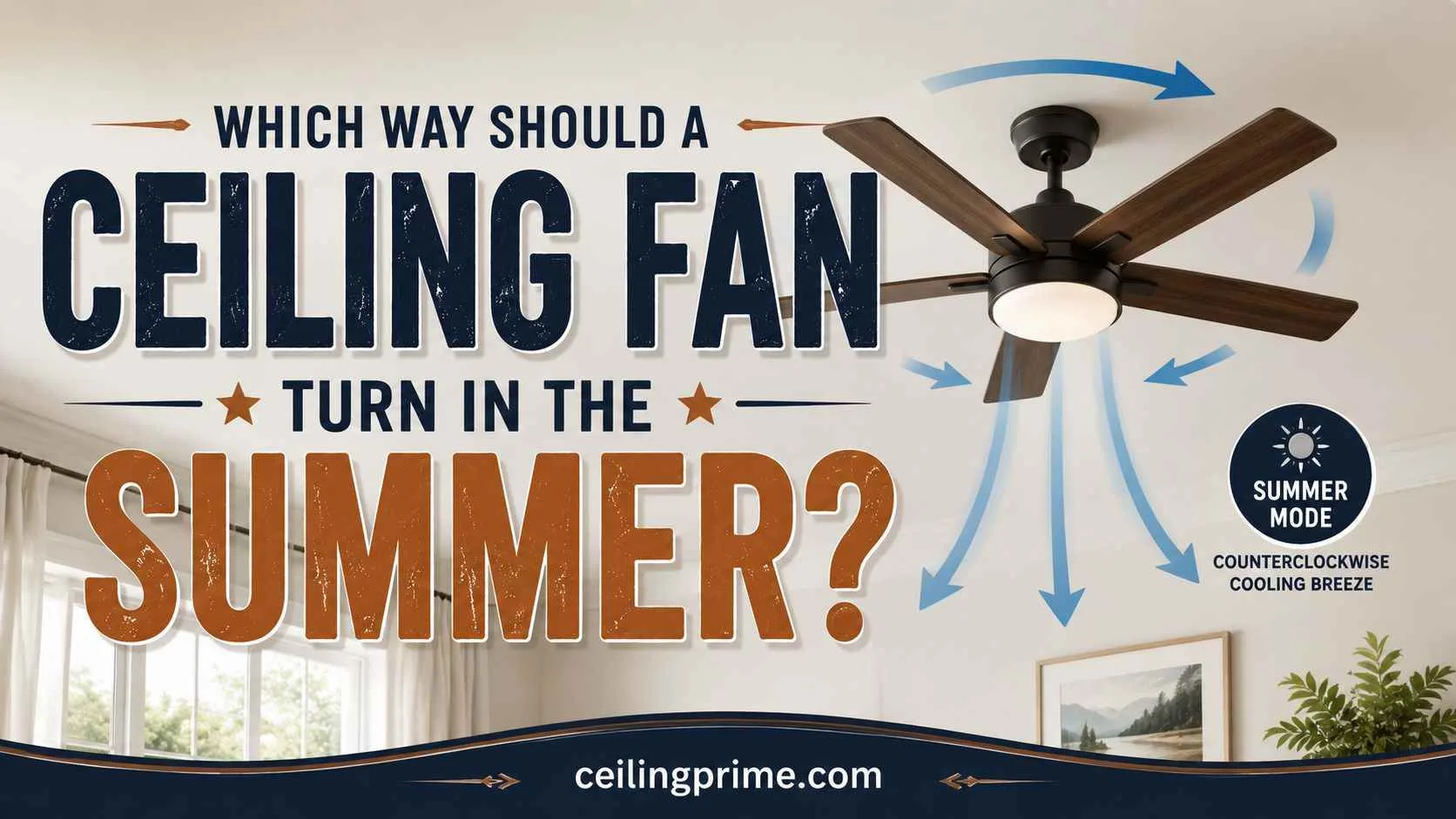
A ceiling fan should spin counterclockwise in the summer when viewed from below. Counterclockwise rotation pushes air straight down. The downward breeze creates a wind chill effect on your skin. The moving air makes you feel 4 to 8 degrees cooler without changing the actual room temperature.
This is the single most searched ceiling fan question every year. Which way should a ceiling fan turn in the summer? Counterclockwise. That one word answers the question. But knowing why it works, how to verify the direction, when to switch, and how to pair a fan with air conditioning saves energy and keeps every room comfortable. This guide covers it all.
The Short Answer: Counterclockwise in Summer
Stand under the fan. Look up. The blades should spin counterclockwise — the top of each blade moves to the left. This is the forward direction on most fans. The angled blades push air straight down toward the floor. You feel a breeze on your skin. That breeze is the cooling effect.
A ceiling fan does not lower the room temperature. It cools people, not rooms. The moving air speeds up moisture evaporation on your skin. That evaporation pulls heat away from your body. This is called the wind chill effect. It makes the air feel 4 to 8°F cooler than the thermometer reads.
Clockwise or Counterclockwise? Summer vs Winter
| Setting | Summer | Winter |
| Direction (from below) | Counterclockwise | Clockwise |
| Airflow | Downward — pushes air to the floor | Upward — pulls air to the ceiling |
| Effect | Wind chill on skin, feels cooler | Pushes warm air down walls |
| Fan speed | Medium to high | Low |
| Switch position | Forward (or counterclockwise) | Reverse (or clockwise) |
| Energy saving | Raise thermostat 4–8°F | Reduce heating costs 10–15% |
People ask which way should a ceiling fan turn in the summer clockwise or counterclockwise. The answer is always counterclockwise for summer cooling. Clockwise is for winter only — it runs at low speed and pushes warm air trapped at the ceiling down the walls without creating a direct breeze.
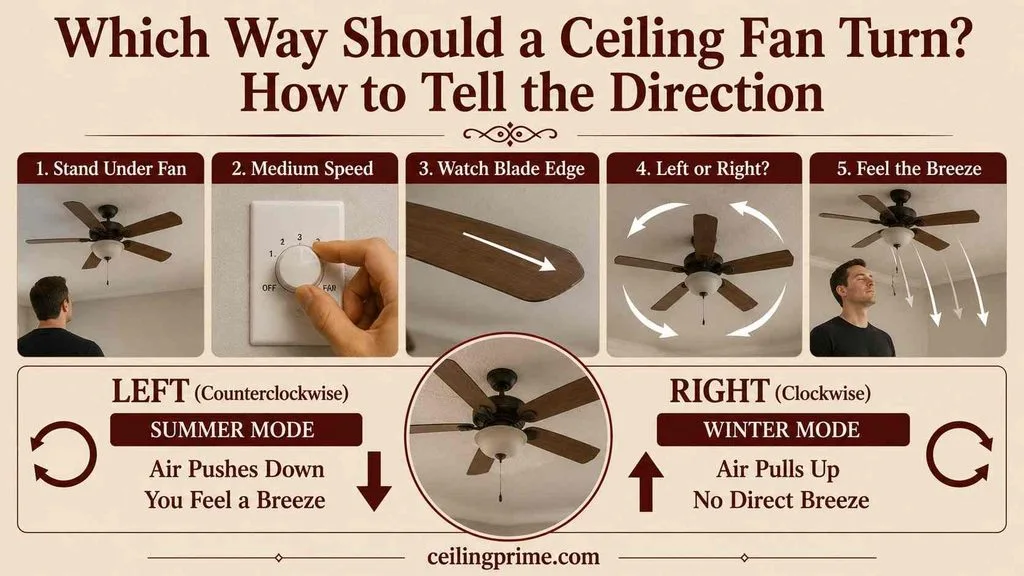
Left or Right? How to Tell the Direction
People search for which way should a ceiling fan turn in the summer left or right. Here is how to tell.
- Stand directly under the fan. Look straight up.
- Turn the fan on to medium speed.
- Watch the leading edge of any single blade.
- If the leading edge moves to the LEFT (counterclockwise), the fan is in summer mode. Air pushes downward. You feel a breeze.
- If the leading edge moves to the RIGHT (clockwise), the fan is in winter mode. Air pulls upward. No direct breeze.
The easiest confirmation test: stand under the running fan. If you feel a direct downward breeze on your face and arms, the fan is set correctly for summer. If you feel no breeze, it is spinning the wrong way.
Forward or Reverse? What the Switch Labels Mean
Most ceiling fans have a direction switch on the motor housing. The switch is a small slider or toggle. Some fans label it “forward” and “reverse.” Others label it “down” and “up.” Some use “F” and “R.” Which way should a ceiling fan turn in the summer forward or reverse? Forward.
- Forward = counterclockwise = summer. The blades push air downward. You feel a breeze. Set the switch to forward, F, or down.
- Reverse = clockwise = winter. The blades pull air upward. No direct breeze. Set the switch to reverse, R, or up.
WiFi-enabled and smart fans controlled through an app label the setting as “summer” or “winter” mode. Voice assistants like Amazon Alexa and Google Assistant can change the direction on compatible fans with a voice command.
Should the Air Go Up or Down in Summer?
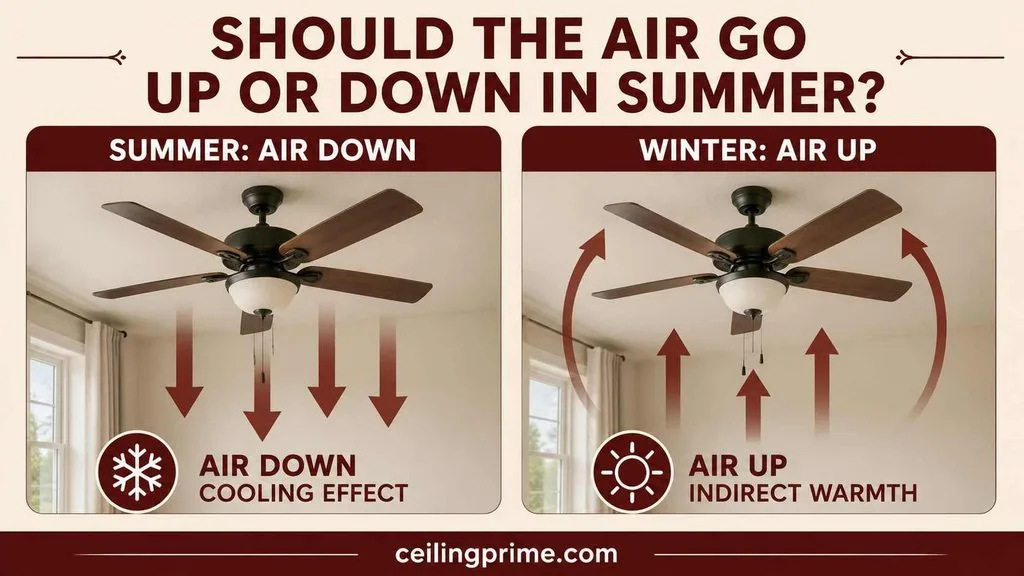
Down. In summer, the fan pushes air downward. The downward airflow creates the wind chill effect on your skin. This is the cooling function. The question of which way should a ceiling fan turn in the summer up or down has a clear answer: down.
In winter, the air goes up. The fan runs clockwise at low speed. It pulls room air upward toward the ceiling. The rising air pushes the warm layer trapped at the ceiling outward and down the walls. You feel indirect warmth without a cold draft.
Using a Ceiling Fan with Air Conditioning in Summer
A ceiling fan paired with air conditioning reduces energy costs by 4 to 8 percent. Here is why: the wind chill effect from the fan makes the room feel cooler without lowering the actual temperature. You can raise the thermostat 4 to 8 degrees and still feel the same comfort level.
Example: Without a fan, you set the AC to 72°F. With a fan running counterclockwise on medium speed, you can set the AC to 78°F and feel the same 72°F comfort. The AC runs less. Your electricity bill drops. Which way should a ceiling fan turn in the summer with air conditioning? Counterclockwise, same as without AC.
- Run the fan on medium or high speed in occupied rooms.
- Turn the fan off when you leave the room. The fan cools people, not air. Running it in an empty room wastes electricity.
- Raise the thermostat 4–8°F while fans are running.
- Use multiple fans in open-concept rooms. One fan covers about 400 square feet effectively.
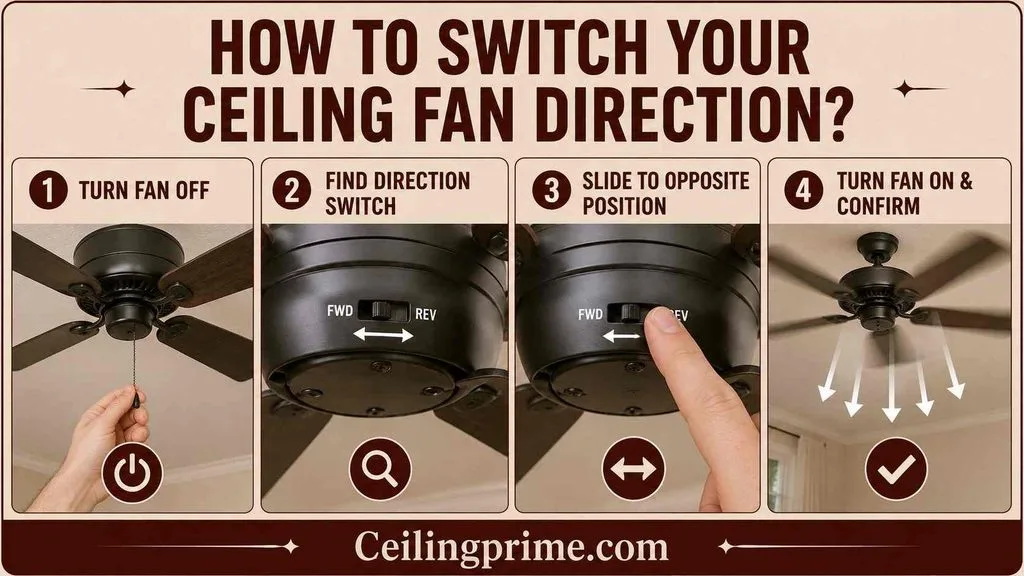
How to Switch Your Ceiling Fan Direction?
- Step 1: Turn the fan off. Wait for the blades to stop completely.
- Step 2: Find the direction switch on the motor housing. It is a small slider or toggle on the side or bottom of the motor body. You may need a step ladder to reach it.
- Step 3: Slide the switch to the opposite position.
- Step 4: Turn the fan on. Stand below. Confirm you feel a downward breeze for summer or no direct breeze for winter.
Switch the direction twice a year: counterclockwise for summer (around Daylight Saving Time in March) and clockwise for winter (around Daylight Saving Time in November).
Fan Speed and Blade Pitch for Maximum Cooling
- Speed: Medium to high speed in summer. Higher speed creates a stronger breeze and a greater wind chill effect. Low speed is for winter mode only.
- Blade pitch: The angle of the blades determines how much air each rotation moves. A steeper pitch (12 to 15 degrees) moves more air per revolution. A shallow pitch (8 to 10 degrees) moves less. Check the blade pitch if your fan runs at high speed but produces a weak breeze — the blades may be too flat.
- Ceiling height: Mount the fan so the blades hang 7 to 9 feet above the floor. Blades higher than 10 feet create a weaker breeze at floor level. For high ceilings, use a downrod to lower the fan to the effective zone.
- Fan size: A 44-inch fan covers rooms up to 225 sq ft. A 52-inch fan covers 225 to 400 sq ft. A 60 to 72-inch fan covers 400+ sq ft. An undersized fan in a large room creates minimal airflow regardless of direction or speed.
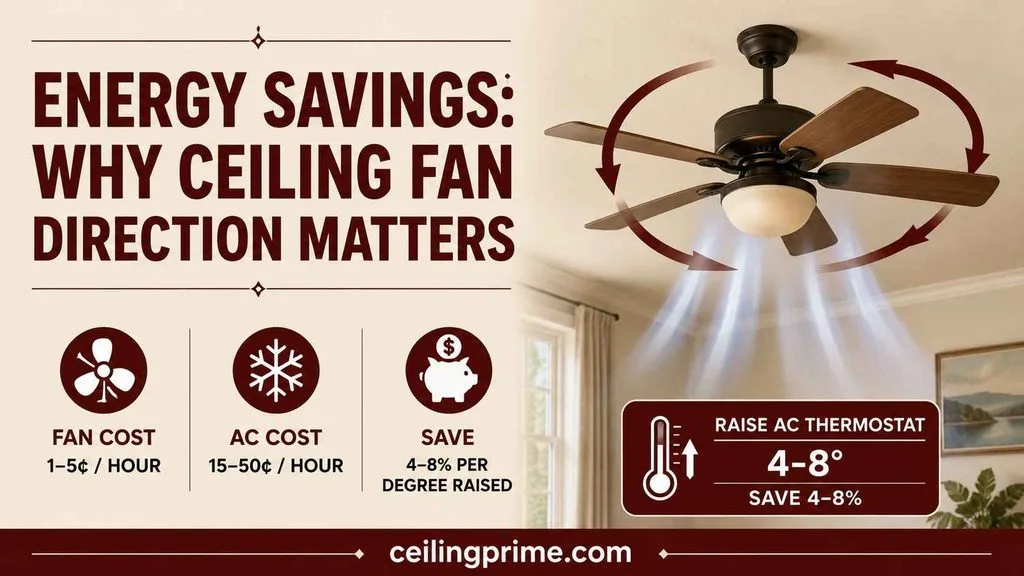
Energy Savings: Why Ceiling Fan Direction Matters
A ceiling fan costs about 1 to 5 cents per hour to run. An air conditioner costs 15 to 50 cents per hour. Setting the ceiling fan to counterclockwise in summer and raising the AC thermostat by 4 to 8 degrees saves 4 to 8 percent on cooling costs for each degree raised.
The Department of Energy (DOE) recommends using ceiling fans with air conditioning as a primary energy-saving strategy. The question of which way should a ceiling fan turn in the summer is a question about comfort and money. The correct direction — counterclockwise — lets you spend less on AC while feeling the same temperature.
Counterclockwise. Every Summer. Every Room.
Which way should a ceiling fan turn in the summer? Counterclockwise when viewed from below. That pushes air downward. The downward breeze creates a wind chill effect that makes you feel 4 to 8 degrees cooler. Pair it with AC and raise the thermostat to save on energy bills. Switch to clockwise in winter at low speed to redistribute warm air. Two direction changes per year. That is all it takes.
Frequently Asked Questions
Does ceiling fan direction really matter?
Yes. Counterclockwise pushes air down and creates a wind chill effect. Clockwise pulls air up and recirculates warm air along walls. Running the fan in the wrong direction in summer provides zero cooling benefit. The breeze is the entire point.
What if I cannot find the direction switch?
Some fans use a remote control or wall switch to change direction. Smart fans use a phone app. If there is no physical switch on the motor housing, check the remote, wall panel, or the manufacturer’s app.
Should I run the ceiling fan all night in summer?
Yes if you sleep in the room. The breeze keeps you cool without running the AC all night. Set the fan to medium speed. Some fans have a timer function that shuts off after a set number of hours.
Does a ceiling fan cool a room or just people?
Just people. The fan does not lower the air temperature. It moves air across your skin. The moving air evaporates moisture and pulls heat away from your body. Turn the fan off when you leave the room. Running it in an empty room wastes electricity.
When should I switch from summer to winter mode?
Switch to clockwise (winter mode) when you start using the heating system. Switch back to counterclockwise (summer mode) when you turn the AC on for the first time in spring. Daylight Saving Time changes in March and November are good reminders.
Can a ceiling fan replace air conditioning?
No. A fan does not lower room temperature. In mild climates (below 85°F), a fan alone may provide enough comfort. In hot climates, a fan supplements AC but does not replace it. The fan lets you raise the thermostat while maintaining the same comfort level.






2 Comments