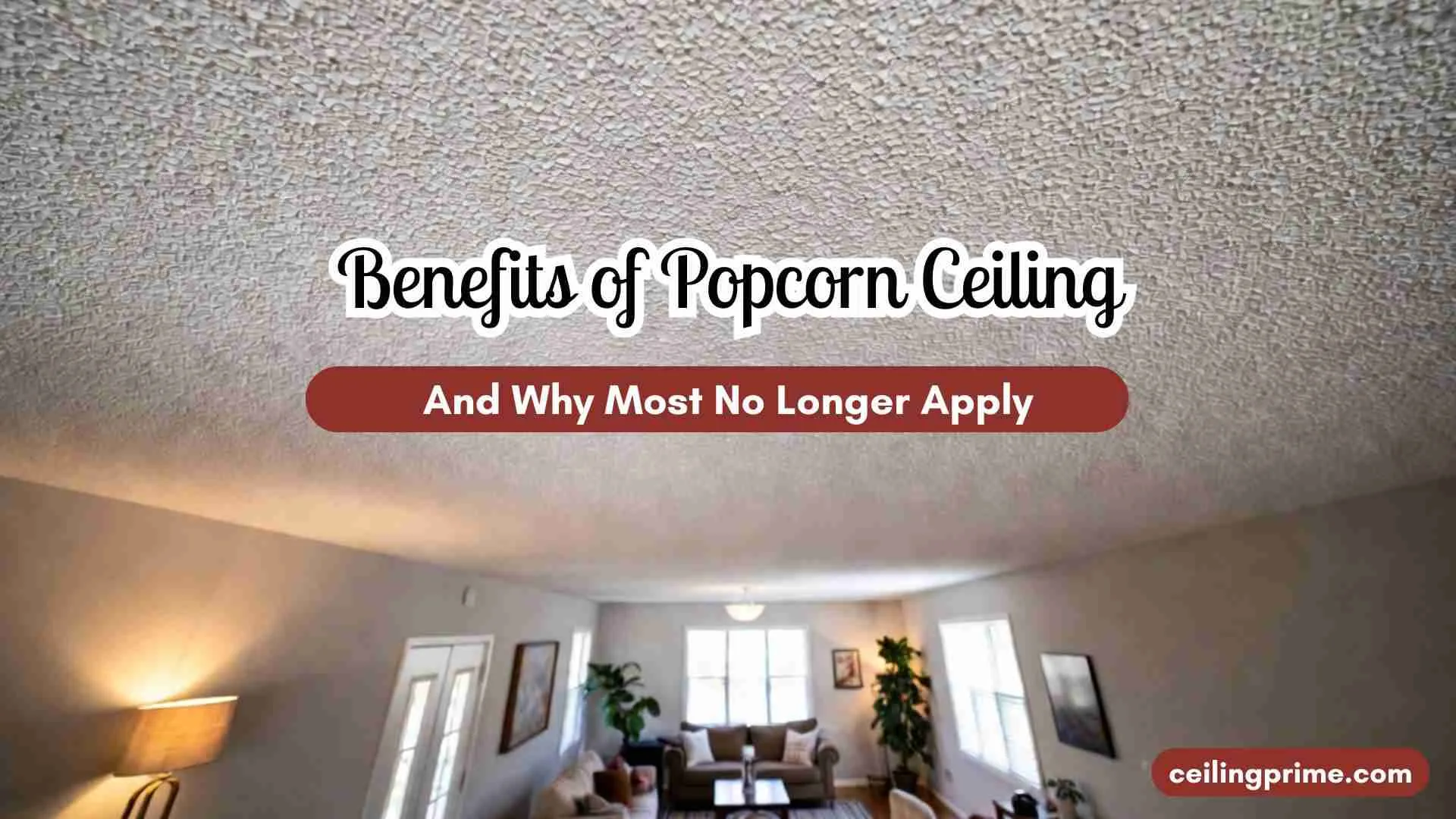
Benefits of Popcorn Ceiling — And Why Most No Longer Apply
Popcorn ceilings had real benefits when they became popular in the 1950s. That is not revisionist history — builders chose them for specific, practical reasons that made sense at the time. But most of those original advantages have either been replaced by better alternatives or are now outweighed by drawbacks that did not exist when the ceilings were first installed. This article covers the genuine benefits of popcorn ceiling texture honestly, then explains what has changed.
What Is Popcorn Ceiling Texture?
Popcorn ceiling texture — also called acoustic ceiling or textured ceiling — is a spray-on or roll-on ceiling treatment with a lumpy, cottage cheese-like surface. It is made from a mix of gypsum with cellulose or perlite aggregates, sprayed over drywall to create a rough, porous finish.
From the 1950s through the 1980s, popcorn texture was standard in residential construction across the United States. Its popularity was not purely aesthetic — the texture offered real functional advantages that builders and homeowners valued. Then the downsides started catching up.
The Original Benefits of Popcorn Ceiling Texture
Here are the genuine, documented reasons popcorn ceilings were widely used — and an honest assessment of whether those benefits still hold today.
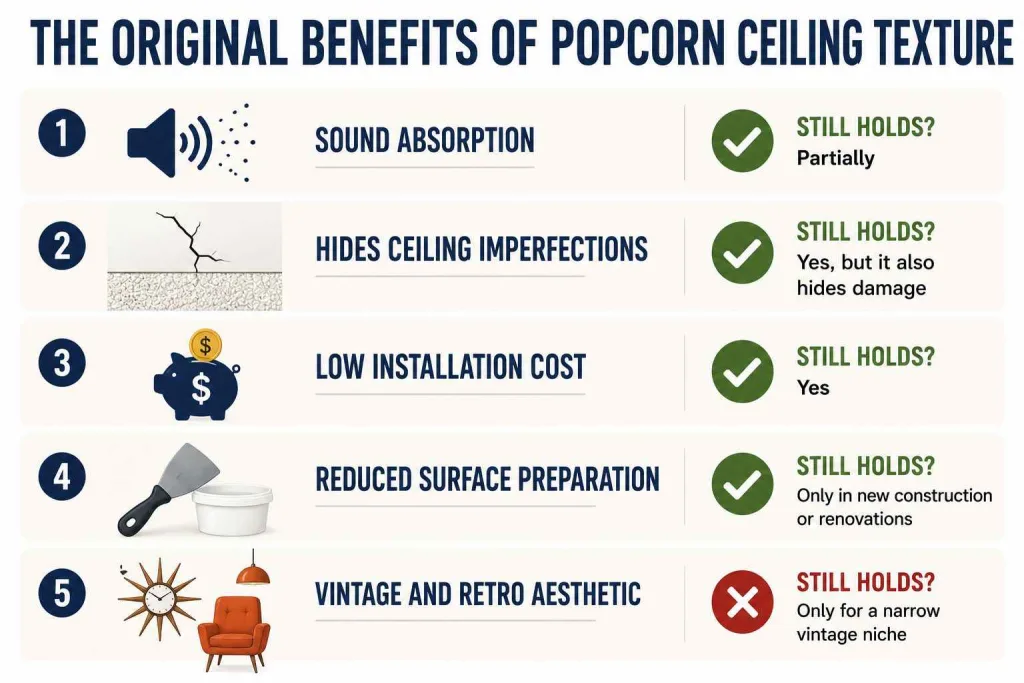
1. Sound Absorption
The uneven, porous surface of popcorn texture absorbs sound waves rather than reflecting them. This reduces echo and reverberation within a room and dampens noise transfer between floors — a practical benefit in multi-story homes, bedrooms, living rooms, and home offices where a quieter environment mattered.
Does this benefit still hold? Partially. The acoustic properties are real, but modest. A popcorn ceiling is not a substitute for proper acoustic insulation or purpose-built sound dampening. Dedicated home theaters and music rooms benefit far more from engineered acoustic panels than from ceiling texture.
For most living spaces, the sound reduction from popcorn texture is marginal enough that it does not justify keeping a ceiling that may contain asbestos.
2. Hides Ceiling & Drywall Imperfections
This was the single biggest practical advantage. Drywall seams, uneven joints, nail pops, and minor cracks are glaringly visible on a smooth, painted ceiling — especially under raking light. Popcorn texture covers all of it. Builders did not need to achieve a Level 5 drywall finish (the smoothest, most labor-intensive standard) because the texture concealed any surface irregularities underneath.
Does this benefit still hold? Yes — the texture does hide flaws. But it also hides damage. A popcorn ceiling can conceal water stains, active leaks, mold growth, and structural cracks until the problem has progressed significantly. At CeilingPrime, we regularly find hidden water damage and mold when removing popcorn ceilings from Austin homes — issues the homeowner had no idea existed. The imperfection-hiding benefit cuts both ways.
3. Low Installation Cost
Applying popcorn texture was fast and required less skill than achieving a smooth, paint-ready finish. A sprayer could texture a ceiling in a fraction of the time that taping, mudding, and sanding to a smooth finish required. Less labor time meant lower construction costs — a meaningful advantage for builders putting up hundreds of homes during the post-war housing boom.
Does this benefit still hold? As an installation method, yes — it is still cheaper to apply new texture than to skim coat to a smooth finish. But this is only relevant if you are applying new, non-asbestos texture to a ceiling with significant flaws. For a pre-1980 home where the existing popcorn texture may contain asbestos, the original installation savings are long spent.
4. Reduced Surface Preparation
Because the texture forgave imperfect drywall work, builders saved on joint compound, sandpaper, and the labor of multiple skim coats. Less prep time per home meant faster project completion — a real economic advantage in high-volume residential construction.
Does this benefit still hold? Only in new construction or complete gut renovations where you are applying fresh texture over new drywall. It has no relevance to homeowners managing existing popcorn ceilings in older homes.
5. Vintage and Retro Aesthetic
In some applications — particularly retro-inspired interiors or period-restoration projects — a popcorn or acoustic ceiling texture can intentionally evoke a specific era. A handful of designers use it deliberately for this purpose.
Does this benefit still hold? For a very narrow slice of homeowners pursuing a specific vintage look, yes. For the broad residential market in Austin, where buyers consistently respond negatively to popcorn ceilings in listings, the aesthetic case is weak. Real estate data shows popcorn ceilings reduce perceived home value and buyer confidence — the opposite of a design asset.
Benefits of Popcorn Ceiling: Then vs. Now
| Sound absorption | Genuine — reduced echo and noise between floors | Marginal benefit; doesn’t justify keeping asbestos-era ceilings |
| Hides imperfections | Genuine — concealed drywall flaws without Level 5 finish | Still works — but also hides water damage, mold, and structural problems |
| Low installation cost | Genuine — faster to apply than smooth finish | Irrelevant for existing ceilings; only applicable to new texture applications |
| Reduced surface prep | Genuine — saved time and materials in high-volume builds | No relevance to homeowners managing existing pre-1980 ceilings |
| Retro aesthetic | Popular from 1950s–1980s; widely accepted style | Narrow niche; most buyers view it as a negative in Austin listings |
Why the Benefits of Popcorn Ceiling Removal Now Outweigh Keeping It?
Most Austin homeowners asking about the benefits of popcorn ceiling are actually trying to decide whether to remove it. Here is a direct look at what removal delivers:
| Asbestos risk eliminated | Pre-1980 popcorn ceilings in Austin frequently test positive for asbestos. Removal — done properly by a licensed contractor — eliminates that ongoing health risk. |
| Hidden damage exposed | Removal reveals water damage, mold, and structural issues while they can still be addressed affordably. Finding these problems after a ceiling collapses is far more expensive. |
| Cleaner air quality | Popcorn texture traps dust, allergens, and cobwebs. A smooth ceiling is easier to clean and does not accumulate the same particulate matter over time. |
| Better light distribution | Smooth ceilings reflect light evenly. Popcorn texture absorbs and scatters light, making rooms appear darker — a particular issue in Austin homes with single overhead fixtures. |
| Higher resale value | Austin buyers view smooth ceilings as a baseline expectation in updated homes. Removal typically returns up to 80% of its cost in resale value improvement. |
| Design flexibility | A smooth ceiling can take any finish — flat paint, satin, tinted, stenciled, coffered, or a new texture of your choosing. A popcorn ceiling locks you into one look. |
| Faster sale timeline | Listings with popcorn ceilings sit longer. Removing before listing reduces the chance of a buyer using it as a negotiating point or walking away. |
Are There Cases Where Keeping a Popcorn Ceiling Makes Sense?
A few, but they are specific:
- The ceiling has tested negative for asbestos and is in perfect condition — no peeling, water staining, or cracking.
- You have no plans to sell, renovate, or disturb the ceiling in any way.
- Budget constraints make removal impossible in the near term — in which case, monitoring the ceiling for deterioration and planning removal before any future renovation is the right approach.
- You are deliberately going for a period-accurate retro interior and the home age and style support it.
In all other situations — particularly if the home is pre-1980, you are planning any renovation, or the ceiling is showing any signs of wear — removal is the better long-term decision.
What Popcorn Ceiling Texture Is Actually Made Of?
Modern popcorn ceiling products use non-asbestos ingredients. Understanding the composition explains both the original benefits and the current limitations:
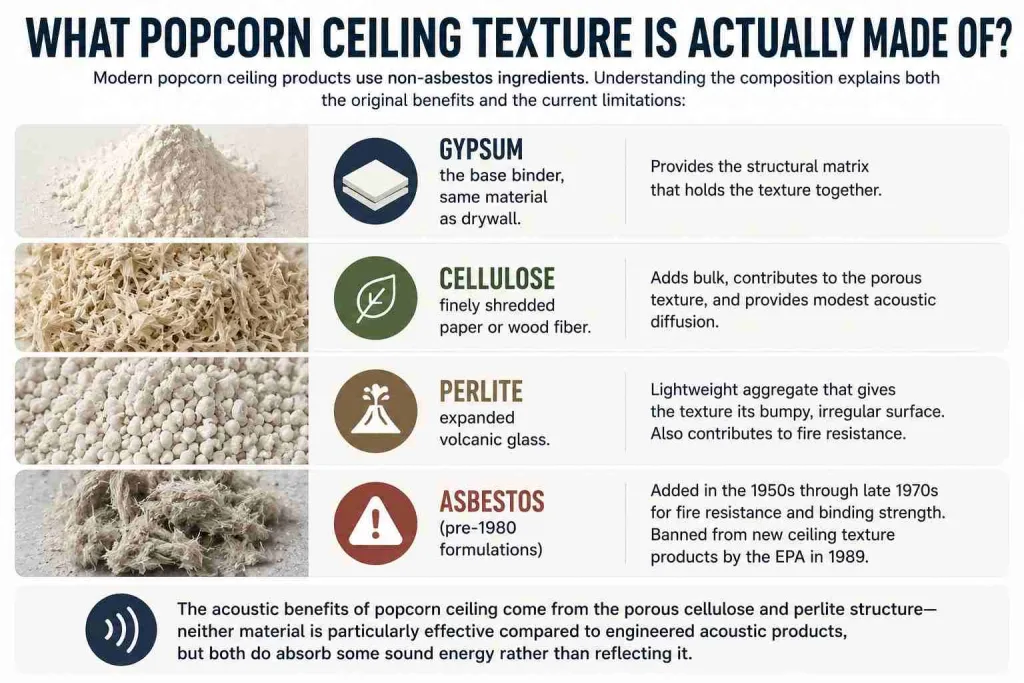
- Gypsum — the base binder, same material as drywall. Provides the structural matrix that holds the texture together.
- Cellulose — finely shredded paper or wood fiber. Adds bulk, contributes to the porous texture, and provides modest acoustic diffusion.
- Perlite — expanded volcanic glass. Lightweight aggregate that gives the texture its bumpy, irregular surface. Also contributes to fire resistance.
- Asbestos (pre-1980 formulations) — added in the 1950s through late 1970s for fire resistance and binding strength. Banned from new ceiling texture products by the EPA in 1989.
The acoustic benefits of popcorn ceiling come from the porous cellulose and perlite structure — neither material is particularly effective compared to engineered acoustic products, but both do absorb some sound energy rather than reflecting it.
Does Popcorn Ceiling Texture Make Sense in Any Room Today?
The answer depends on the room’s function and the home’s age:
Bedrooms
The noise-reduction benefit has some merit in bedrooms — a quieter sleep environment is a real value. But in a pre-1980 Austin home, the asbestos risk in the bedroom where you sleep every night is a more pressing concern than modest sound dampening. In new construction, engineered acoustic underlays and insulation outperform ceiling texture for this purpose.
Living rooms
Popcorn texture in living rooms creates the light absorption problem most noticeably. Central Austin living rooms in older homes often have one ceiling fixture and limited wall windows — popcorn texture makes these rooms feel dimmer. Removal and a smooth finish make a visible difference in perceived room brightness.
Home theaters and music rooms
This is the one application where the acoustic argument has merit. A dedicated home theater or music room benefits from sound absorption, and a textured ceiling contributes to that. But even here, purpose-built acoustic panels, bass traps, and diffusers perform far better than ceiling texture. Popcorn ceiling in a home theater is not wrong — it is just not the best tool for the job.
Hallways
Hallways are high-traffic areas where popcorn ceilings collect the most dust and cobwebs. The maintenance argument for smooth ceilings is strongest here.
Frequently Asked Questions
Q. What is the point of a popcorn ceiling?
The original purpose was threefold: absorb sound, hide drywall imperfections, and reduce installation cost during the post-war housing construction boom of the 1950s through 1980s. All three were genuine benefits that made economic sense at the time.
Q. Are popcorn ceilings good for soundproofing?
They provide modest sound absorption — reducing echo and reverberation — but they are not soundproofing. True soundproofing requires mass and decoupling of building assemblies. Popcorn texture is a surface-level acoustic treatment that helps slightly with reflected sound in a room, not with noise transmission between rooms or floors.
Q. Why is popcorn ceiling bad?
Three main reasons: pre-1980 ceilings frequently contain asbestos, making any disturbance a health risk; the texture traps dust and allergens; and the appearance reduces home value in today’s market. Beyond health and aesthetics, popcorn texture also absorbs light, making rooms appear darker, and can conceal structural damage and water leaks.
Q. Do popcorn ceilings have any benefits worth keeping for new applications?
In new construction with modern, asbestos-free products, popcorn texture can still offer modest sound absorption and hide imperfect drywall work affordably. But most builders and designers today use skim coat with knockdown or smooth finishes, which offer better aesthetics with only marginally more labor. The benefits of new popcorn texture applications are narrow.
Q. What is the benefit of removing a popcorn ceiling specifically in Austin?
Austin’s housing market responds strongly to updated interiors. Hyde Park, Allandale, Crestview, and South Austin buyers expect smooth ceilings in renovated homes. A popcorn ceiling in a listing is a negotiating chip for buyers and a reason for lower offers. CeilingPrime consistently sees removal pay back up to 80% in resale value improvement on Austin homes.
CeilingPrime Removes Popcorn Ceilings in Austin — Properly
Brian Noustens trains and certifies finishing tradespeople across Texas through the Finishing Trades Institute, IUPAT District Council 10. Carlos Medina brings over a decade of Austin residential drywall and texture work. Together they handle the full job: asbestos testing coordination before any work starts, proper containment and removal, skim coat or texture finish, and paint-ready results.
CeilingPrime serves South Austin (78704, 78745), Hyde Park, Allandale, Crestview, North Loop, Cedar Park, Round Rock, Pflugerville, Georgetown, and Lakeway. No subcontractors. Pricing starts at $2.30 per square foot with no hidden fees. Call or email for a free estimate.
Free Estimate: (512) 000-0000 | ceilingsprime@gmail.com | ceilingprime.com