How to Get Cobwebs Off Popcorn Ceiling Without Damaging It
Getting cobwebs off a popcorn ceiling without breaking the texture is entirely possible — but the texture is fragile, and the wrong tool or approach can pull chunks of it off in seconds. The right method uses a soft, dry tool applied with light pressure in small sections. Here is exactly what to use, what to avoid, and a step-by-step approach for different ceiling heights.
The Short Answer
Use a soft-bristled vacuum brush attachment, a dry microfiber duster, or a dome-shaped cobweb duster (often called a Webster duster). Move the tool gently over the cobwebs in small sections. Never use wet cloths or sponges — moisture weakens the texture adhesive and causes it to fall.
Why Popcorn Ceilings Are Fragile — And Why It Matters for Cleaning
Popcorn ceiling texture is made from a mixture of gypsum, cellulose or perlite, and paint — all held to the drywall by adhesive that has been in place since the ceiling was applied, often decades ago. The texture is three-dimensional and porous, which means:
- Cobwebs and dust lodge in the texture bumps easily and build up over time without being visible until they are significant
- Any pressure — mechanical or from moisture — can detach the texture from the drywall beneath
- Wet cleaning methods soak into the texture and can dissolve the adhesive bond, causing sections to drop
- Abrasive tools or scrubbing motions break off texture peaks, leaving visible bald spots that are difficult to patch and match
On pre-1980 ceilings, there is an additional consideration: the texture may contain asbestos. Aggressive cleaning that dislodges or crumbles texture on a pre-1980 popcorn ceiling can release asbestos fibers. If you are not sure whether the ceiling has been tested, use the gentlest possible method and avoid any technique that visibly damages the surface.
Best Tools for Removing Cobwebs From a Popcorn Ceiling
| Vacuum with soft brush attachment | Light cobwebs and dust buildup; most controlled method | Lowest — suction lifts webs without mechanical contact | Any height with wand extension |
| Dome/Webster cobweb duster | Loose cobwebs, high corners, and around fixtures | Low — soft bristles conform to texture shape | Up to 20+ ft with extension pole |
| Dry microfiber duster (flat or wand) | Light dust and thin webs on lower ceilings | Low to moderate — depends on pressure applied | 8–12 ft standard; taller with pole |
| Lint roller (large handle) | Very light dust and fine webs on lower ceilings | Low — adhesive grabs webs without mechanical force | 8–10 ft standard ceiling |
| Dry paint roller cover (clean) | Light overall dust across large flat sections | Low if new and clean; higher if used or stiff | Any with extension handle |
| Damp cloth or sponge | Not recommended | High — moisture weakens texture adhesive | N/A — avoid entirely |
| Stiff-bristled brush | Not recommended | High — breaks off texture peaks | N/A — avoid entirely |
Step-by-Step: How to Get Cobwebs Off Popcorn Ceiling
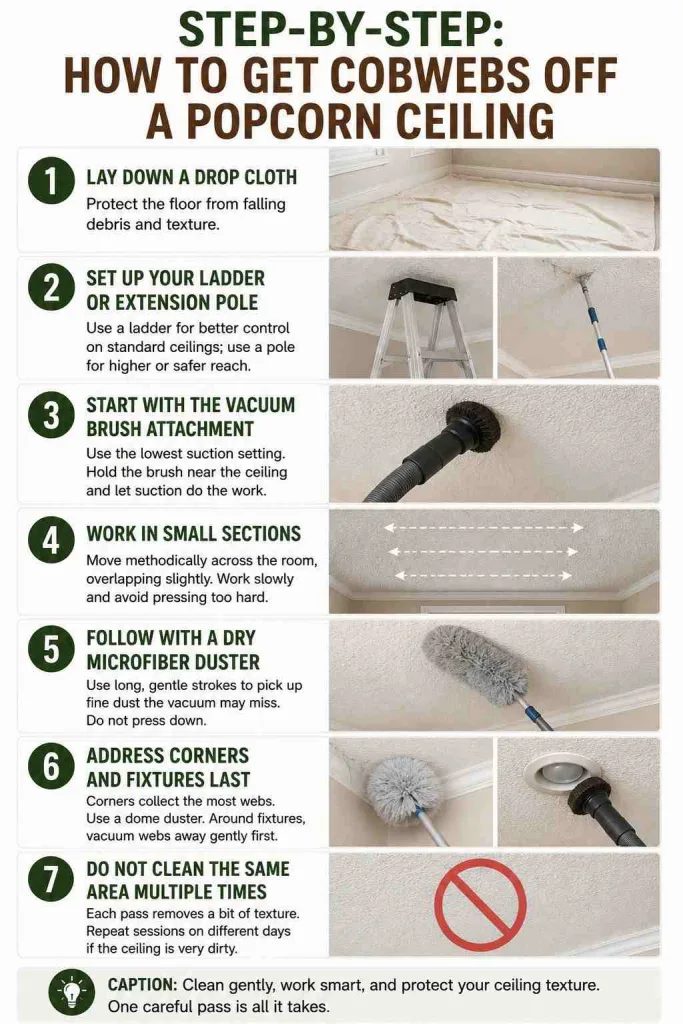
- Lay down a drop cloth or old sheet below the work area — Even a careful cleaning dislodges small pieces of texture and cobweb debris. Protecting the floor means easier cleanup and no embedded texture particles in carpet or flooring.
- Set up your ladder or extension pole — For standard 8–9 foot ceilings, a short stepladder gives better control than a long extension pole. With a pole, you have less ability to feel the pressure you are applying to the ceiling. For ceilings above 9 feet, a longer pole with a dome cobweb duster or a vacuum wand extension is safer than ladder repositioning.
- Start with the vacuum brush attachment on its lowest suction setting — Hold the brush attachment an inch or so from the ceiling surface and let the suction pull the cobweb and loose dust off without the brush bristles making direct contact. For heavier webbing, light contact with the soft brush is fine — but keep the stroke direction consistent (one direction, not scrubbing).
- Work in small sections across the ceiling — Move systematically from one side of the room to the other, overlapping slightly. Work slowly. Rushing creates pressure variations that risk dislodging texture.
- Follow with a dry microfiber duster for any remaining fine dust — After the vacuum pass, a dry microfiber wand or dome duster picks up the fine particles the vacuum may have missed. Use long, gentle strokes — do not press down.
- Address corners and fixtures last — Corners accumulate the densest cobwebs. A dome-shaped Webster duster fits into corners better than a flat tool. Around light fixtures, use the vacuum brush to gently pull webs away from the fixture housing before they are pushed into the electrical opening.
- Do not clean the same area multiple times in one session — Each pass removes a tiny amount of texture. One careful pass is enough. If the ceiling is very dirty, space repeated cleaning sessions out over days rather than going over the same area repeatedly in one session.
Do’s and Don’ts at a Glance
| Use a vacuum with a soft brush attachment on low suction | Use wet cloths, sponges, or damp mops — moisture dissolves texture adhesive |
| Use a dry dome cobweb duster (Webster) for corners and around fixtures | Use stiff brushes or brooms — they break off texture peaks |
| Work in small sections with light, controlled pressure | Scrub or apply sideways pressure — this tears the texture surface |
| Put down drop cloths before starting | Work without floor protection — texture and debris fall and are hard to clean from carpet |
| Use a ladder for low ceilings where control matters more than reach | Rely solely on a long extension pole — less pressure control at distance |
| Let the suction do the work rather than pressing the vacuum head into the ceiling | Apply vacuum suction directly against the texture with full contact — creates dents and pulls texture |
| Test a small inconspicuous area first if the ceiling is old or showing signs of deterioration | Clean aggressively if texture is already flaking or soft — it will come down |
How to Clean a Popcorn Ceiling Without Ruining It — Ongoing Maintenance
Cobwebs accumulate faster in rooms with air movement — ceiling fans, HVAC vents, and open windows create the air currents spiders use to establish web anchor points. In Austin homes, where AC runs heavily from spring through fall and ceiling fans are common, popcorn ceilings in living rooms and bedrooms tend to collect more webs than those in closed rooms.
A practical maintenance schedule: light dusting with a soft brush or vacuum pass 2–4 times per year keeps webs from becoming heavily embedded. Waiting until cobwebs are visibly sagging and thick makes removal harder without damage — thick webs have more anchor points in the texture and require more force to dislodge.
For ceiling fans: clean the fan blades regularly (a pillowcase slipped over each blade and pulled off captures debris without sending it airborne) to reduce the dust and debris that falls onto the ceiling texture below the fan hub.
When Cobwebs and Dust Are a Sign of a Larger Problem?
A popcorn ceiling in consistently poor condition — visible cobwebs within weeks of cleaning, heavy dust accumulation, or texture that is noticeably yellowing unevenly — is often signaling one of these underlying issues:
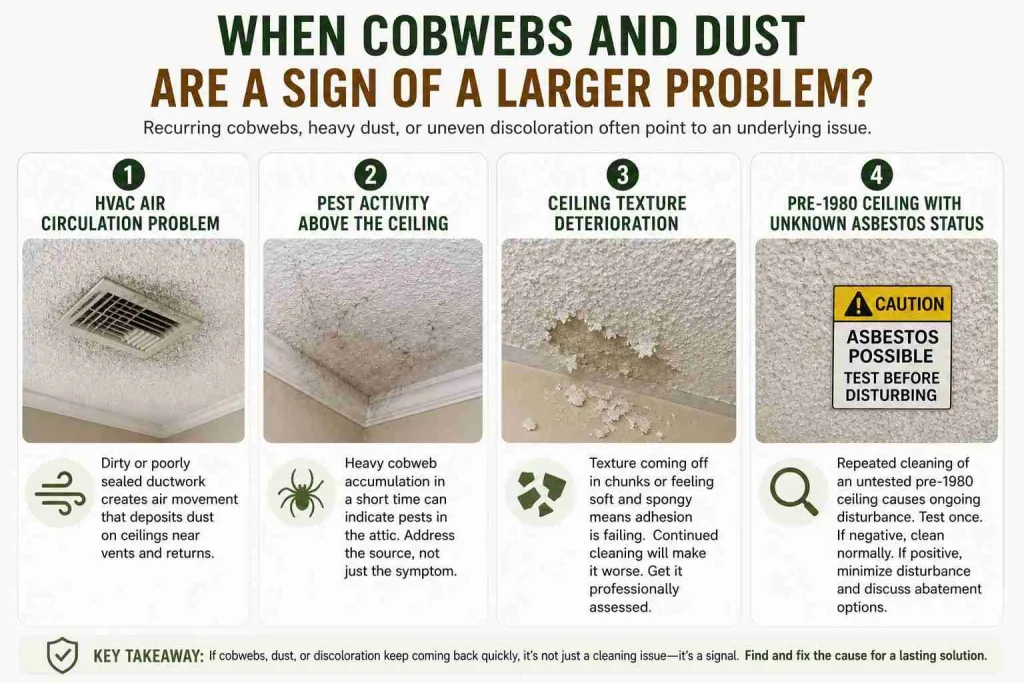
- HVAC air circulation problem — Dirty or poorly sealed ductwork creates air movement patterns that deposit dust and debris on ceiling surfaces near vents and returns.
- Pest activity above the ceiling — Heavy cobweb accumulation in a short time can indicate spiders or other insects living in the attic space above. Address the source, not just the symptom.
- Ceiling texture deterioration — If texture is coming off in chunks during routine cleaning, or if the surface feels soft and spongy, the texture adhesion is failing. Continued cleaning attempts will accelerate the damage. This ceiling needs professional assessment.
- Pre-1980 ceiling with unknown asbestos status — Repeated cleaning of a pre-1980 ceiling that has not been asbestos-tested creates ongoing low-level disturbance. Get the ceiling tested once; if negative, clean normally. If positive, minimize disturbance and discuss abatement options.
Is It Time to Just Remove the Popcorn Ceiling?
Popcorn ceiling texture is the single biggest dust and cobweb trap in any room. The three-dimensional surface catches and holds airborne particles in a way that a smooth ceiling simply does not. Many Austin homeowners who have switched from popcorn to smooth ceilings report a noticeable reduction in the frequency of dusting needed overhead.
The cleaning and maintenance burden is one of the practical reasons — alongside asbestos risk and buyer perception — that popcorn ceiling removal makes long-term sense. A smooth skim-coated ceiling can be wiped clean if needed, picks up far less dust in normal air circulation, and does not trap cobwebs in the same way.
If you are spending significant time and effort cleaning a popcorn ceiling that keeps accumulating debris, the removal cost ($2.30–$4.05 per square foot with CeilingPrime in Austin) is worth considering against the ongoing maintenance burden.
Frequently Asked Questions
Q. What is the best way to remove cobwebs from a popcorn ceiling?
A vacuum with a soft brush attachment on low suction, or a dome-shaped cobweb duster (Webster duster) on an extension pole. Work in small sections with light, consistent pressure. Never use wet methods — moisture weakens the texture adhesive and causes sections to fall.
Q. Can you use a Swiffer duster on a popcorn ceiling?
A dry Swiffer duster can work on light cobwebs and dust on a popcorn ceiling, particularly the Swiffer 360 Duster with its flexible head. The key is using very light pressure — do not push the duster head into the texture. The dry electrostatic sheets attract webs and fine dust without moisture. Avoid the wet Swiffer products entirely on popcorn ceilings.
Q. Can you vacuum a popcorn ceiling?
Yes — this is actually the most controlled method. Use a soft brush attachment on the lowest suction setting and hold it slightly away from the surface so suction pulls webs off without the brush pressing directly into the texture. Full-contact vacuuming at high suction can dent or pull texture.
Q. How do you get rid of dust on a popcorn ceiling?
The same approach as cobwebs: vacuum with a soft brush attachment or use a dry microfiber duster in gentle, one-direction strokes. For heavy dust buildup, a vacuum first pass followed by a microfiber duster for fine particles produces the best result without disturbing the texture.
Q. Is it safe to clean a popcorn ceiling if it might have asbestos?
Gentle dry cleaning — vacuum suction with a brush held slightly away from the surface — is generally considered low-risk because it does not mechanically disturb or crumble the texture. Avoid any cleaning that scrubs, scratches, or breaks the surface. If you are concerned about asbestos status on a pre-1980 ceiling, get it professionally tested before doing anything more aggressive than very gentle dusting.