Does Removing Popcorn Ceiling Increase Home Value?
Yes, removing a popcorn ceiling increases home value in most Austin properties, and the Austin real estate market is one of the better environments for this particular improvement to pay off. The return on investment (ROI) typically runs 50–80% of the removal cost, and in competitive listings, a smooth ceiling can be the difference between a quick sale and a negotiated price reduction. Here is what drives those numbers and when it makes the most sense to act.
The Short Answer: What the Data Shows
No national study provides a single verified figure for how much removing popcorn ceiling increases home value, and anyone who gives you a precise percentage without qualifying it is guessing. What real estate professionals in Austin consistently report is this: popcorn ceilings register as a negative in buyer perception, and removing them eliminates a known objection before it costs you money at the negotiating table.
The value increase comes from two sources. First, buyers in Austin’s market — particularly in Hyde Park, Allandale, Crestview, and South Austin — expect updated interiors and smooth ceilings as a baseline in move-in ready homes. A popcorn ceiling signals “dated” before a buyer has seen anything else.
Second, buyers who notice a popcorn ceiling in a pre-1980 home immediately think about asbestos, which triggers concerns about testing costs, health risk, and the disruption of removal. Eliminating that concern before listing removes the discount buyers apply to properties they see as requiring work.
How Much Does Removing Popcorn Ceiling Increase Home Value?
The value gain depends on your home’s price point, the local real estate market, and the condition of the ceiling underneath. Here is a realistic range based on Austin market conditions and CeilingPrime’s experience on Central Austin jobs:
| Scenario | Avg. Removal Cost | Est. Value Added | Typical ROI |
|---|---|---|---|
| Small room (150 sq ft) | $345–$608 | $500–$900 | ~60–80% ROI |
| Single-story home (1,500 sq ft) | $3,450–$6,075 | $4,500–$8,000 | ~60–80% ROI |
| Full house (2,500 sq ft) | $5,750–$10,125 | $7,000–$13,000 | ~60–75% ROI |
| Pre-1980 home with asbestos abatement | Cost increases 30–50% | Buyer perception gain is higher | ROI similar after accounting for health risk elimination |
| Home with hidden water damage found | Additional repair cost | Prevents much larger loss post-inspection | High — catches problems before they kill the deal |
These figures assume a professional removal and skim coat finish — not painting over the texture or covering with new drywall, both of which are cheaper but deliver less value because buyers and appraisers can often identify covered or painted popcorn ceilings.
What Factors Actually Drive the Value Increase?
The ROI from removing a popcorn ceiling is not fixed — it shifts based on specific conditions in your home and market. Here is what moves the needle:
| Home age | Pre-1980 homes gain more from removal because the asbestos concern is active. Buyers apply a mental discount to any pre-1980 listing with intact popcorn texture. Post-1990 homes gain less because asbestos is not a concern. |
| Ceiling condition | Ceilings with water staining, peeling, or cracking already signal problems to buyers. Removal and repair of what is underneath can reverse that perception entirely. |
| Neighborhood | In Hyde Park, Allandale, Crestview, and 78704 South Austin, smooth ceilings are expected in renovated homes. In lower-price-point markets, the ROI calculation changes. |
| Overall home update level | If the kitchen, baths, and floors are already updated, a popcorn ceiling is even more jarring and will hurt value comparatively more. If the whole house is dated, ceiling removal alone has less impact. |
| Buyer pool | Move-in ready buyers — particularly millennials who now dominate Austin’s buyer pool — are especially averse to any work required post-purchase. Popcorn ceilings are a known turnoff for this demographic. |
| Asbestos presence | A confirmed positive asbestos test result is a required disclosure in Texas. Buyers who learn about asbestos in the ceiling will negotiate hard or walk. Removal before listing eliminates that exposure. |
| Hidden damage revealed | Removal sometimes uncovers water damage, mold, or structural issues. Finding and addressing these pre-sale prevents a far more expensive renegotiation or deal collapse after inspection. |
Does Removing Popcorn Ceiling Increase Home Value More Than Other Updates?
It depends on what else needs attention in your home. Popcorn ceiling removal is generally a mid-tier ROI renovation — better than many cosmetic upgrades, not as high as kitchen or bathroom remodels in dollar terms, but much cheaper to execute. The case for removal is strongest when:
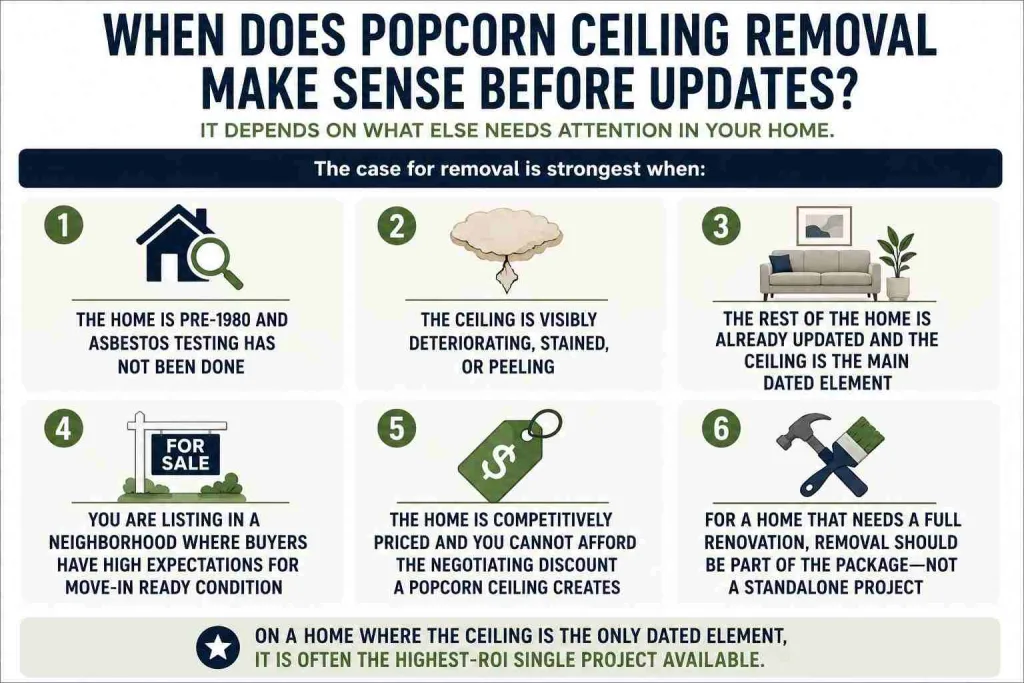
- The home is pre-1980 and asbestos testing has not been done
- The ceiling is visibly deteriorating, stained, or peeling
- The rest of the home is already updated and the ceiling is the main dated element
- You are listing in a neighborhood where buyers have high expectations for move-in ready condition
- The home is competitively priced and you cannot afford the negotiating discount a popcorn ceiling creates
For a home that needs a full renovation, popcorn ceiling removal should be part of the package — not a standalone project done in isolation. On a home where the ceiling is the only dated element, it is often the highest-ROI single project available.
Does Removing Popcorn Ceiling Increase Value If You Are Not Selling?
Yes, though the mechanism is different. If you are not planning to sell, the value gains from removing a popcorn ceiling are practical rather than financial:
- Better lighting — smooth ceilings reflect light evenly, making rooms appear brighter without additional fixtures. This is a daily quality-of-life improvement, especially in central Austin homes with single overhead lights.
- Cleaner air quality — popcorn texture traps dust, cobwebs, and allergens. Removal reduces particulate matter in the room, a meaningful benefit in bedrooms and living rooms.
- Eliminated health risk — for pre-1980 homes with asbestos-containing ceiling texture, removal ends an ongoing exposure risk for everyone in the home.
- Design flexibility — a smooth ceiling can be repainted, stenciled, or finished with any texture you choose. A popcorn ceiling is locked into one look.
If a home improvement loan or home equity is funding the work, the ROI calculation still applies even if you are not selling — you are building equity and reducing deferred maintenance costs.
Remove vs. Cover: Which Adds More Value?
Covering a popcorn ceiling — either by drywalling over it or painting it — is cheaper than removal. Whether it adds comparable value depends on the method and what buyers can see:
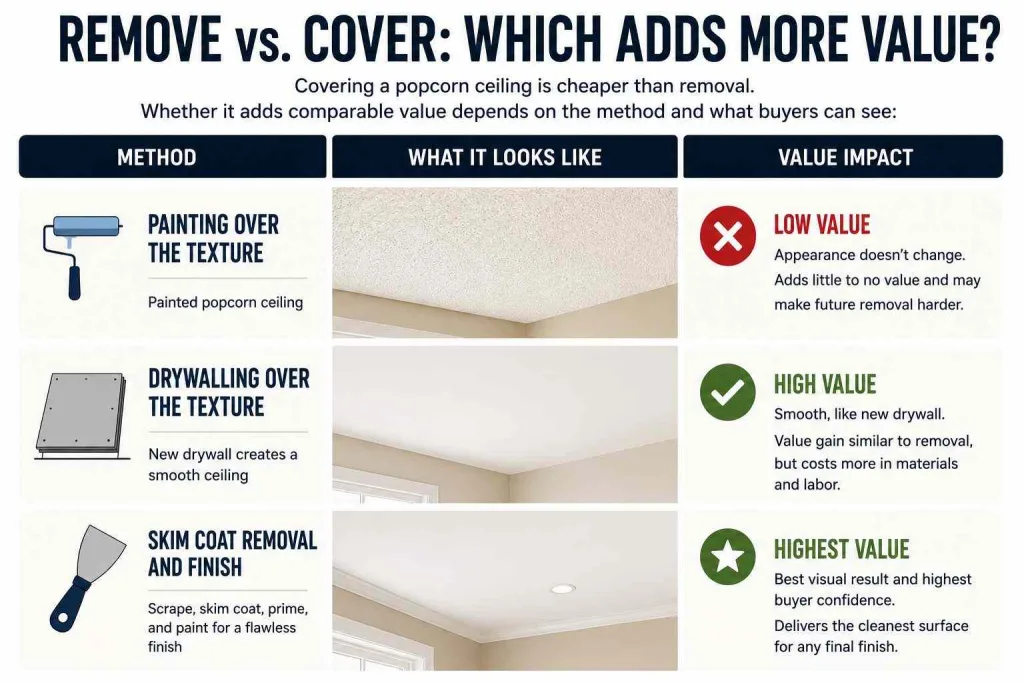
Painting over the texture
Painting does not change the ceiling’s appearance significantly and does not add meaningful value. A buyer looking at a painted popcorn ceiling sees the same thing as an unpainted one. If the texture is from a pre-1980 home, painting may also make future removal harder by sealing the material — increasing the cost and effort of the next owner’s problem.
Drywalling over the texture
Installing new drywall over existing popcorn ceiling — quarter-inch or half-inch panels screwed into the existing surface — creates a smooth ceiling appearance without removal. This is a legitimate approach when the ceiling is heavily painted, heavily damaged, or when removal would be extremely expensive.
The value gain is similar to removal from a buyer’s perspective since the result looks the same. However, it costs more in materials and labor than a standard scrape-and-skim on an unpainted ceiling.
Skim coat removal and finish (the recommended path)
Scraping unpainted popcorn texture, skim coating the drywall underneath to a smooth finish, priming, and painting delivers the best visual result and the highest buyer confidence. Buyers cannot tell the difference between a skim-coated ceiling and new drywall, and this approach gives you the cleanest surface for any final finish. CeilingPrime uses this method as the standard on Austin jobs.
Austin-Specific Market Context
Austin’s real estate market has specific characteristics that affect the popcorn ceiling ROI calculation:
Home age concentration
A large share of Austin’s housing stock — particularly in Hyde Park, Allandale, Crestview, North Loop, and South Austin’s 78704 and 78745 zip codes — was built in the 1950s through 1970s. These homes have the highest asbestos risk and the most buyer-visible popcorn ceiling issues.
Buyer demographics
Austin’s buyer pool skews younger than many comparable markets. Younger buyers place a high premium on move-in ready condition and are less willing to take on renovation projects. A popcorn ceiling in a listing targeted at this demographic creates a larger discount than it would in a market with older, more renovation-tolerant buyers.
Competitive listings
When inventory is tight, buyers compare properties closely. A smooth ceiling is now the baseline expectation in updated Austin homes. A popcorn ceiling in a listing that is otherwise competitive will cost you offers — not necessarily because buyers won’t buy, but because they will negotiate.
Real estate disclosure requirements
Texas requires disclosure of known material defects. A confirmed asbestos popcorn ceiling that has not been abated is a material defect under Texas Property Code. Disclosure invites negotiation. Pre-sale removal eliminates the disclosure obligation.
What Removing a Popcorn Ceiling Costs in Austin?
CeilingPrime’s pricing for popcorn ceiling removal in Austin starts at $2.30 per square foot on the low end and runs to $4.05 per square foot depending on ceiling height, texture thickness, paint presence, and whether asbestos testing and abatement are required.
- Standard removal + skim coat + primer: $2.30–$3.50 per sq ft
- Painted or heavily textured ceilings: $3.00–$4.05 per sq ft
- Asbestos abatement (if confirmed): additional cost for containment, licensed disposal, and clearance testing
- Average Austin job: approximately $2,545 for a typical single-story home
These costs do not include the painting step, which is separate and typically $0.50–$1.50 per square foot for a smooth ceiling after prep. The total investment for most Austin homes runs $3,000–$8,000 for removal, finishing, and paint — against a value gain that frequently exceeds that figure in active market conditions.
Frequently Asked Questions
Q. Does removing popcorn ceiling increase home value in every case?
Not in every case — but in most Austin homes built before 1990, yes. The exception is a home where the ceiling is only a minor issue compared to other deferred maintenance. In that case, prioritize the repairs that create the largest buyer objection first. A real estate professional familiar with your neighborhood is the right person to confirm the priority order.
How much value does removing a popcorn ceiling add in Austin?
Most Austin homeowners see 50–80% of the removal cost returned in increased sale price or reduced buyer negotiation. On a $5,000 removal job, that is $2,500–$4,000 in recovered value — plus the elimination of the negotiating discount buyers apply when they see a popcorn ceiling and start thinking about asbestos.
Q. Does a popcorn ceiling affect a home appraisal?
Directly, appraisers do not apply a fixed penalty for popcorn ceilings. Indirectly, appraisers compare your home to comparable sales. If comparable homes nearby have smooth ceilings and yours does not, the appraiser will note the condition difference when selecting comps. The practical effect is that your home may be compared to less-updated properties — which pulls the appraised value down.
Q. Should I remove a popcorn ceiling before listing or after?
Before listing, in most cases. Buyers who see a smooth ceiling never have to think about asbestos, removal costs, or construction disruption. Buyers who see a popcorn ceiling in a pre-1980 home have all three thoughts immediately. Removing before listing presents the home at its best and prevents the ceiling from becoming a negotiating chip.
Q. Does a DIY popcorn ceiling removal add the same value as professional removal?
DIY removal can produce acceptable results on small areas with no asbestos present, but it rarely achieves the same finish quality as a professional skim coat. Buyers and their agents can usually identify a rough or uneven ceiling surface, which undercuts the value gain.
For a pre-1980 home, DIY removal also carries the legal and health risks of uncontrolled asbestos exposure. Professional removal is the right call when the home is being prepared for sale.