Lights Flickering in House: 10 Causes, Fixes, and When to Call an Electrician
Flickering lights in a house range from a 10-second fix (tighten a loose bulb) to an emergency that requires a licensed electrician immediately (loose wiring causing arcing inside your walls). The challenge is knowing which situation you’re dealing with — because the flicker itself looks the same whether the cause is a $2 light bulb or a $2,000 panel replacement.
The most common causes of lights flickering in house are loose bulbs, faulty light switches, incompatible dimmer switches, overloaded circuits, loose wiring connections, a failing circuit breaker, voltage fluctuations, a loose or failing service neutral, problems with the utility company’s supply, and outdated electrical panels.
Some causes are safe to fix yourself (tightening a bulb, replacing a switch). Others — particularly loose wiring, panel issues, and service neutral problems — are fire hazards that require a licensed electrician immediately. This guide covers all 10 causes with the fix for each, a clear breakdown of what’s safe to DIY versus what requires a professional, and the warning signs that mean you should stop what you’re doing and call an electrician right now.
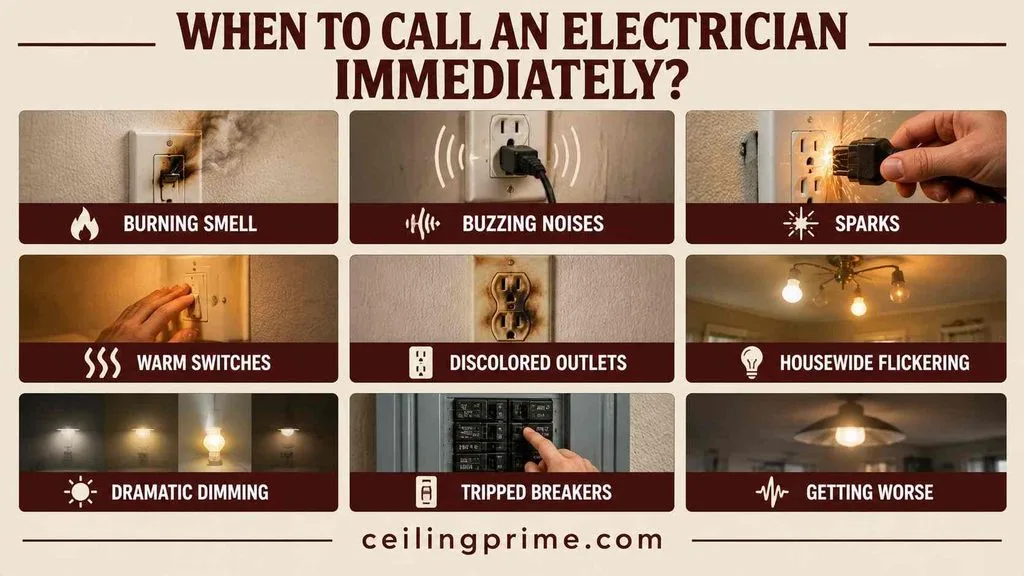
When to Call an Electrician Immediately?
Before reading anything else, know these warning signs. If any of the following accompany your flickering lights, stop using the affected area and call a licensed electrician:
- Burning smell near a switch, outlet, fixture, or electrical panel
- Buzzing or crackling sounds from switches, outlets, or the panel
- Sparks when plugging in or unplugging devices
- Warm or hot switches, outlets, or cover plates
- Discolored or melted outlets or switch plates
- Lights flickering throughout the entire house (not just 1 room)
- Lights that brighten and dim dramatically (some too bright, others too dim)
- Breakers that trip repeatedly or feel warm to the touch
- Flickering that gets progressively worse over days or weeks
These symptoms can indicate loose wiring, arcing, or a failing neutral — all of which are fire hazards. Electrical fires cause an estimated 46,700 home fires per year in the United States (NFPA data). Do not attempt to diagnose or repair these issues yourself.
10 Causes of Lights Flickering in a House
1. Loose Light Bulb
The most common and least dangerous cause of flickering lights — the bulb isn’t fully screwed into the socket, creating an intermittent connection.
- What you see: A single light flickers, usually consistently
- Risk level: Low
- DIY fix: Turn off the light. Let the bulb cool. Screw it in firmly (don’t over-tighten). If the flicker stops, the problem is solved.
- When to call a pro: If the bulb is tight and still flickers, the issue is in the socket, wiring, or fixture — not the bulb.
2. Bulb Type Mismatch (LED and CFL Issues)
Some LED and CFL bulbs flicker because they’re incompatible with the fixture, the dimmer switch, or the electrical circuit they’re on.
- What you see: LED or CFL bulbs flicker, buzz, or strobe — especially when dimmed
- Risk level: Low
- DIY fix: Replace the bulb with a different brand or type. If using a dimmer, ensure the bulb is labeled “dimmable” AND the dimmer switch is rated for LED/CFL (older dimmers designed for incandescent bulbs cause flickering with LEDs). Replace the dimmer with an LED-compatible dimmer switch if needed.
- Cost: $3 to $8 for a bulb, $15 to $30 for a new dimmer switch
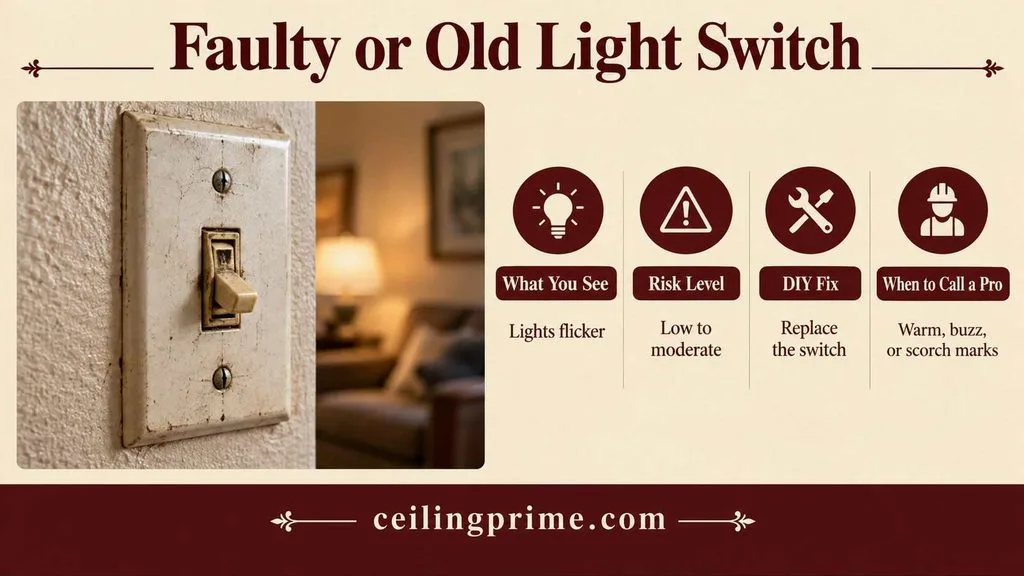
3. Faulty or Old Light Switch
A worn-out light switch can cause intermittent contact — the internal mechanism wears down over time, creating an inconsistent connection that makes the light flicker.
- What you see: Lights flicker when you touch or toggle the switch, or flicker randomly on a circuit controlled by an older switch
- Risk level: Low to moderate
- DIY fix (if experienced): Replace the switch. Turn off the breaker first. If you’re not comfortable working with wiring, call an electrician — a switch replacement costs $50 to $150 from a professional.
- When to call a pro: If the switch is warm, buzzes, or has scorch marks — these indicate arcing, which is a fire hazard.
4. Incompatible Dimmer Switch
Older dimmer switches (designed for incandescent bulbs) are incompatible with modern LED and CFL bulbs — the mismatch causes flickering, buzzing, and strobing, especially at low dim levels.
- What you see: Lights flicker or strobe when dimmed, especially at the lowest settings
- Risk level: Low (annoying, not dangerous)
- DIY fix: Replace the old dimmer with an LED-compatible dimmer switch (Lutron, Leviton, and other major brands make them). Cost: $15 to $40. Installation requires basic wiring knowledge.
- When to call a pro: If you’re not comfortable working with electrical wiring, a professional dimmer switch replacement costs $75 to $150.
5. Overloaded Circuit
When too many appliances and devices draw power from the same circuit, the electrical load exceeds the circuit’s capacity — causing lights to dim or flicker, especially when high-draw appliances (air conditioners, space heaters, hair dryers, microwaves) kick on.
- What you see: Lights dim briefly when a large appliance turns on (AC compressor, washing machine, microwave), then return to normal
- Risk level: Moderate — brief dimming when an appliance starts is normal (the motor draws extra current during startup). Persistent dimming or flickering indicates the circuit is overloaded.
- DIY fix: Redistribute appliances across different circuits. Don’t run multiple high-draw appliances on the same circuit simultaneously. If the problem persists, the circuit may need to be upgraded.
- When to call a pro: If flickering happens frequently with normal appliance use, an electrician can assess whether the circuit needs a dedicated line for high-draw appliances or whether the panel needs upgrading.
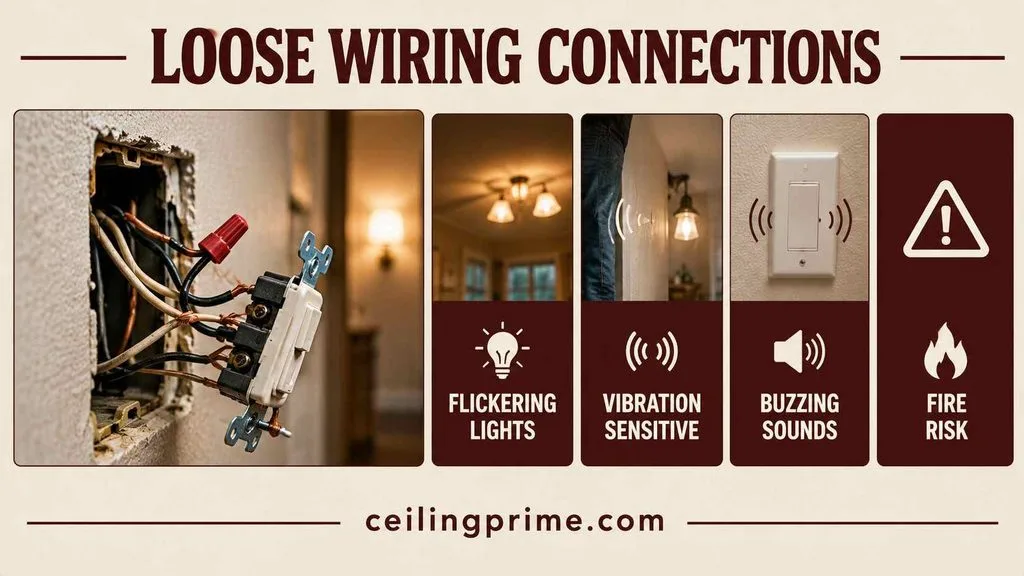
6. Loose Wiring Connections
Loose wiring is one of the most dangerous causes of lights flickering in a house. Over time, wire connections can loosen due to age, heat, vibration, or poor original installation — creating intermittent contact that causes flickering and, more critically, arcing.
- What you see: Lights flicker randomly or when you walk near a wall (vibration loosens the connection). Flickering may affect multiple lights on the same circuit. You may hear a buzzing or crackling sound.
- Risk level: HIGH — arcing from loose connections is a leading cause of electrical fires
- Fix: Call a licensed electrician immediately. Do NOT attempt to open junction boxes, outlets, or fixtures to tighten wiring yourself unless you are a qualified electrician.
- Cost: $150 to $400 for a professional diagnosis and repair.
7. Failing Circuit Breaker
Circuit breakers have a finite lifespan (25 to 30 years). Internal contacts wear out, springs weaken, and the breaker loses its ability to maintain a solid connection with the bus bar — creating intermittent contact that causes flickering.
- What you see: Lights on one circuit flicker or dim repeatedly. The breaker may trip occasionally or feel warm to the touch. Flickering worsens over time.
- Risk level: High — a failing breaker that doesn’t trip when it should is a fire and electrocution hazard
- Fix: A licensed electrician replaces the failing breaker and inspects the bus bar for damage. Cost: $150 to $300 per breaker replacement.
- When to call a pro: Immediately if a breaker is warm to the touch, trips repeatedly, or won’t stay in the ON position.
8. Voltage Fluctuations
Normal household voltage in the United States is 120 volts (with an acceptable range of 114 to 126 volts). If voltage rises or drops outside this range, lights may flicker, dim, or brighten unexpectedly.
- What you see: Lights flicker, dim, or brighten unpredictably. Light bulbs burn out faster than expected. Electronics behave erratically.
- Risk level: Moderate to high — sustained voltage outside the normal range can damage appliances and electronics
- Fix: An electrician can measure voltage with a multimeter. If voltage is consistently outside 114 to 126 volts, the problem may be in your home’s wiring, your panel, or the utility company’s supply.
- When to call a pro: If you notice bulbs burning out frequently (every few months) or electronics behaving erratically alongside flickering lights.
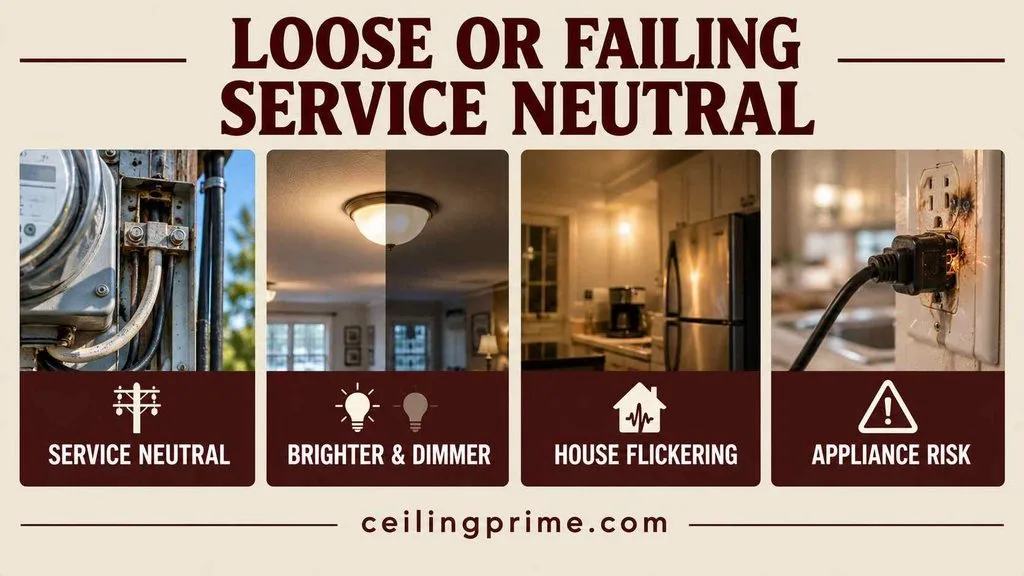
9. Loose or Failing Service Neutral
The service neutral wire connects your home’s electrical system to the utility grid’s neutral conductor. If this connection loosens or fails, it creates voltage imbalance between the 2 120-volt legs of your home’s electrical system — causing some lights to brighten dangerously while others dim.
- What you see: Some lights in the house are brighter than normal while others are dimmer. Lights flicker throughout the house. Appliances may behave erratically or be damaged.
- Risk level: CRITICAL — a loose neutral can send 180+ volts through circuits designed for 120 volts, destroying appliances and creating extreme fire risk
- Fix: Call your utility company AND a licensed electrician immediately. This is an emergency.
- Cost: Utility-side repairs are typically the utility company’s responsibility. Home-side neutral repairs cost $200 to $500+.
10. Utility Company Supply Issues
Sometimes the problem isn’t in your house — it’s in the utility company’s infrastructure. Damaged transformers, weather-related outages, grid overload, and maintenance work can all cause lights to flicker.
- What you see: Lights flicker across the entire house. Neighbors may report the same issue. Flickering may coincide with storms, high winds, or extreme temperatures.
- Risk level: Low (for the homeowner) — the utility company is responsible for their infrastructure
- Fix: Call your utility company to report the issue. If the problem is on their side (transformer, supply line, grid), they’ll dispatch a crew.
- How to check: Ask your neighbors if they’re experiencing the same flickering. If they are, the problem is likely utility-side, not house-side.
Lights Flickering in House: Quick Diagnosis Table
| Symptom | Likely Cause | Risk Level | Action |
| 1 bulb flickers | Loose bulb or bad bulb | Low | Tighten or replace bulb |
| LED flickers on dimmer | Incompatible dimmer switch | Low | Replace with LED-compatible dimmer |
| Flickers when switch is toggled | Faulty switch | Low-Moderate | Replace switch (DIY or electrician) |
| Dims when AC or appliance kicks on | Overloaded circuit | Moderate | Redistribute loads; may need dedicated circuit |
| Random flickering on 1 circuit | Loose wiring or failing breaker | High | Call electrician |
| Flickering + buzzing or crackling | Arcing from loose connection | CRITICAL | Call electrician immediately |
| Flickering throughout entire house | Utility issue or loose neutral | CRITICAL | Call utility company + electrician |
| Some lights too bright, others too dim | Loose service neutral | CRITICAL | Emergency — call utility + electrician |
| Flickering + burning smell | Overheating wiring | CRITICAL | Turn off breaker, call electrician |
DIY vs Professional: What’s Safe to Fix Yourself?
| Task | DIY Safe? | Notes |
| Tighten a loose bulb | Yes | Turn off first, let cool |
| Replace a light bulb | Yes | Match wattage and bulb type to fixture rating |
| Replace a dimmer switch | Yes (if experienced) | Turn off breaker first. Must match dimmer to bulb type. |
| Replace a light switch | Yes (if experienced) | Turn off breaker, verify with voltage tester before touching wires |
| Redistribute appliances across circuits | Yes | Plug high-draw appliances into different outlets on different circuits |
| Inspect or repair wiring | NO | Fire and electrocution risk. Licensed electrician only. |
| Replace a circuit breaker | NO | Panel work requires a licensed electrician |
| Diagnose voltage fluctuations | NO | Requires professional equipment and expertise |
| Repair service neutral | NO | Emergency — utility company + licensed electrician |
| Inspect or upgrade electrical panel | NO | Licensed electrician only |
How Much Do Electrical Repairs Cost?
| Repair | Estimated Cost |
| Electrician diagnostic visit | $75–$150 |
| Switch or outlet replacement | $50–$150 |
| Dimmer switch replacement | $75–$150 |
| Circuit breaker replacement | $150–$300 |
| Dedicated circuit installation | $200–$500 |
| Wiring repair (per connection) | $150–$400 |
| Electrical panel upgrade (100A to 200A) | $1,500–$3,000 |
| Full house rewiring (older home) | $8,000–$15,000+ |
Final Thoughts
Lights flickering in a house always have a cause — and the cause matters more than the flicker itself. A loose bulb is a 10-second fix. An incompatible dimmer switch is a $30 replacement. But loose wiring causing arcing inside your walls, a failing breaker that won’t trip, or a loose service neutral sending 180 volts through a 120-volt circuit — those are emergencies that cause house fires.
The diagnostic table in this guide maps every symptom to its likely cause, risk level, and recommended action. For anything beyond tightening a bulb, replacing a switch, or swapping a dimmer — call a licensed electrician. The cost of a diagnostic visit ($75 to $150) is the cheapest insurance you’ll ever buy against an electrical fire.
Pay attention to what accompanies the flicker. If it’s just a light that needs tightening — tighten it. If it comes with buzzing, crackling, burning smell, warm switches, or affects the whole house — stop reading this article and pick up your phone. Some problems get better when you wait. Electrical problems get worse.
Lights Flickering in House: Frequently Asked Questions
Are flickering lights dangerous?
It depends on the cause. A loose bulb is not dangerous. Loose wiring, a failing breaker, or a loose service neutral are fire hazards and potentially life-threatening. If flickering affects multiple rooms, is accompanied by buzzing/burning/sparks, or gets progressively worse — call an electrician immediately.
Why do my lights flicker when I turn on an appliance?
Brief dimming when a high-draw appliance (AC, washing machine, microwave, hair dryer) starts is normal — the motor draws extra current during startup. If the dimming is severe, lasts more than a second, or happens with normal-draw devices, the circuit may be overloaded or the wiring may need professional inspection.
Why are my lights flickering in the whole house?
Whole-house flickering typically indicates a problem at the electrical panel, the service entrance, or the utility company’s supply — not a single fixture or circuit. A loose service neutral is the most dangerous cause. Call your utility company to check their side, and call a licensed electrician to inspect your panel and service entrance.
Can flickering lights cause a fire?
Yes — if the flickering is caused by loose wiring, arcing, or a failing breaker. Arcing (electrical current jumping across a gap in a loose connection) generates extreme heat and is a leading cause of electrical fires. If you hear crackling, smell burning, or see sparks — turn off the breaker and call an electrician.
Should I worry about lights flickering during a storm?
Brief flickering during storms is usually caused by wind affecting power lines and is temporary. If flickering continues after the storm, or if you notice damage (fallen trees near power lines, a damaged service mast on your house), call your utility company. Do not approach downed power lines.
How do I know if my electrical panel needs replacing?
Signs your panel may need upgrading include lights flickering frequently, breakers that trip often, a panel that’s warm to the touch, a panel older than 30 years, a fuse box (instead of breakers), rust or corrosion on the panel, or a panel rated below 200 amps for a modern home. An electrician can assess whether a panel upgrade ($1,500 to $3,000) is needed.






2 Comments