Ceiling Fan for Low Ceiling: How to Choose the Right One
Choosing a ceiling fan for low ceiling rooms means working within a tight vertical space. The fan blades must sit at least 7 feet above the floor for safety and performance. On an 8-foot ceiling, that leaves only 12 inches for the fan housing, motor, and blades combined. A standard downrod fan hangs 12 to 18 inches below the ceiling. That drops the blades to 6 to 6.5 feet. Too low. Dangerous.
Low-profile fans solve this. They mount flush against the ceiling with no downrod. The motor housing sits directly on the mounting bracket. The blades hang 8 to 11 inches below the ceiling surface. On an 8-foot ceiling, the blades sit at 7 feet 1 inch to 7 feet 4 inches above the floor. Safe. Functional. Code-compliant. This guide covers everything you need to know: the height rules, mount types, blade spans, light options, and room-by-room picks.
The 7-Foot Rule: Why Height Matters
Building codes and safety standards require fan blades to sit at least 7 feet above the finished floor. This keeps heads, hands, and tall furniture clear of the spinning blades. Here is how ceiling height determines your fan options.
| Ceiling Height | Mount Type | Fan Profile | Blade Height Above Floor |
| 7 ft 6 in or less | Flush mount (hugger) | Under 9 inches total | ~6 ft 10 in — barely clears |
| 8 ft | Flush mount (hugger) | 8–11 inches total | 7 ft 1 in – 7 ft 4 in — ideal |
| 8 ft 6 in | Flush or short downrod (3–4 in) | 11–15 inches total | 7 ft 3 in – 7 ft 5 in |
| 9 ft | Standard downrod (4–6 in) | Any | 7 ft 6 in – 8 ft |
| 10 ft+ | Extended downrod (12–36 in) | Any | 7 ft 6 in – 8 ft 6 in |
A ceiling fan for low ceiling rooms must be flush mount (hugger style) on 8-foot ceilings. On 7.5-foot ceilings, only ultra-low-profile models (under 9 inches total) work safely. Below 7.5 feet, a ceiling fan is not recommended.
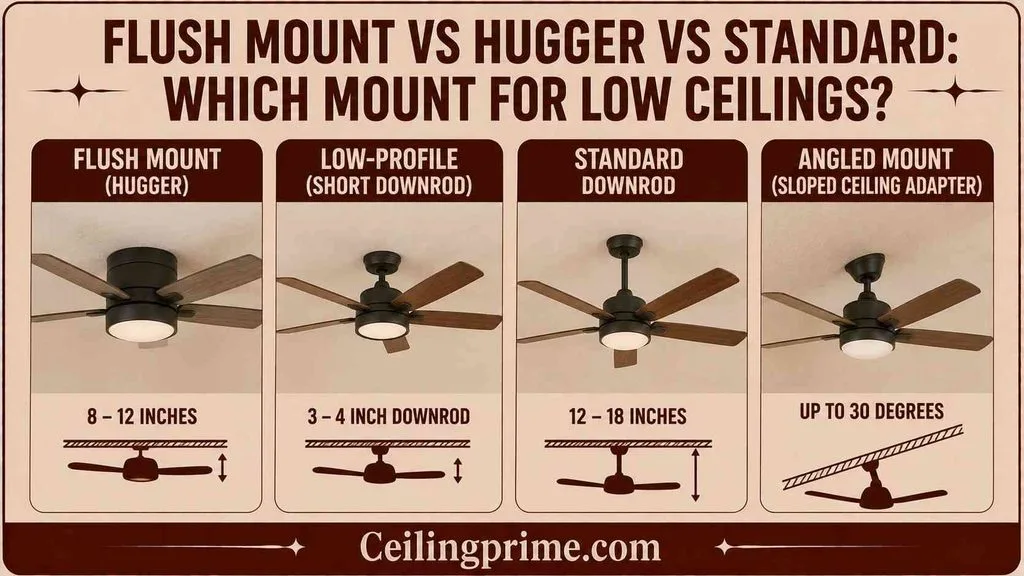
Flush Mount vs Hugger vs Standard: Which Mount for Low Ceilings?
- Flush mount (hugger): The motor housing bolts directly to the ceiling bracket with no downrod. Total profile: 8 to 12 inches from the ceiling to the lowest point of the blades. This is the standard low-profile fan installation. The blades sit as close to the ceiling as physically possible.
- Low-profile with short downrod: Some fans use a 3-to-4-inch downrod to drop the motor slightly below the ceiling surface. This provides better airflow than a hugger because the blades have more clearance above them. Works on 8.5-foot ceilings where a hugger would be too tight against the drywall.
- Standard downrod: Uses a 4-to-6-inch downrod. Total hang: 12 to 18 inches below the ceiling. Only works on 9-foot or taller ceilings. Does not work on low ceilings. The blades hang below the 7-foot safety line.
- Angled mount (sloped ceiling adapter): Allows fans to mount on sloped or vaulted ceilings up to 30 degrees. Not needed for flat low ceilings. Mentioned here because some low rooms have angled sections where a standard mount does not sit flat.
Blade Span by Room Size
| Room Size (sq ft) | Blade Span | Example Rooms |
| Under 75 | 29–36 inches | Closets, small bathrooms, laundry |
| 75–144 | 36–42 inches | Bedrooms, home offices |
| 144–225 | 44–50 inches | Master bedrooms, living rooms |
| 225–400 | 50–56 inches | Large living rooms, open kitchens |
| 400+ | 56–72 inches | Great rooms, open-concept spaces |
Blade span is measured from the tip of one blade to the tip of the opposite blade. Too small and the fan does not move enough air. Too large and the airflow feels like a wind tunnel in a small room. Low-profile rooms follow the same span rules as any other fan. Low profile does not mean small blades.
Ceiling Fan for Low Ceiling with Lighting
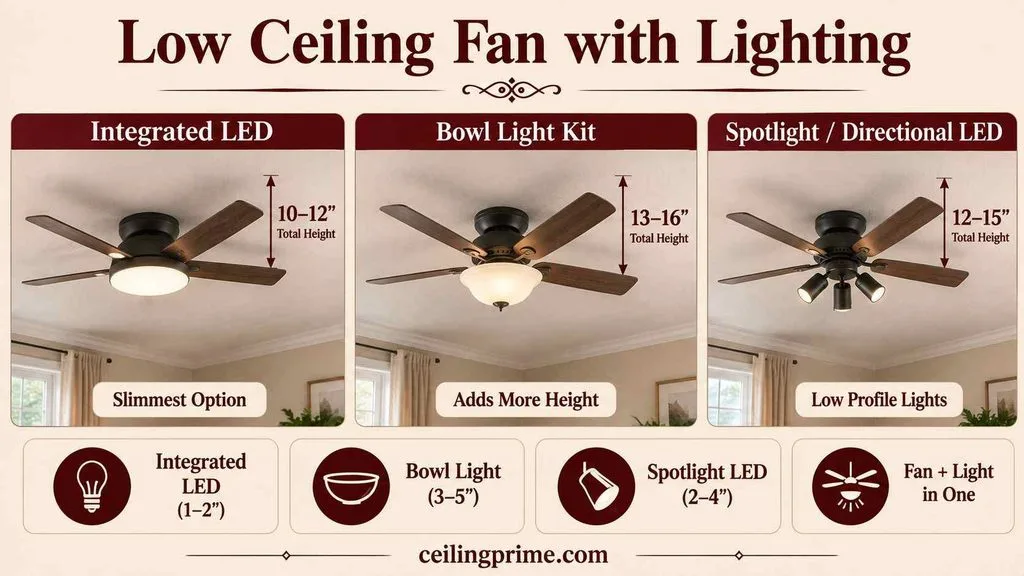
Many low-profile fans include an integrated LED light kit. The light sits inside the motor housing or in a slim disc below it. This adds 1 to 3 inches to the total profile. On an 8-foot ceiling, a fan with light hangs 10 to 14 inches below the surface. The blades sit at about 7 feet. That is still safe.
- Integrated LED: The light is built into the fan housing. No separate attachment. The slimmest option. Adds 1 to 2 inches. Best for low ceilings.
- Bowl light kit: A glass or frosted bowl clips to the bottom of the fan. Adds 3 to 5 inches. May push the blades below 7 feet on 8-foot ceilings. Measure before buying.
- Spotlight or directional LED: 2 to 4 small spotlights aimed outward from the motor housing. Adds minimal height. Good for task lighting in kitchens.
A fan with integrated lighting replaces the overhead light fixture entirely. One device handles both air circulation and room lighting. This eliminates the need for a separate ceiling light that would compete for the same vertical space.
Ceiling Fan for Low Ceiling No Light
Fans without a light kit are 1 to 3 inches shorter in total profile. Choose a no-light model when: the room already has wall sconces, floor lamps, or recessed can lights that provide adequate illumination. Or when you want the slimmest possible profile on a 7.5-to-8-foot ceiling. A no-light fan on an 8-foot ceiling hangs 8 to 10 inches below the surface. Blades sit at 7 feet 2 inches to 7 feet 4 inches.
Ceiling Fan for Low Ceiling Bedroom
Bedrooms need quiet operation above all else. Motor noise that is unnoticeable in a living room becomes a sleep disruptor in a bedroom. Here is what to look for in a bedroom low-profile fan installation.
- DC motor: DC motors run 50 to 70% quieter than AC motors. They use less energy. They cost $30 to $80 more. The silence is worth it for a bedroom fan.
- Blade span: 42 to 52 inches for standard bedrooms (120–200 sq ft). 36 to 42 inches for small bedrooms or guest rooms under 120 sq ft.
- Remote control: A remote lets you adjust speed and light without getting out of bed. Wall switches require walking to the door in the dark.
- Reversible motor: Run counterclockwise in summer for a cooling breeze. Run clockwise in winter to push warm air down from the ceiling without a direct draft on the bed.
- Warm-tone LED: Choose a fan with a 2700K to 3000K color temperature light. Cool white (4000K+) disrupts melatonin and sleep quality.
Ceiling Fan for Low Ceiling Living Room
Living rooms demand stronger airflow than bedrooms. They are typically larger. They hold more people. They produce more heat from electronics, sunlight, and activity.
- Blade span: 50 to 56 inches for 200–400 sq ft rooms. Larger living rooms may need two fans or a single 60-inch model.
- CFM rating: Look for 4,000 to 6,000+ CFM (cubic feet per minute). Higher CFM means more air moved per minute. Low-profile fans with angled blades achieve higher CFM than flat-blade hugger models.
- Style: Living rooms are the most visible room in the house. Choose a fan that matches the decor: matte black for modern, brushed nickel for transitional, wood tone for farmhouse. Low profile does not mean basic — flush mount fans come in every design style.
- Dimmable LED: Living rooms need adjustable light. A dimmable integrated LED lets you shift from bright task lighting to soft ambient lighting for movie nights.
A low-profile living room fan replaces both the overhead fixture and a portable floor fan. It saves floor space and looks cleaner than a pedestal fan in the corner.

Ceiling Fan for Low Ceiling Small Room
Small rooms under 100 square feet — home offices, nurseries, walk-in closets, laundry rooms — need a compact fan with a tight blade span.
- Blade span: 29 to 36 inches. Anything larger overpowers a small room with too much airflow.
- 3-blade design: Three blades create less visual bulk overhead. A 3-blade 30-inch fan looks proportional in a 75 sq ft room. A 5-blade 52-inch fan overwhelms it.
- Wet or damp rated (for bathrooms and laundry): Small bathrooms and laundry rooms have moisture. Choose a damp-rated fan. Standard dry-rated fans corrode in humidity.
- Reversible operation: Essential in small rooms. In summer the fan cools. In winter it recirculates warm air that pools at the ceiling. In a small room with low ceilings, warm air pools just above your head. Reversing the fan pushes it back down.
A small-room flush mount fan works best with an integrated LED. The LED eliminates the need for a separate light fixture in a room where every inch of ceiling space matters.
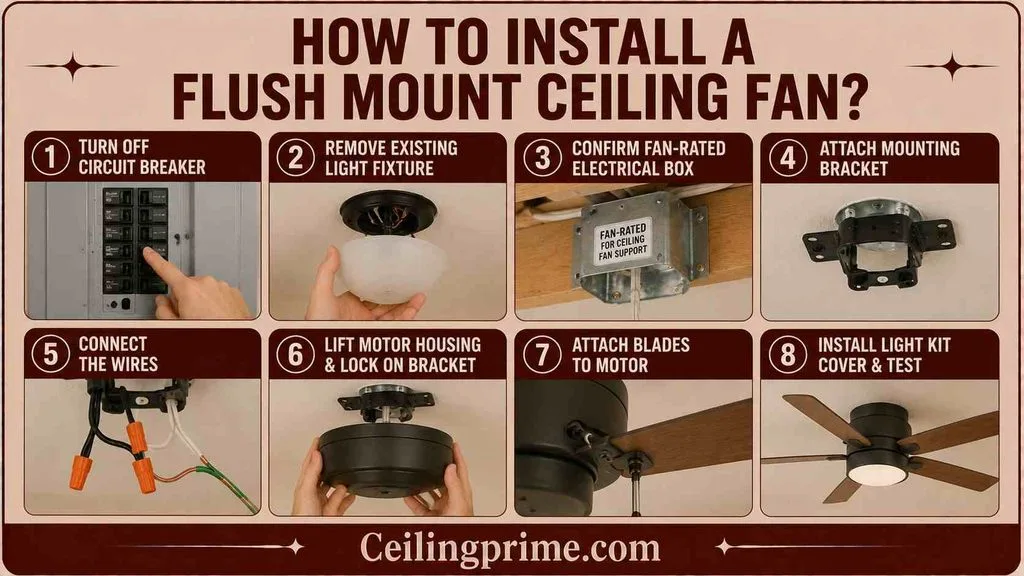
How to Install a Flush Mount Ceiling Fan?
- Step 1: Turn off the circuit breaker for the room.
- Step 2: Remove the existing light fixture. Disconnect the wires. Leave the electrical box in place.
- Step 3: Confirm the electrical box is fan-rated. Ceiling fans weigh 15 to 50 pounds. Standard light fixture boxes support 50 pounds maximum. If the box is not fan-rated, replace it with a fan-rated brace box that clamps between joists.
- Step 4: Attach the fan mounting bracket to the electrical box.
- Step 5: Connect the wires. Black to black (hot). White to white (neutral). Green or bare copper to green (ground). If the fan has a light kit, connect the blue wire to the black hot wire.
- Step 6: Lift the motor housing and lock it onto the mounting bracket. Hugger fans have no downrod — the housing connects directly.
- Step 7: Attach the blades to the motor using the included screws. Tighten each blade bracket evenly.
- Step 8: Install the light kit cover or no-light cap. Turn on the breaker. Test all speeds and the light.
A flush mount fan installs in 30 to 60 minutes. The hardest part is lifting the motor housing overhead. A helper makes this easier.
Ceiling Fan Costs for Low Ceiling Rooms
| Item | Cost |
| Budget flush mount fan (AC motor, no light) | $40–$80 |
| Mid-range flush mount fan (LED light, remote) | $80–$200 |
| Premium flush mount fan (DC motor, LED, smart control) | $200–$500 |
| Fan-rated electrical box (if replacement needed) | $15–$30 |
| DIY installation (materials only) | $0 (comes with hardware) |
| Professional installation (electrician) | $100–$250 |
The Right Fan for Every Low Ceiling Room
A ceiling fan for low ceiling rooms must be flush mount, sit within the 7-foot safety line, and match the room size in blade span. Choose a DC motor for bedrooms. Choose high CFM for living rooms. Choose 29 to 36 inch blades for small rooms. Add integrated LED when the fan replaces the room light. And always confirm the electrical box is fan-rated before you start.
Frequently Asked Questions
Can I install a ceiling fan on a 7-foot ceiling?
Only ultra-low-profile hugger models with a total profile under 9 inches. The blades will sit around 6 feet 10 inches above the floor. This barely meets the 7-foot recommendation. Taller household members may feel uncomfortable. On ceilings below 7.5 feet, consider a wall-mounted fan instead.
Do flush mount fans work as well as downrod fans?
They move less air per watt because the blades sit closer to the ceiling. Air cannot flow freely above the blades. Fans with angled or curved blades compensate for this by directing more air downward. Choose a flush mount fan with a high CFM rating for comparable performance.
What is the quietest ceiling fan for a bedroom?
A DC motor fan. DC motors produce 50 to 70% less noise than AC motors. They run at more speed settings (typically 6 to 7 vs 3 for AC). The lowest speed is nearly silent.
Can I add a light to a no-light flush mount fan?
Some fans accept a light kit attachment. Check the model specifications before buying. Many flush mount fans designed without a light cannot be modified because the motor housing lacks a wiring harness for the light.
How do I measure the total hang of a ceiling fan?
Measure from the ceiling surface to the lowest point of the fan (bottom of the light kit, or bottom of the blade tips if the blades angle downward). Subtract that measurement from your ceiling height. The result must be 7 feet or more for safe operation.
Is a 3-blade or 5-blade fan better for low ceilings?
Both work equally well. Blade count does not significantly affect airflow. 3-blade fans look cleaner and less bulky in small rooms. 5-blade fans look more traditional. Choose based on aesthetics, not performance.