
How to Repair Hole in Ceiling: Every Size, Every Material
Knowing how to repair hole in ceiling surfaces saves you from paying $150 to $400 for a handyman visit. The repair method depends on three things: hole size, ceiling material, and what caused the damage. A nail hole takes spackle and 5 minutes. A foot-through-the-attic hole takes a drywall patch and a weekend.
This guide covers repairs for every situation: small holes, medium holes, large holes, drywall, plasterboard, plaster, popcorn texture, ceiling tiles, water leak damage, corner gaps, and seam separation. Each section covers only that specific repair with no repeated steps.
Choose Your Repair by Hole Size and Material
| Hole Size | Best Method | Materials | Time |
| Under 1/2 inch (nail/screw) | Spackle fill | Lightweight spackle, putty knife | 10 minutes + dry time |
| 1/2 inch to 3 inches | Self-adhesive mesh patch | Mesh patch kit, joint compound | 30 minutes + dry time |
| 3 to 6 inches | California patch (self-backing) | Drywall scrap, joint compound | 1 hour + dry time |
| 6+ inches | Cut-and-replace (joist-to-joist) | New drywall, screws, tape, compound | 2–3 hours + dry time |
Pick the right method for your hole size. Using spackle on a 6-inch hole fails within weeks. Using a full joist-to-joist repair on a nail hole wastes hours. Match the method to the size.
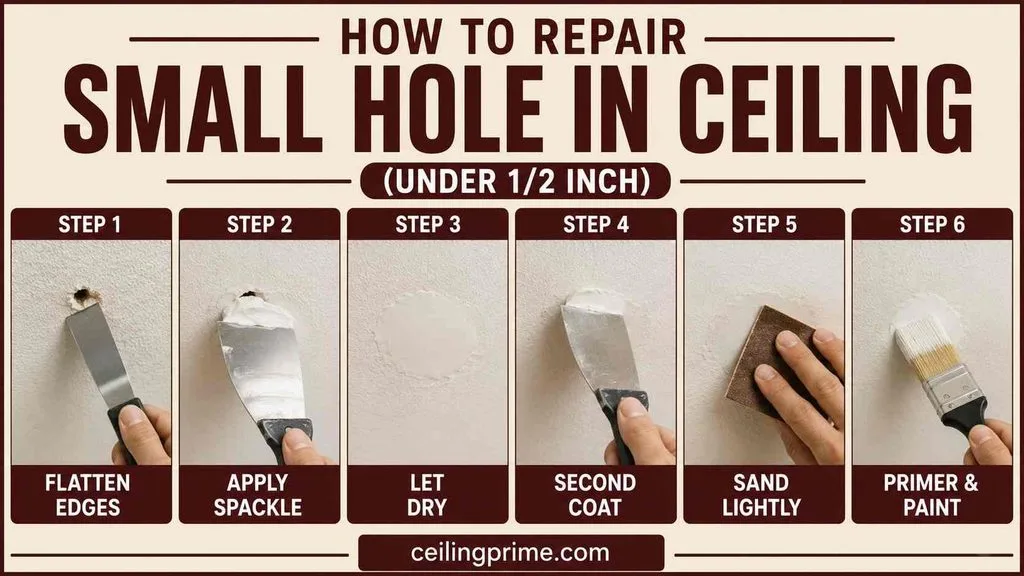
How to Repair Small Hole in Ceiling (Under 1/2 Inch)
Nail holes, screw holes, small anchor holes, and pin holes from hooks fill with spackle in minutes. This is the simplest ceiling drywall repair.
- Step 1: Press the tip of a putty knife against the hole to flatten any raised edges or paper fringe.
- Step 2: Load lightweight spackle onto a 2-inch putty knife. Press it into the hole. Smooth flat with one pass.
- Step 3: Let dry. Lightweight spackle dries in 30 to 60 minutes. It shrinks slightly as it dries.
- Step 4: Apply a second thin coat if the first coat shrank below the surface. Let dry.
- Step 5: Sand lightly with 220-grit sandpaper. Wipe dust with a damp cloth.
- Step 6: Dab primer on the patch with a small brush. Let dry. Touch up with ceiling paint.
Cost: under $10 in materials. A tub of spackle and a putty knife handle dozens of repairs.
How to Repair Hole in Ceiling Drywall (1/2 Inch to 6 Inches)
Option A: Self-Adhesive Mesh Patch (1/2 to 3 Inches)
A ceiling hole repair kit from any hardware store contains a self-adhesive mesh patch and a small tub of joint compound. The mesh sticks over the hole. Compound covers the mesh.
- Peel the backing off the mesh patch. Center it over the hole. Press firmly. The adhesive holds it in place.
- Apply joint compound over the patch with a 6-inch putty knife. Feather the edges 2 to 3 inches past the mesh.
- Let dry 2 to 4 hours. Apply a second coat. Feather wider. Let dry.
- Sand smooth with 120-grit. Prime. Paint.
Option B: California Patch (3 to 6 Inches)
The California patch uses a drywall scrap as a self-backing plug. No mesh needed. No backing board needed.
- Cut a drywall scrap 1.5 inches larger than the hole on all sides.
- Flip it face-down. Score through the back paper and gypsum core around the patch outline. Do not cut through the front paper face.
- Snap and peel the outer gypsum away. Leave the front paper flap extending past the core on all sides.
- Apply compound to the back of the paper flap. Press the gypsum plug into the hole. Smooth the flap flat against the ceiling.
- Apply 2 to 3 coats of compound over the flap. Feather 4 inches past the edges. Sand between coats. Prime. Paint.
The California patch is the best technique for repairing ceiling drywall holes between 3 and 6 inches. It creates an invisible repair under paint.
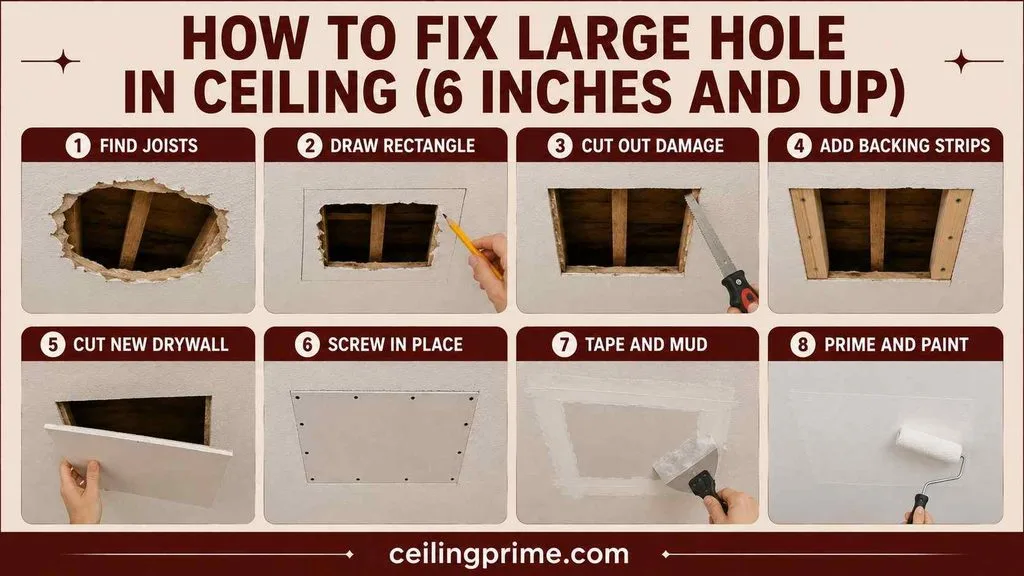
How to Fix Large Hole in Ceiling (6 Inches and Up)
Large holes from foot-through-the-attic accidents, removed light fixtures, water damage collapse, or plumbing access need a joist-to-joist drywall replacement.
- Step 1: Find the nearest ceiling joist on each side of the hole with a stud finder. Mark them.
- Step 2: Draw a rectangle around the hole. Extend each side to the center of the nearest joist. The new drywall will screw into these joists.
- Step 3: Cut along the lines with a drywall saw. Remove the damaged section.
- Step 4: If any edges do not land on a joist, install a wood backing strip (1×3 or 2×4). Screw it to the existing drywall with half extending into the opening.
- Step 5: Cut new drywall to fit the opening. Same thickness as the existing ceiling (usually 1/2 inch).
- Step 6: Screw the patch into the joists and backing strips every 8 inches.
- Step 7: Apply paper tape over all seams. Cover with 3 coats of joint compound, feathering each coat wider than the last. Sand between coats.
- Step 8: Prime and paint. Use a ceiling hole cover plate if the hole was from a removed light fixture and you want a quick, clean finish without patching.
How to Repair Hole in Ceiling Plaster?
Plaster ceilings in pre-1950s homes behave differently than drywall. The plaster is hard, brittle, and sits on wood lath strips. Here is how to fix ceiling plaster holes without replacing the entire surface.
Small Plaster Holes (Under 3 Inches)
- Clean loose plaster from the edges. Brush away dust.
- Dampen the edges with a wet sponge. Dry plaster pulls moisture from the compound too fast.
- Press joint compound into the hole. Build up in thin layers. Each layer must dry before the next.
- Sand smooth. Prime with shellac-based primer. Paint.
Large Plaster Holes (Over 3 Inches)
- Remove all loose and crumbling plaster back to solid edges.
- If the wood lath is intact, apply joint compound directly to the lath in thin layers. Build up to the surrounding surface level.
- If the lath is damaged or missing, cut a piece of drywall to fit the opening. Screw it to the lath or ceiling joists.
- Tape the seams between the drywall patch and the surrounding plaster with mesh tape. Apply 3 coats of compound. Sand. Prime. Paint.
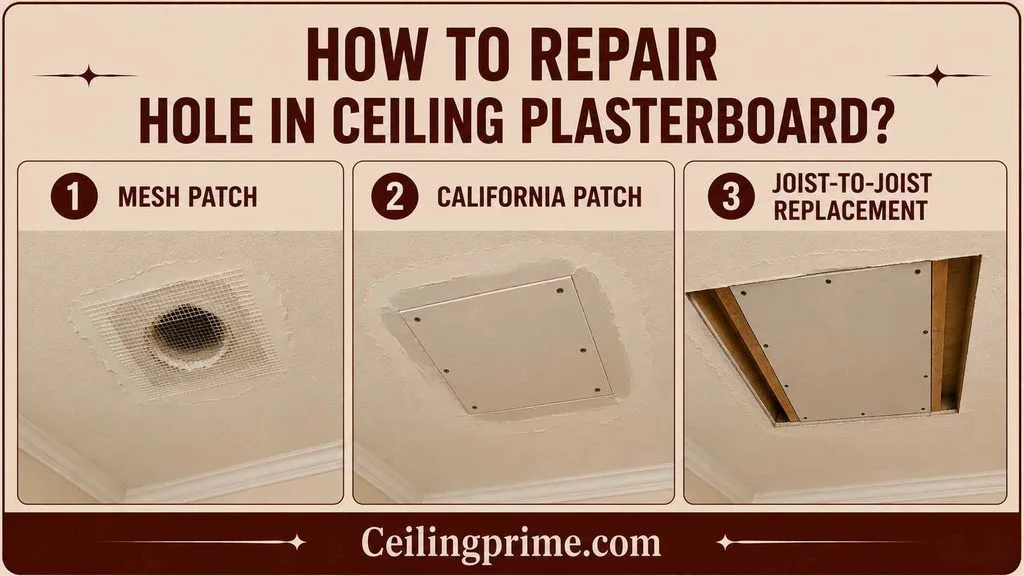
How to Repair Hole in Ceiling Plasterboard?
Plasterboard (also called gyprock or sheetrock) is the same material as drywall. The repair methods for drywall above apply directly. Use the mesh patch for small holes. Use the California patch for medium holes. Use the joist-to-joist replacement for large holes. The techniques are identical to standard drywall repair.
How to Repair Hole in Ceiling with Popcorn Texture?
Popcorn ceilings add a texture-matching step after the drywall repair. Repair the hole first using the size-appropriate method above (spackle, mesh, California patch, or joist-to-joist). Then match the texture.
- Step 1: Prime the patched area. Let dry.
- Step 2: Shake a can of aerosol popcorn texture spray. Hold 18 inches from the ceiling.
- Step 3: Spray in short bursts. Build up the texture in thin layers. Test the spray pattern on cardboard first to match the existing texture size.
- Step 4: Let dry 24 hours. The texture shrinks as it dries.
- Step 5: Paint with flat ceiling paint using a thick-nap roller. Do not roll over wet popcorn texture — it pulls off.
Test for asbestos in homes built before 1986 before cutting, sanding, or spraying any popcorn ceiling material.
How to Repair Hole in Ceiling from Water Leak?
Water damage holes need the source fixed before the ceiling repair. This applies to roof leaks, plumbing leaks, and HVAC condensation drips. Here is the process for leak-caused holes.
- Step 1: Fix the leak. Call a plumber or roofer. Turn off the water supply or tarp the roof as a temporary measure.
- Step 2: Let the ceiling dry completely. Run fans and a dehumidifier for 24 to 48 hours.
- Step 3: Check for mold. Inspect the joist cavity above the hole. Gray, green, or black spots on wood mean mold. Treat with a mold-killing solution before closing the cavity.
- Step 4: Cut the damaged drywall back to the nearest joists. Remove all soft, crumbly, or stained material.
- Step 5: Install new drywall. Screw into joists. Tape and mud the seams. Use stain-blocking primer to prevent old water marks from bleeding through the new paint.
- Step 6: Match the ceiling texture if needed. Prime and paint.
Do not patch over water-damaged drywall. Wet drywall loses its structural bond. New compound applied over weakened drywall fails within months.
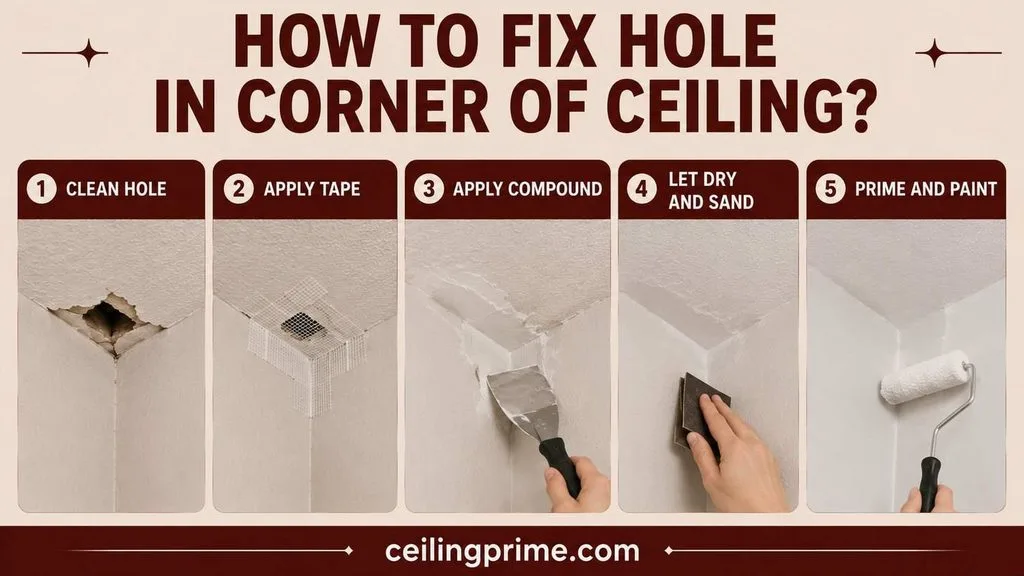
How to Fix Hole in Corner of Ceiling?
Corner holes where the ceiling meets the wall are tricky because the repair sits on two planes. The ceiling and the wall both need compound, and the corner angle must stay sharp.
- Clean the hole and remove loose material.
- Apply paper tape or mesh tape across the corner, covering the hole and extending onto both the ceiling and wall surfaces.
- Apply joint compound over the tape on both planes. Use a corner knife or run a 6-inch putty knife along each surface separately.
- Let dry. Sand lightly. Apply a second coat. Sand again.
- Prime both surfaces. Paint the ceiling and wall to match.
How to Repair Hole in Ceiling Tile?
Drop ceiling tiles (acoustical tiles) are the easiest to repair. Damaged tiles lift out of the grid track. Replacement tiles drop in.
- Push the damaged tile up and slide it sideways off the grid. Remove it.
- Measure the tile size. Standard sizes are 24×24 inches and 24×48 inches.
- Buy a matching replacement tile at any hardware store. Cut to size if needed.
- Slide the new tile into the grid. Lower it into place.
If the hole is small and you want to avoid replacing the full tile, patch it with lightweight spackle. Sand smooth. Paint to match. But spackle patches on porous ceiling tiles look visible under direct light. Full replacement produces a cleaner result.
How to Repair Ceiling Drywall Seams?
Drywall seams crack when the original paper tape loses adhesion. The seam opens into a visible line. This is not a hole, but the repair process is similar.
- Pull off the old loose tape. Scrape the seam clean with a putty knife.
- Apply a thin bed of joint compound along the seam. Press new paper tape into the wet compound. Smooth flat.
- Apply a second coat of compound over the tape. Feather 6 inches past the seam on each side.
- Let dry. Sand with 120-grit. Apply a third coat if needed.
- Prime and paint. For the best blend, paint the entire ceiling.
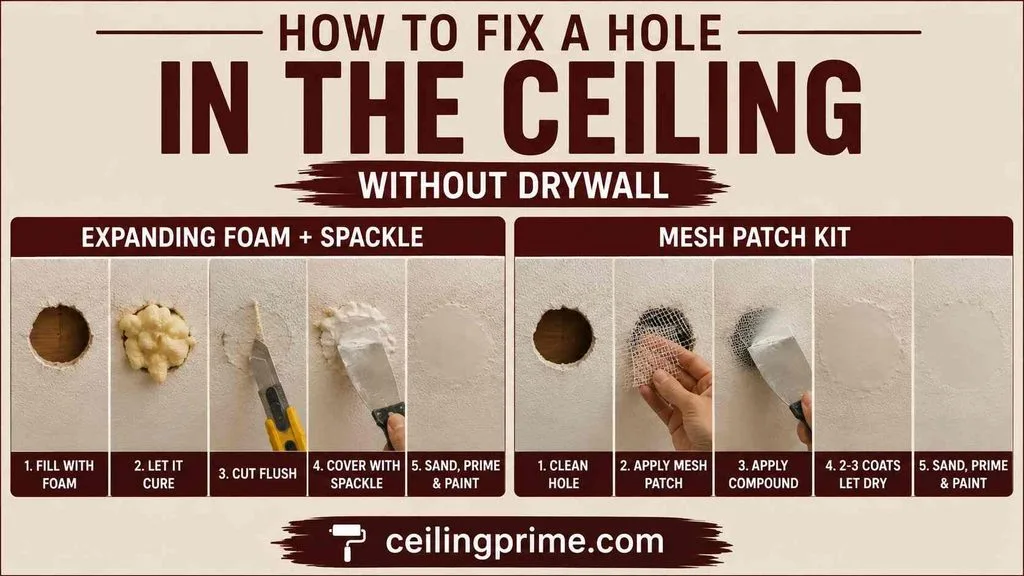
How to Fix a Hole in the Ceiling Without Drywall?
If you do not have drywall scraps or do not want to cut drywall, two alternatives work for medium holes.
- Expanding foam + spackle: Fill the hole with low-expansion spray foam. Let it cure and harden. Cut the excess flush with a utility knife. Cover the foam surface with lightweight spackle. Sand smooth. Prime and paint. This works for irregular holes up to 4 inches.
- Mesh patch kit: A self-adhesive mesh patch sticks directly over the hole. Apply joint compound over the mesh in 2 to 3 coats. No drywall cutting needed. Works for holes up to 3 inches.
Ceiling Hole Repair Costs
| Repair Type | 2026 Cost |
| DIY small hole (spackle + paint) | $5–$15 |
| DIY mesh patch kit | $8–$15 |
| DIY California patch | $10–$25 |
| DIY large hole (joist-to-joist) | $20–$60 |
| DIY popcorn texture match | $10–$20 (spray can) |
| Ceiling hole cover plate (fixture ring) | $5–$15 |
| Professional repair (any size) | $100–$400 |
Match the Method to the Hole and the Material
Now you know how to repair hole in ceiling for every situation. Spackle fills nail holes. Mesh patches cover small damage. The California patch handles medium holes without backing boards. Joist-to-joist replacement fixes large damage permanently. Plaster needs thin layers and dampened edges. Popcorn needs texture spray after the patch dries. And water damage needs the leak fixed first, always.
Frequently Asked Questions
What is the easiest way to cover a hole in the ceiling?
For removed light fixtures, a ceiling hole cover plate snaps over the electrical box and hides the hole. No patching, taping, or painting needed. For nail holes, spackle fills the hole in 5 minutes.
Can I use caulk to fill a ceiling hole?
No. Caulk does not sand flat. It stays soft and flexible. Joint compound or lightweight spackle are the correct fillers. They dry hard, sand smooth, and accept paint evenly.
Do I need to prime before painting the repair?
Yes. Joint compound and spackle absorb paint differently than the surrounding ceiling. Without primer, the patch shows as a dull spot surrounded by the sheen of the original paint. One coat of primer evens the absorption.
How do I match old popcorn texture on a patch?
Use aerosol popcorn texture spray. Hold the can 18 inches away. Spray in short bursts. Test on cardboard first to match the particle size and density of the existing texture.
Can I repair a plaster ceiling with drywall compound?
Yes for small holes. Dampen the plaster edges first. Apply joint compound in thin layers. For large holes, cut a drywall patch to fit and tape the seams. Use shellac-based primer on plaster before painting.
When should I call a professional instead of DIY?
Call a pro for holes larger than 2 square feet, holes with active water damage, holes surrounded by mold, holes in asbestos-containing popcorn texture, and holes in high or vaulted ceilings you cannot safely reach.





One Comment