Are Popcorn Ceilings Dangerous? What Austin Homeowners Must Know
If your home was built before 1980, there is a real chance your popcorn ceilings contain asbestos — and that matters whether you plan to sell, renovate, or simply live there. Are popcorn ceilings dangerous? The short answer: yes, under specific conditions. This guide explains exactly when, why, and what to do about it.
What Makes Popcorn Ceilings Potentially Dangerous?
Popcorn ceilings — also called acoustic ceilings, textured ceilings, or cottage cheese ceilings — were popular in American homes built between the 1950s and late 1980s. Manufacturers added asbestos to the texture mix because it was cheap, fire-resistant, and effective at dampening sound.
Asbestos itself is not dangerous when it stays intact. The danger begins when the material is disturbed. Scraping, sanding, drilling, or water damage can break the texture apart and release asbestos fibers into the air. Once airborne, those microscopic fibers are inhaled and can lodge permanently in lung tissue, causing serious health issues over time — including mesothelioma, lung cancer, and other lung diseases.
The Environmental Protection Agency (EPA) and the Occupational Safety and Health Administration (OSHA) both classify asbestos as a known human carcinogen. The Consumer Product Safety Commission (CPSC) banned asbestos in textured ceiling products in 1977, but contractors used existing stockpiles well into the early 1980s, so homes built after 1977 are not automatically safe.
Are All Popcorn Ceilings Dangerous?
Not every popcorn ceiling contains asbestos, but you cannot determine that visually. Two ceilings in the same house can have completely different compositions. The only way to know for certain is professional testing.
Here is a general risk framework based on home age:
| Before 1977 | High | Test before any work; professional removal likely required |
| 1977–1985 | Moderate | Test before any work; stockpile materials were still in use |
| 1986–1990 | Low | Test if renovating; unlikely but not impossible |
| After 1990 | Very Low | Modern materials; no asbestos testing required in most cases |
Austin has a significant concentration of mid-century homes — particularly in Hyde Park, Allandale, Crestview, and the 78704 zip code of South Austin. Many of these properties were built squarely in the high-risk window. If your home falls in that range, treat the ceiling as potentially hazardous until a test confirms otherwise.
What Types of Asbestos Were Used in Popcorn Ceilings?
Three types of asbestos fibers were commonly used in building materials in the United States:
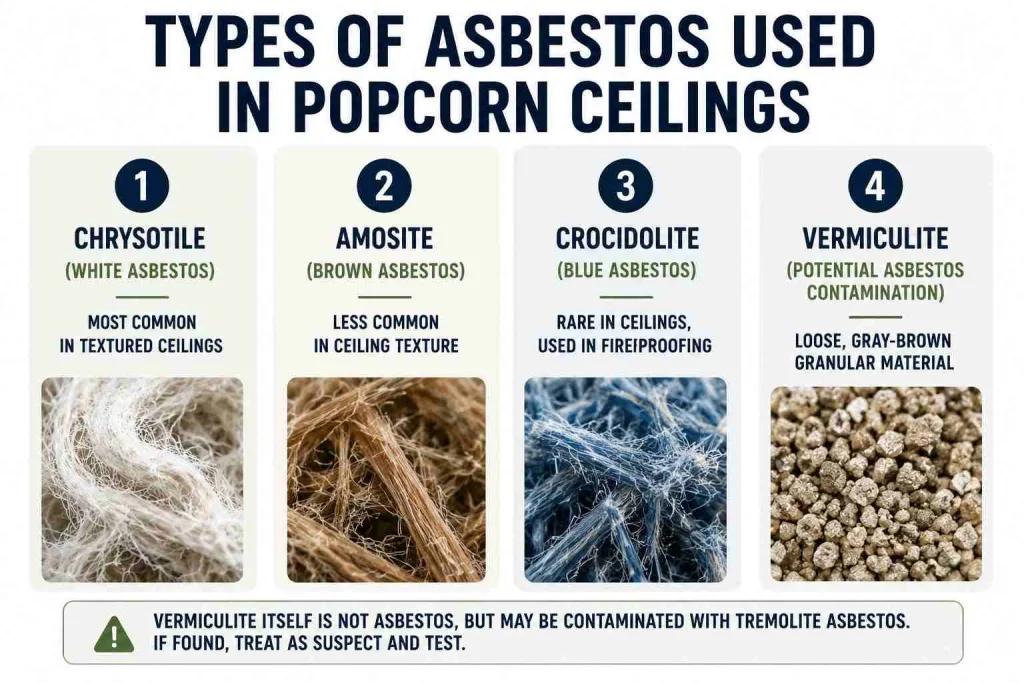
- Chrysotile (white asbestos) — the most common type found in textured ceilings. It has a curly fiber structure and was considered less potent than other types, though it still carries serious health risks with prolonged exposure.
- Amosite (brown asbestos) — less common in ceiling texture, but occasionally present in acoustic tiles. Its straight, brittle fibers make it more easily inhaled.
- Crocidolite (blue asbestos) — rarely found in ceilings but used in some fireproofing materials. Considered the most hazardous form due to its thin, needle-like fibers.
Some homes built in the 1960s and 1970s may also have vermiculite in ceiling materials. Vermiculite itself is not asbestos, but a large portion of the US supply was contaminated with tremolite asbestos during mining. If you find loose, gray-brown granular material in your ceiling, treat it as suspect and test it.
When Are Popcorn Ceilings Dangerous vs. Safe to Leave Alone?
An undisturbed popcorn ceiling that contains asbestos does not release fibers. If the texture is firmly bonded, intact, and you are not renovating, the ceiling poses minimal immediate risk. This condition is called non-friable — meaning it cannot be crumbled by hand pressure.
A popcorn ceiling becomes actively dangerous when it is:
- Peeling, flaking, or visibly deteriorating
- Damaged by water stains or active leaks
- Crumbling at edges around light fixtures or vents
- About to be scraped, sanded, or painted over
- Located in a room undergoing any renovation or remodeling
Even painting over a popcorn ceiling can disturb the surface enough to release fibers if the material is friable. Before any work, get air quality testing done if you have reason to believe asbestos is present.
Other Hazards Found Under Popcorn Ceilings
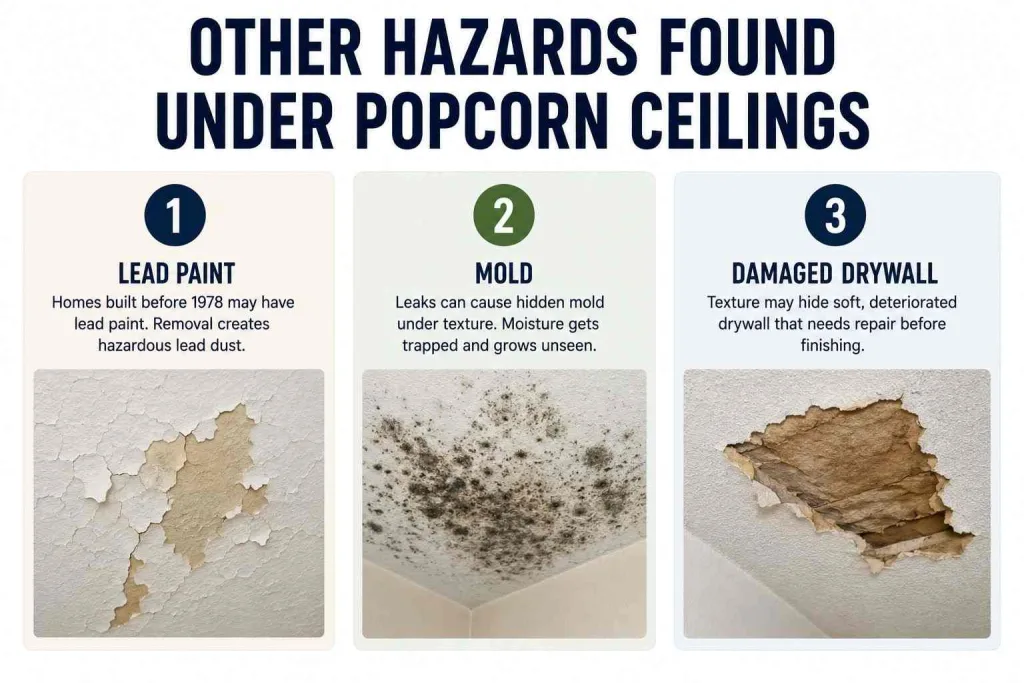
Asbestos gets most of the attention, but it is not the only hazard Brian and Carlos at CeilingPrime watch for on older Austin homes. Here is what can show up when you start pulling down popcorn texture:
Lead Paint
Homes built before 1978 may have lead paint on the ceiling surface below or above the texture layer. Disturbing that paint during removal creates lead dust, which is hazardous — especially for children. A home inspection or lead paint test before removal is standard practice on pre-1978 properties.
Mold
Water leaks from upstairs bathrooms or roofing problems often hide under textured ceilings. The popcorn surface traps moisture and can develop mold colonies that are not visible from below. Once removed, the drywall beneath may need mold remediation before the new surface goes up.
Damaged Drywall
On some older homes, particularly 1950s to 1960s construction, the texture was applied directly to drywall that has since softened or deteriorated. Removing the ceiling texture can expose structural issues that require repair before painting.
How to Test a Popcorn Ceiling for Asbestos?
Professional asbestos testing is the only reliable method. Air quality testing — done by a certified industrial hygienist — can detect airborne fibers, but the most common approach is sampling and testing of the ceiling material itself.
The process works like this:
- A licensed inspector takes a small sample of the ceiling texture (typically about 1 square inch) using a wet method to prevent fiber release.
- The sample is sent to an accredited laboratory that analyzes it using polarized light microscopy or transmission electron microscopy.
- Results come back within 2–5 business days and identify the fiber type and percentage by weight.
- If asbestos is found at 1% or greater — the EPA threshold — the material is regulated and must be handled accordingly.
Texas requires compliance with EPA National Emission Standards for Hazardous Air Pollutants (NESHAP) rules and Texas Commission on Environmental Quality (TCEQ) regulations for asbestos abatement. The Texas Department of State Health Services (DSHS) licenses asbestos professionals in the state.
Do not attempt to collect a sample yourself unless you are trained to do so. Improper sampling is one of the most common ways people accidentally release asbestos fibers.
DIY Removal vs. Professional Removal: What’s the Risk?
Are popcorn ceilings dangerous to remove yourself? Yes — especially on pre-1980s homes where asbestos is a real possibility. Here is a direct comparison:
| Asbestos testing | Rarely done first | Required before work begins |
| Fiber containment | Minimal — fans, open windows spread fibers | Full containment with plastic sheeting and negative air pressure |
| Protective gear | Often inadequate — standard dust masks fail | Full respirators (N100 or P100), Tyvek suits, gloves |
| HEPA filtration | Typically absent | HEPA filters on all vacuums and air scrubbers |
| Disposal | Trash bag — illegal if asbestos-positive | Licensed waste contractor, sealed and labeled containers |
| Legal liability | Full owner liability if fibers spread | Licensed contractor carries insurance and permits |
| Cost | $50–$200 in materials | $2.30–$4.05 per sq ft in Austin |
DIY popcorn ceiling removal is only reasonable when a certified test has confirmed zero asbestos content AND the material has never been painted (painted popcorn ceilings are significantly harder to scrape and often require skim coating anyway). Even in that scenario, you will still need proper respirators, plastic sheeting, and HEPA vacuums.
If the test comes back positive, DIY removal is not an option. It is illegal in most jurisdictions and creates serious health risks for you, your family, and any neighbors within airborne fiber range.
Encapsulation: An Alternative to Removal
If full removal is not in the budget, encapsulation is a legitimate option for intact ceilings. This involves sealing the asbestos-containing texture with a specially formulated coating that bonds the fibers and prevents release.
Encapsulation works best when:
- The ceiling is in good condition with no peeling or water damage
- You are not planning to renovate or sell in the near term
- The ceiling height is low enough that future disturbance is unlikely
Encapsulation does not eliminate the asbestos — it manages it. Any future renovation, sale inspection, or ceiling damage will resurface the issue. Most Austin real estate agents and home inspectors recommend full removal before listing, particularly for 1950s–1980s properties where buyers increasingly ask about it.
Real Estate and Legal Considerations in Texas
Texas sellers are required to disclose known material defects under the Texas Property Code. A confirmed asbestos popcorn ceiling that has not been abated qualifies as a material defect. Failing to disclose it can expose the seller to lawsuits, settlements, and significant financial liability after closing.
Buyers increasingly request asbestos inspections as part of the home inspection process. A positive result can delay or kill a sale, push buyers to request price reductions, or result in the seller being required to complete asbestos abatement before closing.
Beyond disclosure, real estate disclosure requirements vary by transaction type. Investment properties, rental properties, and commercial conversions each carry different obligations. If you own a rental in Austin and have not addressed popcorn ceiling asbestos risk, consult a Texas attorney and a licensed abatement contractor before your next tenant move-in.
Frequently Asked Questions
Q. Are all popcorn ceilings dangerous?
No. Popcorn ceilings installed after 1990 almost certainly do not contain asbestos. Ceilings from the 1977–1985 window are lower risk but not risk-free. Any ceiling from before 1977 should be tested before any disturbance.
Q. Are popcorn ceilings a health hazard if I don’t touch them?
An intact, undisturbed popcorn ceiling with asbestos poses minimal immediate risk. The hazard increases sharply when the material is scraped, drilled, water-damaged, or deteriorating. Even aging without obvious damage can cause a ceiling to become friable over time.
Q. Is popcorn ceiling dust dangerous?
Yes — ceiling dust from a pre-1980 popcorn ceiling can contain asbestos fibers. Even a single disturbance event in an enclosed room with no ventilation can generate enough airborne particles to warrant concern. Do not sweep or vacuum popcorn ceiling debris without knowing whether asbestos is present; standard vacuums spread fibers rather than contain them.
Q. How do I know if my popcorn ceiling has asbestos?
You cannot tell by looking at it. A certified lab test is the only reliable answer. Expect to pay $25–$75 per sample for testing, plus the cost of a licensed inspector to collect the sample safely.
Q. Are popcorn ceilings dated?
Yes — popcorn ceilings have been out of style since the late 1980s and are widely seen as a cosmetic liability. Beyond aesthetics, the potential health risks associated with pre-1980 installations mean most Austin home buyers view them negatively. Removal typically returns up to 80% of its cost in resale value.
Q. Can I paint over a popcorn ceiling to make it safe?
Painting over an asbestos popcorn ceiling can actually make future removal harder and does not eliminate the asbestos. It may provide very short-term encapsulation if the right product is used, but it is not a substitute for abatement. Any future renovation will still require proper asbestos handling.
Q. What should I do if my popcorn ceiling is already crumbling?
Do not disturb the area further. Seal off the room with plastic sheeting if possible, and contact a licensed asbestos abatement contractor for an emergency assessment. A crumbling pre-1980 ceiling is a friable asbestos concern until proven otherwise.