Why Is My Ceiling Sweating? 7 Causes, Fixes & Prevention Guide
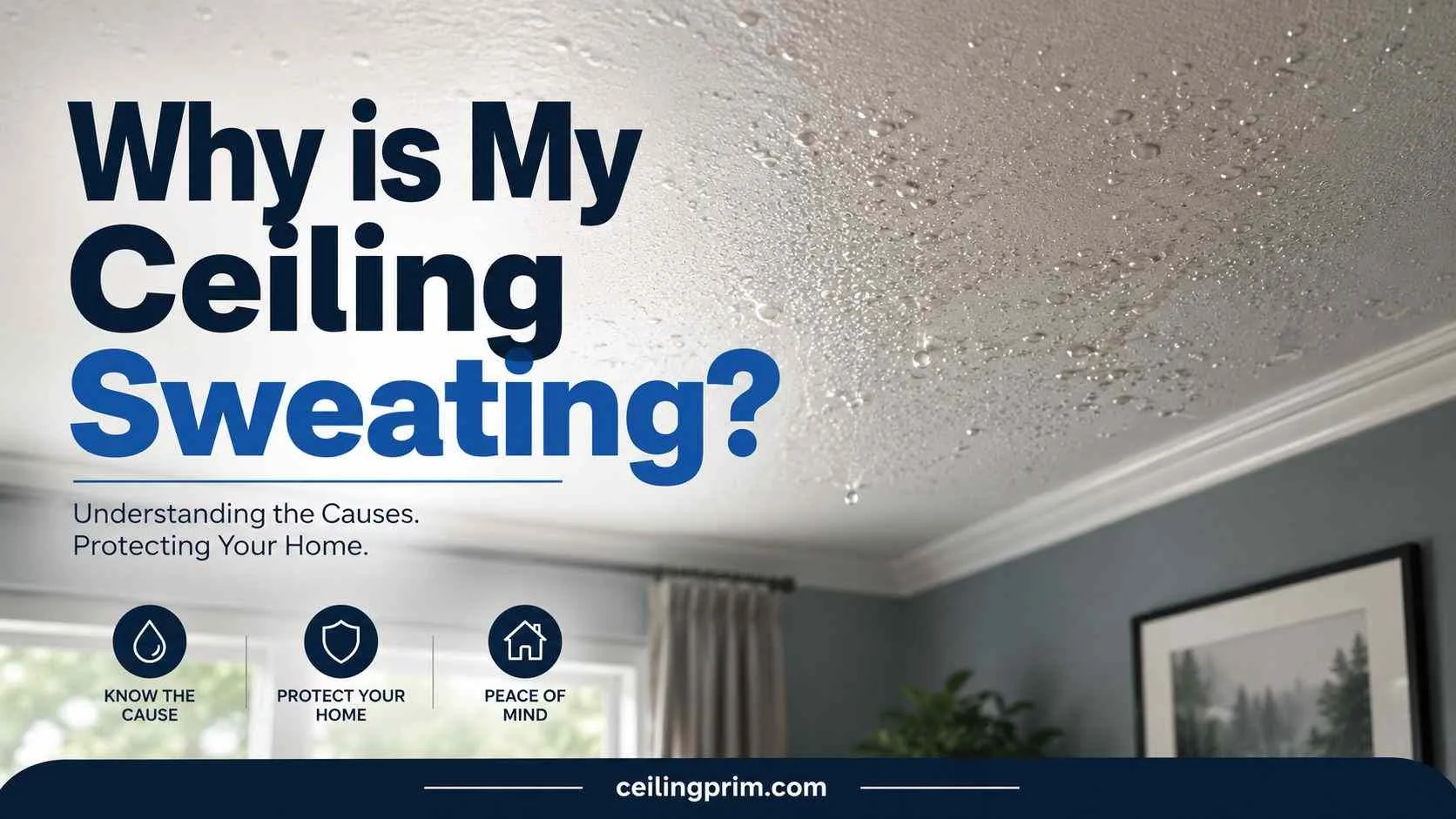
Your ceiling is sweating. Water droplets sit on the surface. The drywall looks damp or shiny. This is ceiling condensation. Warm moist air hits a cold ceiling. The moisture turns from vapor to liquid. It collects on the coldest surface. That surface is your ceiling.
Ceiling sweating is not a leak. It is a humidity problem. The air inside holds too much moisture. The ceiling is too cold. The two meet and water forms. This guide covers why is my ceiling sweating, 7 causes and the fix for each one.
Quick Answer: Why Is My Ceiling Sweating?
A ceiling sweats when its surface temperature reaches or falls below the dew point of the surrounding air.
For example, a room at 70°F and 60% relative humidity has a dew point of about 55°F. If part of the ceiling reaches 55°F or lower, condensation can form.
The most common causes include:
- High indoor humidity
- Poor attic insulation
- Air leaks around ceiling penetrations
- Poor bathroom or kitchen ventilation
- Cold HVAC ducts or AC vents
- Thermal bridging
- Roof, plumbing, or HVAC leaks
Lowering indoor humidity and keeping the ceiling surface warmer can help. But first, make sure the moisture is not coming from a leak.
What to Do Right Now
If you see moisture on your ceiling, take these steps before assuming it is harmless.
- Wipe away visible moisture. This removes surface water but does not fix the cause.
- Check indoor humidity. Use a hygrometer to measure relative humidity.
- Measure the ceiling temperature. An infrared thermometer can help identify cold spots.
- Run bathroom and kitchen exhaust fans. Use them when producing steam.
- Use a dehumidifier if humidity is high.
- Check the attic above the affected area. Look for wet insulation, water droplets, or dark roof sheathing.
- Check whether the moisture appears after rain.
- Look for stains, bubbling paint, soft drywall, or mold.
- Keep water away from electrical fixtures. If a light fixture or other electrical component is wet, avoid touching it and address the electrical hazard safely.
Do not paint over an actively wet ceiling. The moisture source needs to be fixed first.
Why Does Condensation Form on a Ceiling?
Air contains water vapor. Relative humidity tells you how much moisture the air contains compared with the amount it could hold at that temperature.
The dew point is the temperature at which the air becomes saturated and condensation begins.
When a ceiling surface is at or below the dew point, moisture can form.
Two factors are especially important:
- Higher humidity: More moisture is available to condense.
- Lower ceiling temperature: The surface reaches the dew point more easily.
Poor insulation can make a ceiling colder. Air leakage can bring humid indoor air into cold areas. Cold ducts can create small areas where condensation starts first.
What Temperature Does a Ceiling Start Sweating?
There is no single temperature at which every ceiling starts sweating.
It depends on both room temperature and relative humidity.
| Room Temperature | Relative Humidity | Approx. Dew Point |
| 65°F | 50% | 46°F |
| 70°F | 50% | 50°F |
| 70°F | 60% | 55°F |
| 75°F | 60% | 60°F |
| 75°F | 70% | 65°F |
For example, if your room is 70°F with 60% relative humidity, a ceiling surface around 55°F can reach the dew point.
This gives you a useful way to investigate the problem. Measure the room temperature and humidity. Then measure the ceiling surface temperature.
If the ceiling is close to or below the dew point, condensation becomes a strong possibility.
What Should Indoor Humidity Be in Winter and Summer?
There is no single humidity setting that works equally well in every U.S. climate.
ENERGY STAR generally places ideal building relative humidity around 30% to 50%. In colder climates during the heating season, it recommends about 30% to 40% to help prevent condensation on cold surfaces.
A practical starting point is:
- Cold winter weather: often 30–40%
- Mild conditions: often 40–50%
- Summer: often around 40–50%, depending on climate and air conditioning
- Very cold weather: lower indoor humidity may be needed to prevent condensation
Do not blindly target 50% in every climate.
Your home’s insulation, windows, ceiling temperature, outdoor weather, and ventilation all affect condensation risk.
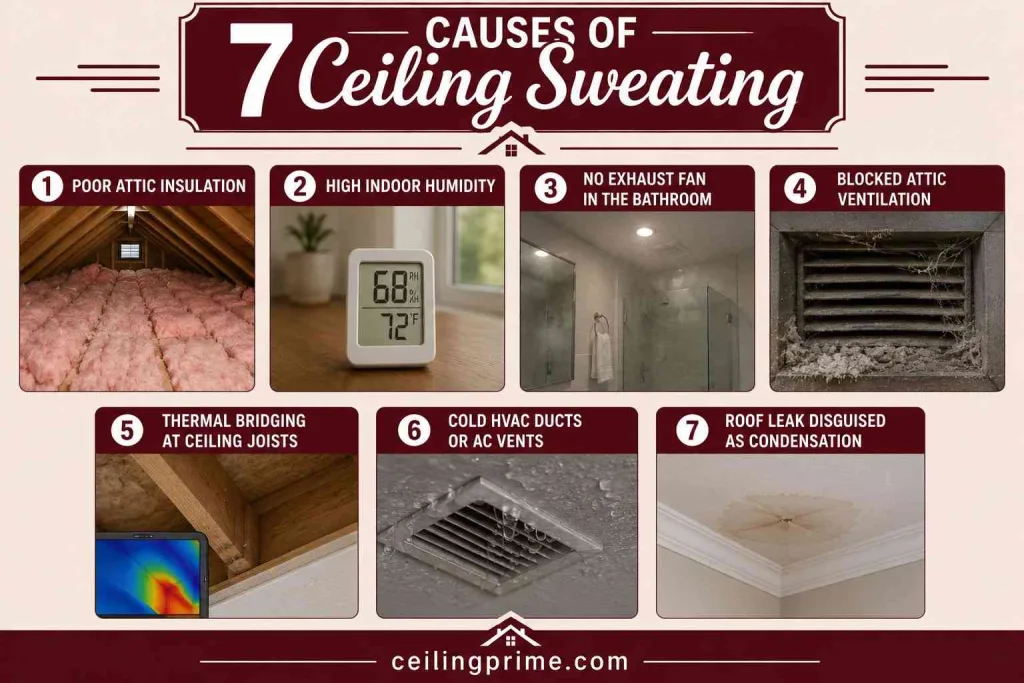
7 Causes of Ceiling Sweating
1. Poor attic insulation.
Thin or missing attic insulation is the top cause. Cold air from the attic cools the drywall. The warm room air hits the cold surface. Water forms. Add R-38 to R-49 insulation to fix this.
2. High indoor humidity.
Cooking adds moisture to the air. Hot showers fill rooms with steam. Drying clothes indoors raises humidity. Even breathing adds water vapor. Keep indoor humidity below 50 percent.
3. No exhaust fan in the bathroom.
Steam from hot showers rises to the ceiling. Without an exhaust fan it stays there. The moisture soaks into the drywall. Mold grows within 48 to 72 hours. Run the exhaust fan for 20 minutes after showering.
4. Blocked attic ventilation.
Soffit vents let cool air into the attic. Ridge vents let hot air escape the attic. When either is blocked moisture gets trapped. Insulation pushed over soffit vents is common. Clear the vents to restore airflow.
5. Thermal bridging at ceiling joists.
Ceiling joists conduct cold from the attic. The drywall directly below each joist gets colder. Moisture collects in lines that match the joists. This pattern is called ghosting. It looks like faint stripes on the ceiling.
6. Cold HVAC ducts or AC vents.
Cold air ducts running through the ceiling create cold spots. The warm room air hits these cold zones. Water forms around the vent or register. Insulate exposed ductwork in the attic. Seal any air leaks at vent boots.
7. Roof leak disguised as condensation.
Not every wet ceiling is condensation. A roof leak also wets the ceiling. Check after heavy rain for new spots. If moisture appears only after rain it is a leak. If moisture appears on cold mornings it is condensation.
Room-by-Room Guide to Ceiling Sweating
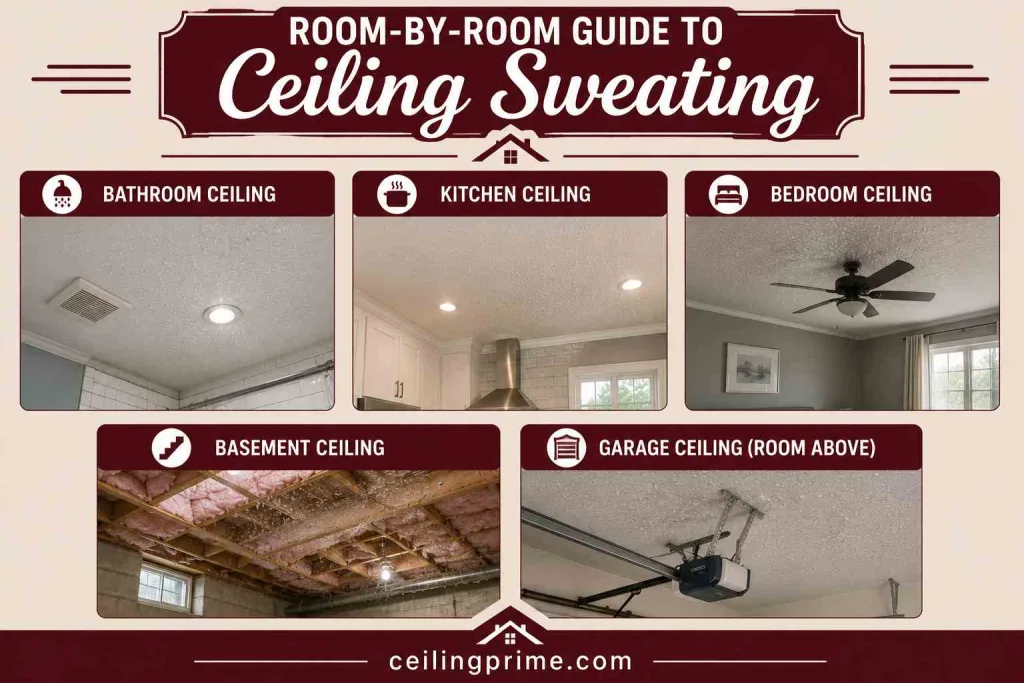
Bathroom ceiling:
The most common room for this problem. Shower steam rises to the ceiling daily. Run the exhaust fan during every shower. Keep it running 20 minutes after. Use a timer switch for automatic shutoff. Wipe the ceiling dry if droplets form.
Kitchen ceiling:
Boiling water creates heavy steam. Range hoods vent cooking moisture outside. Use the range hood every time you cook. Open a window if no hood exists. Ceiling fans help circulate the air.
Bedroom ceiling:
Two people breathing overnight add moisture. A closed bedroom traps the humid air. Open the door at night for airflow. Run a small dehumidifier in winter. Keep the room above 65 degrees to prevent cold surfaces.
Basement ceiling:
Basements are naturally humid. The ceiling is often the coldest surface. Use a dehumidifier set to 45 percent. Insulate exposed joists and ductwork above. Check for water seepage through foundation walls.
Garage ceiling (room above):
Garages are unheated in winter. The ceiling between the garage and room above gets cold. Insulate the garage ceiling with R-30 or higher. Seal gaps around pipes and wires. This stops ceiling sweating in the room above the garage.
How to Stop Your Ceiling from Sweating
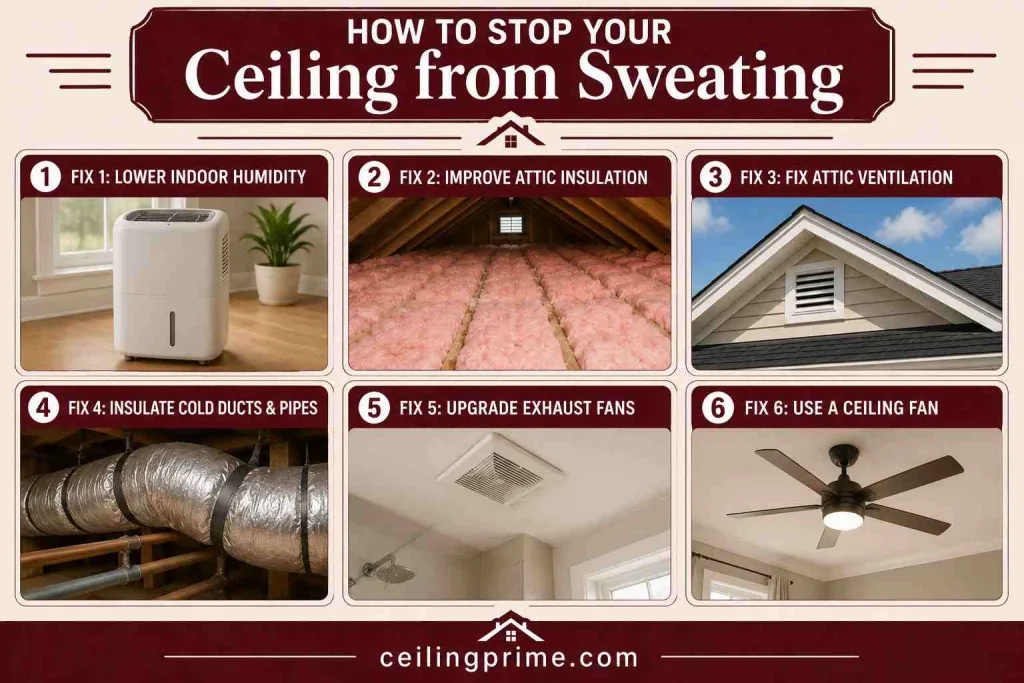
Fix 1: Lower Indoor Humidity
Buy a hygrometer for $10 to $20. Measure the indoor relative humidity. Target 30 to 50 percent. Use a dehumidifier to pull moisture from the air. Run exhaust fans in bathrooms and kitchens. Open windows for 15 minutes daily when weather permits.
Fix 2: Improve Attic Insulation
Check your attic insulation depth. R-38 is the minimum for most U.S. climate zones. R-49 is recommended for cold climates. Add blown-in cellulose or fiberglass batts. Do not compress existing insulation. Do not block soffit vents with new insulation. Condensation stops when the ceiling stays warm.
Fix 3: Fix Attic Ventilation
Clear blocked soffit vents. Install baffles to keep insulation away from vents. Check ridge vents for obstructions. Add a gable vent if none exists. Balanced airflow removes trapped moisture from the attic. This keeps the roof deck dry and the ceiling warm.
Fix 4: Insulate Cold Ducts and Pipes
Wrap exposed HVAC ducts with duct insulation wrap. Seal joints with foil tape not duct tape. Insulate cold water pipes in the ceiling cavity. This eliminates the cold spots that attract condensation.
Fix 5: Upgrade Exhaust Fans
Replace old bathroom fans with high-CFM models. A fan rated 80 to 110 CFM handles most bathrooms. Install a timer switch or humidity sensor switch. The fan runs automatically until humidity drops. This removes shower steam before it reaches the ceiling.
Fix 6: Use a Ceiling Fan
A ceiling fan circulates air near the ceiling. Moving air prevents moisture from settling. Set the fan to run clockwise on low in winter. This pushes warm air down from the ceiling. The ceiling surface stays warmer. Condensation cannot form on a warm surface.
Why Is My Ceiling Sweating Around the AC Vent?
Water around an AC register does not automatically mean the roof is leaking.
A cold supply register can cool nearby drywall below its dew point. Humid indoor air can then condense around the opening.
Check for:
- Gaps between the register boot and drywall
- Damaged duct insulation
- Sweating ductwork
- High indoor humidity
- Condensation inside the attic
- HVAC condensate problems
If water is dripping from the HVAC system or returning repeatedly, have the system inspected.
Can Recessed Lights Cause Ceiling Condensation?
Recessed lights can create openings between the living space and attic.
Older fixtures may allow air to move through these openings. That can carry indoor moisture toward colder attic areas.
Check for:
- Gaps around fixtures
- Air leakage
- Missing air sealing
- Improper insulation clearance
- Older fixtures that are not suitable for insulation contact
Do not cover a recessed fixture with insulation unless the fixture is specifically designed and rated for that installation. Follow the manufacturer’s requirements.
Is It Condensation, a Roof Leak, or a Plumbing Leak?
Use the pattern as a clue, not as proof.
| Sign | Condensation | Roof Leak | Plumbing Leak |
| Appears during cold or humid weather | Often | Not necessarily | Not necessarily |
| Appears after rain | Usually no | Often | Usually no |
| Gets worse after plumbing use | No | No | Often |
| Appears around a bathroom | Possible | Possible | Common |
| Covers a broad cold area | Possible | Less typical | Less typical |
| Localized stain | Possible | Common | Common |
| Wet attic wood | Possible | Common | Only if plumbing is in attic |
| Nearby pipe or fixture | No | No | Often |
If the moisture returns after rain, investigate the roof. If it appears after using a bathroom, toilet, appliance, or plumbing fixture, investigate the plumbing. If it appears during humid or cold conditions and disappears when humidity falls, condensation becomes more likely.
Why Is My Ceiling Sweating in Winter?
Winter is a common season for ceiling condensation. The process can look like this:
Cold outdoor air → cold attic → cold ceiling → warm indoor air → dew point reached → condensation
The risk is higher when:
- Attic insulation is inadequate
- Ceiling air leaks exist
- Indoor humidity is high
- Bathroom fans are not used
- Exhaust ducts discharge into the attic
- Recessed lights allow air leakage
- The room is directly below an attic
Cold mornings can make the problem especially noticeable.
If your ceiling sweats mainly in winter, measure indoor humidity and inspect the attic before assuming the roof is leaking.
Why Is My Ceiling Sweating in Summer?
Summer condensation can happen for a different reason.
Warm outdoor air can contain a large amount of moisture. Air conditioning then cools the indoor environment and some ceiling or HVAC surfaces.
Common summer causes include:
- High indoor humidity
- Cold HVAC ducts
- Cold AC registers
- Poor duct insulation
- Duct air leaks
- Overcooled rooms
- HVAC humidity-control problems
- Poor attic insulation
- Unsealed ceiling penetrations
Summer condensation is especially possible in hot, humid areas.
If moisture appears near an AC vent, inspect the HVAC system and vent connection rather than assuming it is a roof problem.
Mold Risk from a Wet Ceiling
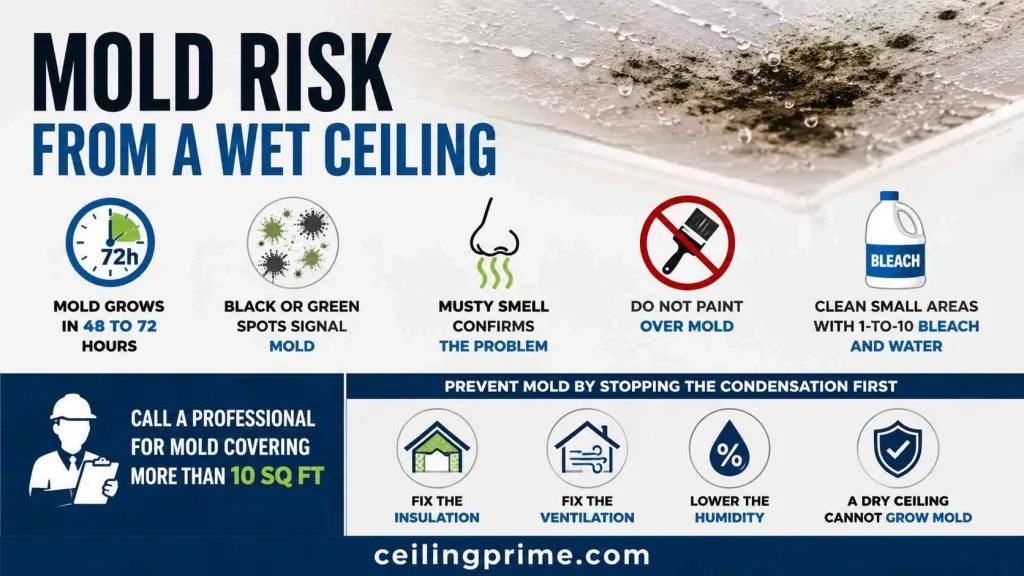
Mold grows on damp surfaces within 48 to 72 hours. A sweating ceiling gives mold everything it needs. The drywall stays wet. The temperature is comfortable. The darkness behind the ceiling is perfect for mold growth.
Black or green spots near the wet area signal mold. A musty smell confirms the problem. Do not paint over mold. It grows behind the paint. Clean small areas with a 1-to-10 bleach and water solution. Call a professional for mold covering more than 10 square feet.
Prevent mold by stopping the condensation first. Fix the insulation. Fix the ventilation. Lower the humidity. A dry ceiling cannot grow mold.
Condensation or Roof Leak? How to Tell
| Condensation Signs | Roof Leak Signs |
| Fine mist of droplets across a wide area | Focused stain in one spot |
| Appears on cold mornings or humid days | Appears during or after rainfall |
| Affects multiple rooms or large ceiling areas | Usually one room near a roof penetration |
| Attic wood and insulation are dry above the spot | Attic wood and insulation are wet above the spot |
| Disappears when humidity drops or room warms | Gets worse with each rain event |
Check the attic above the wet ceiling. Dry wood means condensation. Wet wood means a leak. Fix leaks with a roofer. Fix condensation with insulation and ventilation.
Fix Costs for a Sweating Ceiling in 2026
| Fix | 2026 Cost |
| Hygrometer (humidity meter) | $10–$20 |
| Portable dehumidifier | $150–$350 |
| Bathroom exhaust fan upgrade | $150–$400 installed |
| Attic insulation (blown-in, 1000 sq ft) | $800–$2,500 |
| Soffit vent clearing and baffles | $200–$600 |
| Duct insulation wrap | $100–$400 |
| Ceiling fan installation | $150–$400 |
| Mold remediation (professional) | $1,000–$5,000 |
The cheapest fix is a hygrometer and a dehumidifier. The most impactful fix is adding attic insulation. Most homeowners spend $300 to $1,500 total to stop ceiling sweating permanently.
How to Handle Mold on a Wet Ceiling?
Do not assume that bleach is the best solution. EPA guidance recommends cleaning mold from hard surfaces with detergent and water and notes that bleach is not recommended as a routine mold-removal method. Porous materials that cannot be properly cleaned and dried may need to be removed.
For a small area, the appropriate cleanup method depends on the material and condition. If the ceiling is extensively damaged, the drywall is soft, or mold is widespread, professional assessment may be appropriate.
The most important step is still the same: Fix the moisture source first.
Cleaning mold without correcting the moisture problem does not solve the underlying issue.
Stop the Moisture Before It Causes Damage
Ceiling sweating is a humidity and insulation problem. Lower the humidity below 50 percent. Run exhaust fans in bathrooms and kitchens. Add attic insulation to R-38 or higher. Clear blocked soffit and ridge vents. Insulate cold ducts and pipes. And check the attic to rule out a roof leak.
Frequently Asked Questions
Is a sweating ceiling dangerous?
The water itself is not dangerous. But mold grows on wet ceilings within 48 hours. Mold causes allergies and breathing problems. Fix the moisture source quickly.
Can I just wipe the ceiling dry?
Wiping removes the water temporarily. The condensation returns the next day. Fix the cause: lower humidity or add insulation.
Why does my ceiling sweat only in winter?
Cold outside air cools the attic. The attic cools the ceiling. Warm indoor air hits the cold ceiling. Condensation forms. Better attic insulation prevents the ceiling from getting cold.
Does a ceiling fan stop ceiling condensation?
It helps. Moving air keeps the ceiling surface warmer. Warm surfaces do not attract condensation. A ceiling fan alone may not solve the problem. Combine it with better insulation and lower humidity.
Should I call a professional?
Call a pro if mold covers more than 10 square feet. Call a pro if you cannot access the attic. Call a pro if the wet ceiling is sagging or soft. Call a roofer if you suspect a leak instead of condensation.
What humidity level stops ceiling sweating?
Keep indoor humidity between 30 and 50 percent. Below 30 percent feels too dry. Above 50 percent causes condensation on cold surfaces. A hygrometer costs $10 and reads the level instantly.