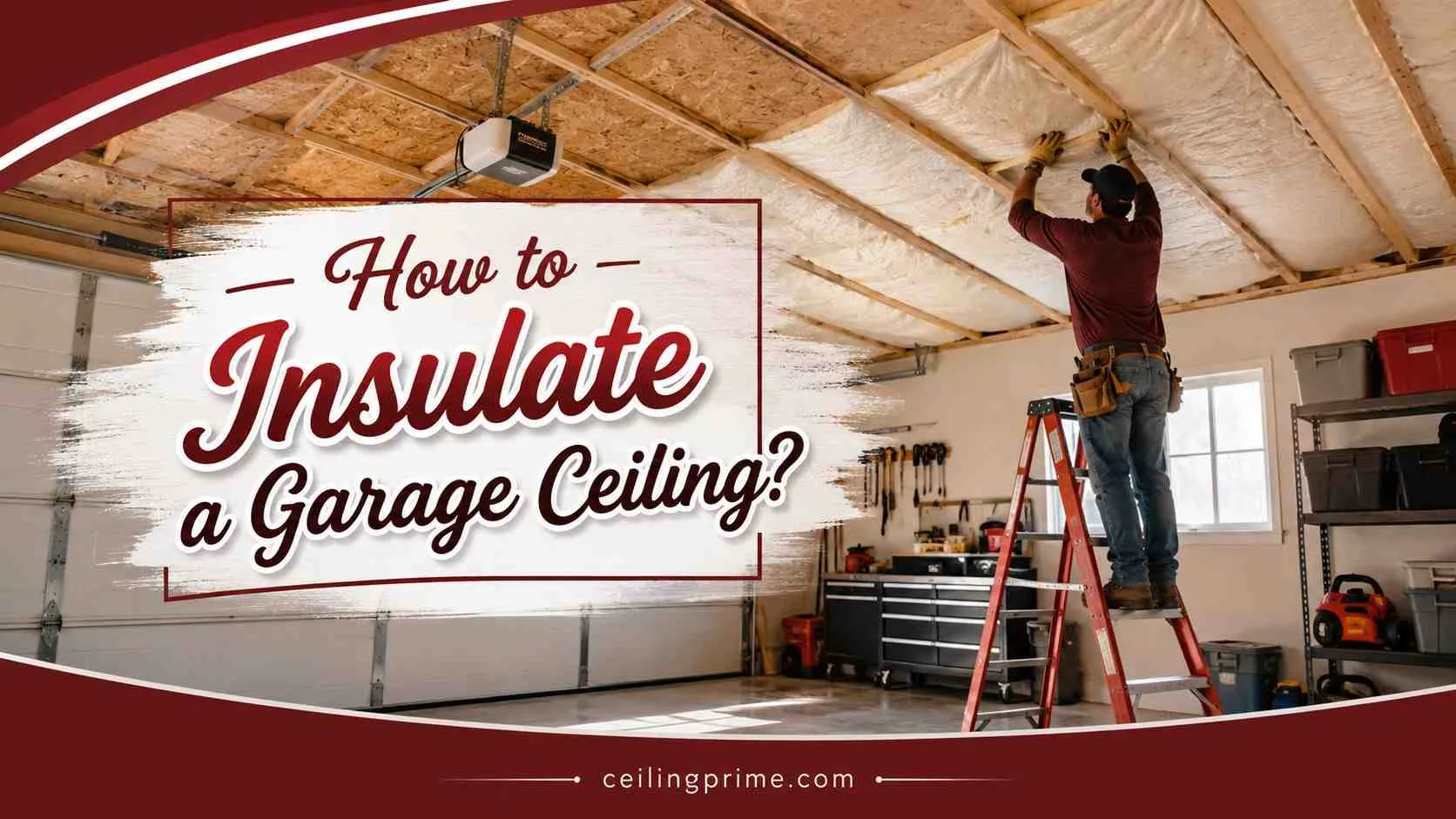
How to Insulate a Garage Ceiling mgapgarage: Complete DIY Guide
Garage ceiling insulation is the second most impactful insulation upgrade in an attached garage — right after the shared wall with the house. If a bedroom, home office, or bonus room sits above your garage, an uninsulated ceiling lets cold air rise into that room in winter and bakes it with radiant heat in summer. According to the Department of Energy, insulating the boundary between your garage and living space can reduce energy loss through that surface by 60 to 70 percent.
This guide explains how to insulate a garage ceiling mgapgarage. Learn the right R-value for your climate zone. Compare the four best insulation materials. Follow simple steps for open joists and finished ceilings. Understand vapor barrier placement and fire code requirements. Avoid common mistakes. See the estimated costs for 2026.
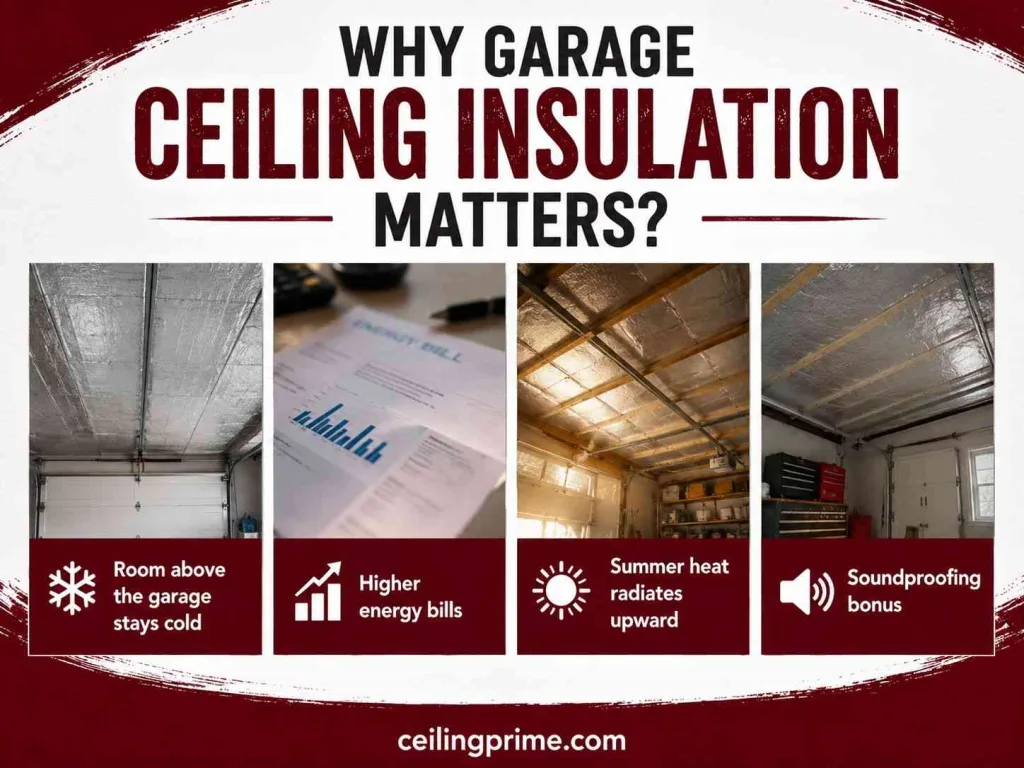
Why Garage Ceiling Insulation Matters?
- Room above the garage stays cold: Heat rises from the living space above, passes through an uninsulated garage ceiling, and escapes into the unheated garage. The room above stays 5–15°F colder than the rest of the house in winter.
- Higher energy bills: Your HVAC system works harder to compensate for the heat loss through the uninsulated ceiling. Garage ceiling insulation can cut heating costs for that room by 30–50%.
- Summer heat radiates upward: In hot climates, the garage traps heat from the concrete floor and cars. That heat rises into the room above, making it 10–20°F warmer than the rest of the house.
- Soundproofing bonus: Insulation between the garage ceiling joists blocks noise from workshop tools, garage door openers, and car engines from reaching the rooms above. Mineral wool (Rockwool) provides the best sound dampening.
R-Values for Garage Ceiling Insulation by Climate Zone
The Department of Energy and the International Energy Conservation Code (IECC) Climate Zone Map set minimum R-values based on where you live. Use this table to find the right target for your garage ceiling insulation project.
| Climate Zone | Region Examples | Ceiling R-Value | Vapor Barrier? |
| 1–2 (Hot) | South FL, TX coast, HI | R-30 | Not required |
| 3–4 (Mixed) | NC, TN, CA, OK, VA | R-38 | Check local code |
| 5–6 (Cold) | NY, OH, PA, CO, WA | R-49 | Yes — warm side |
| 7 (Very Cold) | MN, WI, ME, MT, AK | R-49 to R-60 | Yes — warm side |
When in doubt, go with the higher R-value. Over-insulating costs a small amount more upfront but saves energy for the life of the home. Find your exact zone on the IECC Climate Zone Map.
4 Best Materials for Garage Ceiling Insulation
| Material | R-Value/Inch | Cost/sq ft | DIY? | Best For |
| Fiberglass batts | R-3.2–R-3.8 | $0.50–$1.50 | Yes | Open joists, budget |
| Blown-in cellulose | R-3.5–R-3.7 | $0.80–$1.50 | Moderate | Finished ceilings |
| Spray foam (open cell) | R-3.5–R-3.7 | $1.00–$2.50 | Hire a pro | Air sealing + insulation |
| Spray foam (closed cell) | R-6.0–R-6.5 | $2.00–$5.00 | Hire a pro | Max R-value, moisture barrier |
Fiberglass batts are the best choice for most DIY homeowners: cheap, widely available, and straightforward to install between exposed ceiling joists. Blown-in cellulose is the go-to for ceilings that already have drywall. Closed-cell spray foam delivers the highest performance but requires professional installation.
How to Install Garage Ceiling Insulation (Open Joists)
This method works when the ceiling joists are exposed — no drywall installed yet. Fiberglass batts are the standard material for this approach.
Tools needed: Tape measure, utility knife, staple gun with staples, expanding foam sealant, safety glasses, work gloves, dust mask, 6-mil polyethylene sheeting (cold climates).
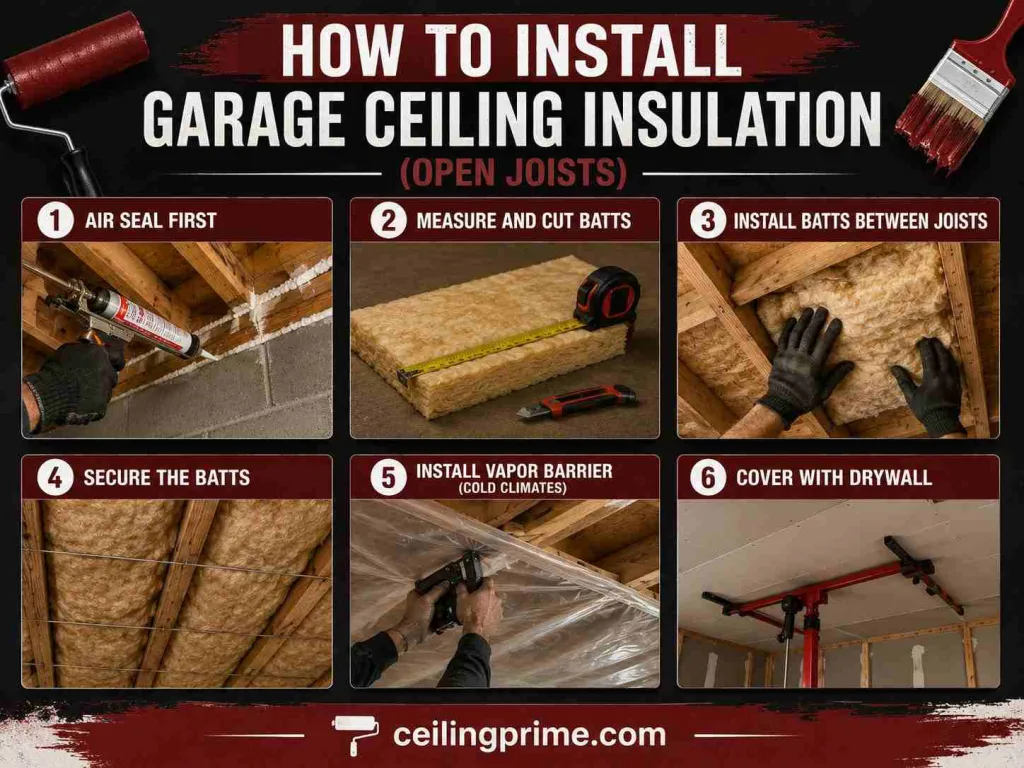
Step 1 — Air Seal First
Before installing any insulation, seal every gap, crack, and penetration in the ceiling. Use expanding foam sealant around light fixture boxes, electrical wires, plumbing pipes, and where the joists meet the top plate. Air sealing before insulating is the single most overlooked step in the entire project. A 5% gap in coverage can reduce the effective R-value of the entire ceiling by 25% or more.
Step 2 — Measure and Cut Batts
Measure the width and depth of each joist bay. Standard spacing is 16 inches on center (14.5-inch cavity) or 24 inches on center (22.5-inch cavity). Use R-30 batts for 2×10 joists or R-38 batts for 2×12 joists. Cut batts 1 inch longer than the cavity for a snug friction fit. Use a utility knife against a straight edge on a flat surface.
Step 3 — Install Batts Between Joists
Press each batt into the cavity between joists. The batt should fill the space completely with no gaps, voids, or compression. Compressed insulation loses R-value: a compressed R-30 batt performs like R-19 or less. If using faced batts (kraft paper or foil), the facing goes toward the warm side — toward the living space above, not toward the garage.
Step 4 — Secure the Batts
Friction fit holds most batts in place. For heavy batts that sag, run wire supports (insulation hangers) or nylon twine across the bottom of each joist bay. Staple the wire or twine to the joist faces every 12 inches.
Step 5 — Install Vapor Barrier (Cold Climates)
In climate zones 5 through 7, staple 6-mil polyethylene sheeting across the bottom of the joists (the garage-facing side). Overlap seams by 12 inches and seal with housewrap tape. The vapor barrier prevents warm, moist air from the room above from condensing inside the cold insulation. In hot and mixed climates (zones 1–4), a vapor barrier on the garage ceiling is not required.
Step 6 — Cover with Drywall
Most building codes require exposed insulation in a garage to be covered with 1/2-inch drywall or a fire-rated barrier. This fire separation requirement protects the living space above from a garage fire. Screw drywall to the bottom of the joists and tape/mud the seams.
How to Insulate a Garage Ceiling mgapgarage That Is Already Drywalled
If the garage ceiling already has drywall, you cannot access the joist bays to install batts. Blown-in cellulose is the best solution. Here is how it works.
- Step 1: Locate each joist bay by tapping the ceiling or using a stud finder. Mark the center of each bay.
- Step 2: Drill a 2-inch hole in the center of each joist bay using a hole saw.
- Step 3: Feed the blower hose into each hole and fill the cavity with cellulose insulation until full. The hose resistance increases as the cavity fills — that is how you know it is packed.
- Step 4: Patch each hole with a drywall plug, joint compound, and sanding. Prime and paint to match.
Many home improvement stores (Home Depot, Lowe’s) lend blowing machines free when you buy a minimum amount of insulation — typically 10 or more bags. Blown-in cellulose provides R-3.5 to R-3.7 per inch and fills irregular cavities better than batts. This is the standard method for adding garage ceiling insulation to a finished ceiling without tearing out the drywall.
Special Considerations: Room Above the Garage
When a bedroom, home office, or bonus room sits directly above the garage, insulation is not optional — it is the only thing standing between a comfortable room and a freezing or overheated space. Three specific factors apply to garage ceiling insulation under a living space.
- Higher R-value target: Use R-38 to R-49 instead of the standard R-30. The temperature difference between an unheated garage and a 70°F living space can exceed 30–40°F in winter.
- Air seal aggressively: The garage-to-room boundary is the largest source of air leakage in most homes. Seal every penetration: electrical wires, plumbing pipes, HVAC ducts, recessed light fixtures (use IC-rated cans only), and the perimeter where the joists meet the top plates.
- Rigid foam for continuous coverage: Install a layer of rigid foam board (XPS at R-5 per inch or polyiso at R-6 per inch) across the bottom of the joists before drywall. This creates a continuous thermal break that stops cold-bridging through the wood joists themselves.
Garage Ceiling Insulation Costs in 2026
| Method | DIY Cost (2-Car Garage) | Professional Cost |
| Fiberglass batts (open joists) | $200–$600 | $600–$2,000 |
| Blown-in cellulose (finished ceiling) | $300–$700 | $800–$2,500 |
| Spray foam — open cell | N/A (pro only) | $1,000–$2,500 |
| Spray foam — closed cell | N/A (pro only) | $2,000–$5,000 |
| Rigid foam board (continuous layer) | $150–$400 | $400–$1,200 |
Fiberglass batts are the cheapest DIY option at $0.50–$1.50 per square foot in materials. Closed-cell spray foam costs $2–$5 per square foot installed but provides the highest R-value per inch, a built-in moisture barrier, and complete air sealing in one step.
5 Common Mistakes to Avoid
Here are some of the common mistakes to avoid while insulate a garage ceiling.
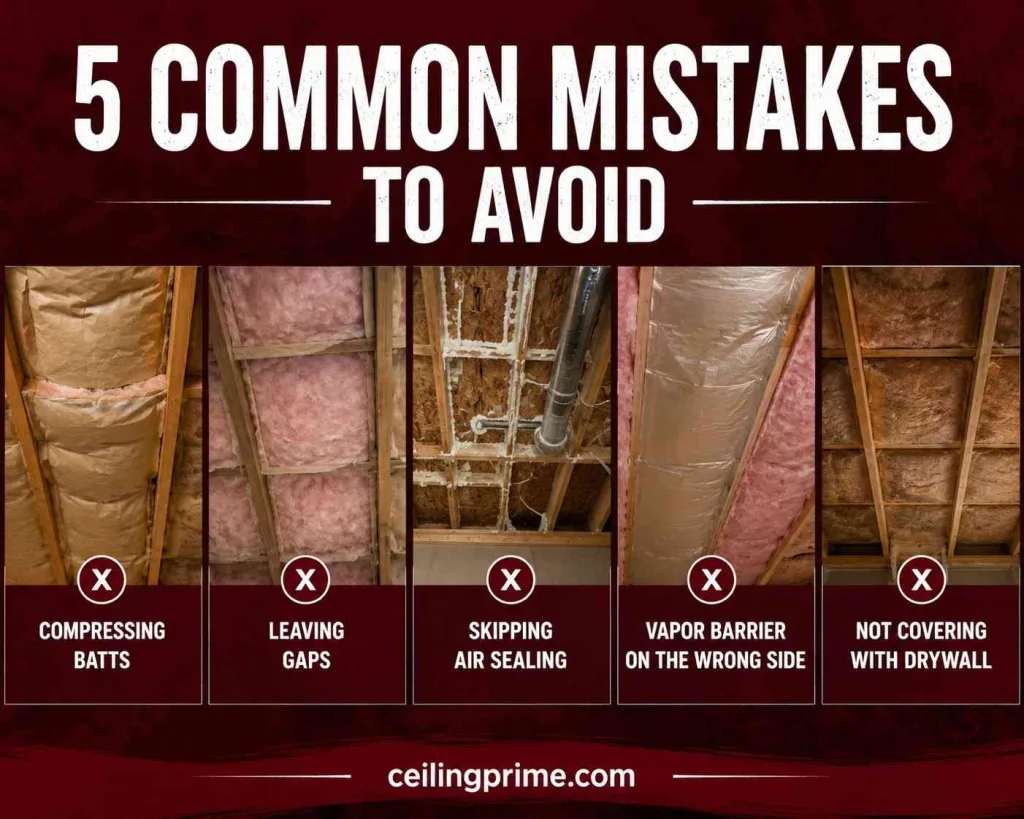
- Compressing batts: Squeezing R-30 insulation into a space designed for R-19 batts does not give you R-30. A compressed batt loses R-value. Use the correct batt thickness for the joist depth.
- Leaving gaps: A 5% gap in insulation coverage reduces the effective R-value of the entire ceiling by 25% or more. Fill every joist bay completely.
- Skipping air sealing: Insulation slows heat transfer but does not stop air movement. Seal every gap with expanding foam before installing batts or cellulose.
- Vapor barrier on the wrong side: The vapor barrier goes on the warm side — the side facing the heated living space above. Installing it on the garage side traps moisture inside the insulation and causes mold.
- Not covering with drywall: Building codes require exposed insulation in a garage to be covered with fire-rated drywall. Exposed fiberglass is a fire hazard and degrades from UV and physical damage.
Frequently Asked Questions
What R-value do I need for my garage ceiling?
R-30 in hot climates (zones 1–2), R-38 in mixed climates (zones 3–4), and R-49 to R-60 in cold climates (zones 5–7). If a room sits above the garage, use the higher end of the range.
Can I insulate a garage ceiling that already has drywall?
Yes. Use blown-in cellulose. Drill 2-inch holes between each joist, blow in the insulation, and patch the holes. A blowing machine rental is often free with a minimum insulation purchase.
Do I need a vapor barrier on my garage ceiling?
In cold climates (zones 5–7), yes. Install 6-mil polyethylene sheeting on the warm side (facing the room above). In hot or mixed climates (zones 1–4), a vapor barrier is not required.
Is spray foam worth the cost for a garage ceiling?
Closed-cell spray foam costs 3–4 times more than fiberglass batts but delivers the highest R-value per inch (R-6.0–R-6.5), acts as both a moisture barrier and an air seal, and eliminates cold bridging through the joists. It is the best option when a bedroom or home office sits above the garage.
Can I use mineral wool instead of fiberglass?
Yes. Mineral wool (Rockwool) provides R-3.3 to R-4.2 per inch, does not absorb moisture, and offers better sound dampening than fiberglass. It costs $0.80–$2.00 per square foot. It is the best choice if soundproofing between the garage and the room above is a priority.
What if I have recessed lights in the garage ceiling?
Use IC-rated (insulation contact) recessed cans only. IC-rated fixtures allow insulation to touch the housing directly. Non-IC fixtures require 3 inches of clearance around the housing, creating gaps that leak heat.




One Comment